

Independent economic modeling by Fraunhofer ISI has assessed the potential industrial and economic impact of the European Union’s Clean Corporate Vehicles Regulation on the automotive sector. The analysis examines how the policy framework could influence vehicle manufacturing, employment, and investment across member states through 2030.
The Clean Corporate Vehicles Regulation establishes binding targets requiring large companies to source zero- and low-emission vehicles, with a mandate of 69 percent such vehicles—including a minimum of 45 percent zero-emission—across new corporate car registrations EU-wide by 2030. A complementary provision in Article 4 creates a financial-incentive mechanism allowing member states to provide support to corporate vehicles beginning 2028, with the requirement that such vehicles meet “made-in-EU” criteria as defined under the Industrial Accelerator Act. These origin requirements extend beyond final assembly to encompass minimum content thresholds for batteries, electric powertrains, and electronic components.
The Fraunhofer ISI modeling examined three economic parameters: value creation, employment effects, and investment levels. The research compared ambitious and moderate implementation scenarios against a baseline case, defining EU production as encompassing EU27 member states, EFTA countries (Iceland, Liechtenstein, Norway, Switzerland), and the United Kingdom.
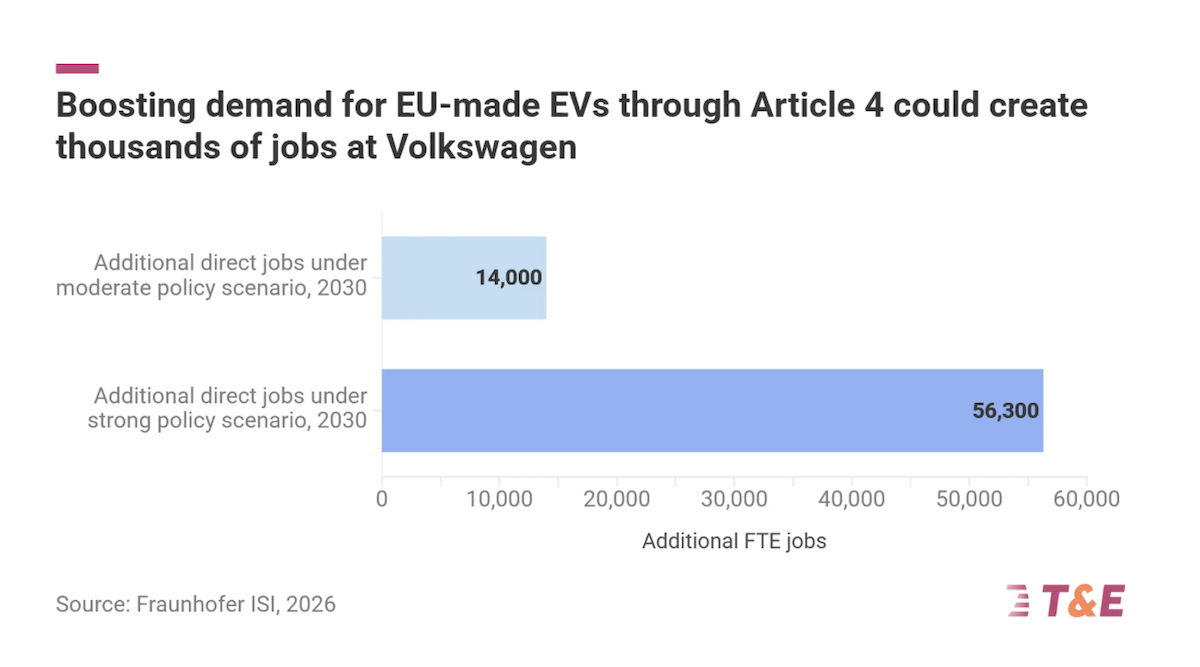
According to the analysis, Volkswagen—representing over one-quarter of new European vehicle registrations—could experience significant effects under different implementation scenarios. Under moderate conditions, the company’s corporate battery-electric vehicle sales could increase by approximately 99,000 units by 2030, offsetting roughly 14 percent of its planned production reductions. An ambitious scenario would yield increases around 590,000 vehicles, potentially offsetting 84 percent of planned cuts. The modeling suggests such outcomes could preserve approximately 14,000 direct full-time equivalent jobs across the company’s operations, with potential increases to 56,300 jobs under stronger implementation conditions.
The overall analysis concludes the regulation could generate up to €48 billion in value creation and create 344,000 jobs by 2030, with employment and manufacturing gains distributed according to existing industrial capacity in the sector.
Article Attribution | Read More at Article Source
Article summary produced by Claude AI