

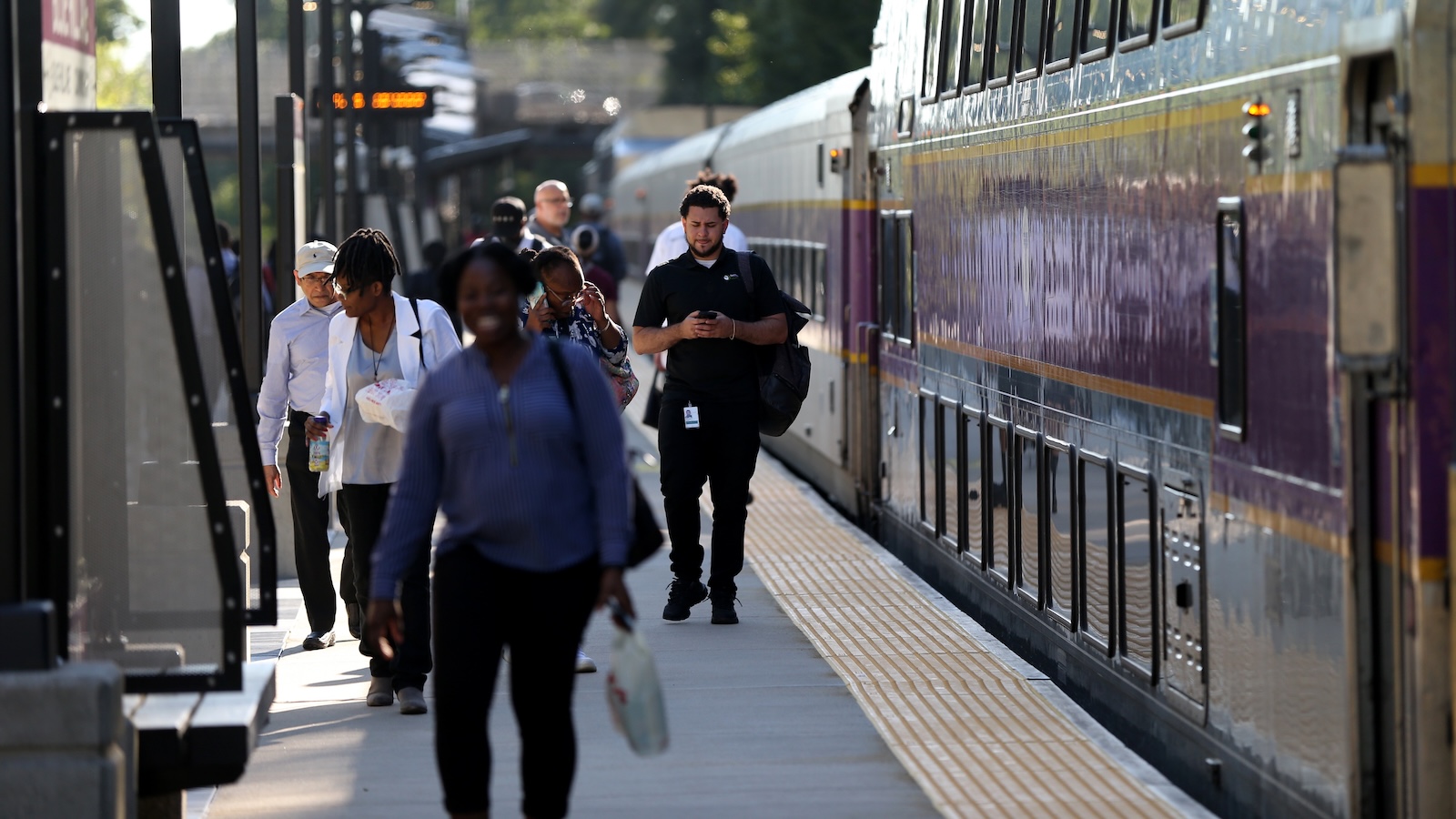
The Massachusetts Bay Transportation Authority is moving forward with plans to electrify the Fairmount commuter rail line using battery-powered trains. The transit agency will lease seven battery-powered trains, each consisting of four cars, in a 15-year arrangement expected to cost $765 million. The Swiss-manufactured trains are scheduled for delivery by 2030 and represent the T’s effort to gain experience with battery technology before potentially deploying it more widely across its network.
The Fairmount Line project has roots in decades of community advocacy. Beginning in 1995, transit advocates including Marvin Martin pressed the transit authority to expand service through Dorchester and other neighborhoods. The agency subsequently added multiple stops along the route between 2012 and 2019. Beyond expanding stops, Martin and others have pushed for electrification to reduce air pollution in these communities. The new battery-powered trains are expected to increase service frequency from every 30 minutes to every 20 minutes while eliminating approximately 17,700 tons of annual carbon dioxide emissions compared to the diesel trains they would replace.
Battery-powered trains offer advantages over traditional electrification methods because they do not require installation of overhead catenary wires, reducing infrastructure costs and complexity. However, some experts note that the technology remains largely unproven on routes with ridership levels comparable to the Fairmount Line. Other transit systems are pursuing similar approaches, with Caltrain in the San Francisco Bay Area and Chicago’s Metra both planning battery-powered train deployments by 2028. Battery-powered trains manufactured by French company Alstom are currently operating on a 50-mile route in Germany that serves 2 million passengers annually.
Electrification of transit systems represents a return to historical practices, as Boston and other cities initially deployed electric streetcars and subways in the late 1800s and early 1900s. Most American commuter rail lines, however, remained diesel-powered due to cost considerations and operational decisions by freight and long-distance passenger railroads. Recent examples demonstrate potential benefits of electrification, with Caltrain’s 2024 conversion to electric service resulting in commute time reductions of up to 23 percent, 60 percent ridership increases, and an 89 percent reduction in riders’ exposure to black carbon pollution.
Article Attribution | Read More at Article Source
Article summary produced by Claude AI