

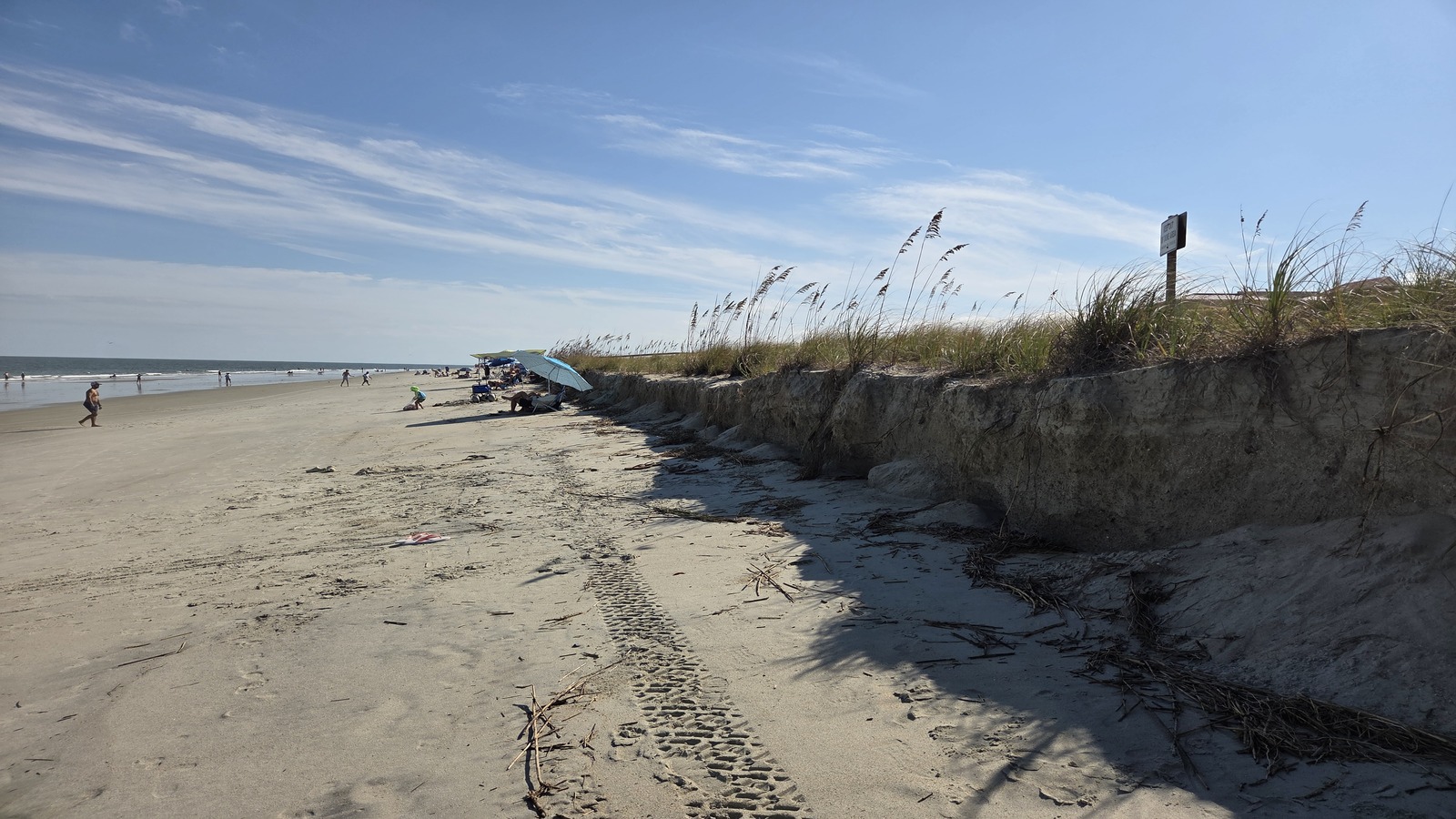
Tybee Island, a barrier island off Georgia’s coast, has experienced significant beach erosion due to human infrastructure that has interrupted the natural flow of sand from northern islands. Development, seawalls, jetties, and shipping channels have altered coastal dynamics, causing beaches to recede at an accelerating rate. To counteract this process, the Army Corps of Engineers has conducted periodic beach renourishment projects along the eastern seaboard since the 1970s.
On Tybee Island, renourishment occurs approximately every seven years. Following a project in winter 2019 and 2020 that deposited 1.3 million cubic yards of sand, more than half of that material has already eroded. In some areas, the erosion has created dramatic changes to the landscape, with dunes cut back sharply and vegetation exposed. The erosion has also damaged sea turtle nesting areas and impacted local businesses, with some rental operations forced to relocate and hotel bookings declining due to beach conditions.
The situation presents growing concerns for the island’s long-term sustainability. Rising sea levels, increasing approximately half an inch annually due to climate change, compound the erosion challenge. City officials emphasize that healthy beaches and dunes serve as critical protection against storm surge and ocean encroachment for both the island and nearby mainland areas.
Funding constraints have complicated renewal efforts. The next scheduled renourishment, planned for this winter, initially faced obstacles when federal beach nourishment programs received insufficient congressional funding and Tybee was excluded from the project list. Local leaders, residents, and Georgia’s congressional delegation advocated for the project before the Army Corps of Engineers redirected funds from other initiatives to make the work possible.
The upcoming project will employ a revised approach. Rather than disposing of sand dredged from the Savannah River shipping channel offshore, the Corps will deposit it in shallow waters near Tybee’s beach. This method aims to reduce wave action that depletes the beach and allow sand movement more consistent with natural coastal processes. City officials anticipate this innovation could extend the interval between renourishment cycles from seven years to approximately ten years.
Article Attribution | Read More at Article Source
Article summary produced by Claude AI