

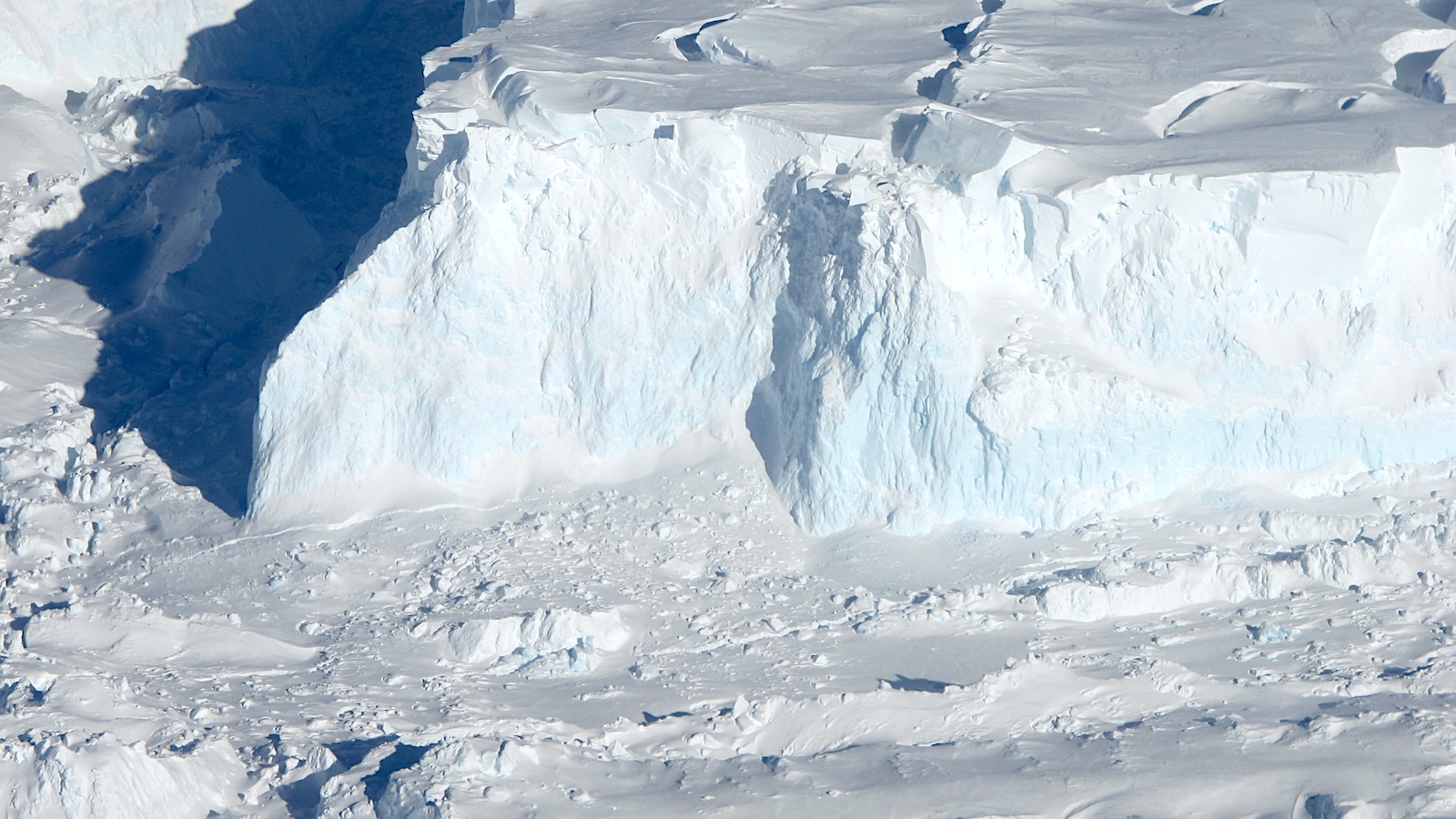
Scientists studying Thwaites Glacier in Antarctica, a massive ice formation roughly the size of Florida, have identified critical mechanisms that accelerate its deterioration and contribute to global sea level rise. The glacier holds enough ice to elevate sea levels by approximately two feet and acts as a natural barrier holding back the West Antarctic ice sheet, much of which sits below sea level. As Thwaites weakens, additional ice becomes exposed to ocean water, triggering a feedback loop that accelerates melting. Complete collapse of Thwaites could trigger failure of the broader ice sheet, potentially raising sea levels by up to 10 feet.
A study published in Nature Communications earlier this month identified a previously overlooked factor in computer models simulating Thwaites’ behavior. Researchers, led by UCLA glaciologist Mattia Poinelli, found that the grounding zone—where the glacier rests on the seabed—is not a fixed boundary but oscillates with tidal movements. As this zone rises and falls, warm ocean water penetrates underneath the glacier, creating channels that facilitate additional melting. By incorporating this dynamic into their model, researchers achieved better accuracy in matching observed satellite data and generated projections about future behavior.
The updated model suggests Thwaites could become permanently detached from the seafloor as early as 2038, with a 60 percent probability of this occurring by the end of the century. Under current climate conditions, the glacier is projected to contribute three centimeters of sea level rise by century’s end—double the amount estimated by earlier models. To provide context, Thwaites currently accounts for approximately 4 percent of global sea level rise, and over the past three decades has contributed roughly 10 centimeters, already causing significant coastal impacts including property loss in North Carolina and forced relocations in the Solomon Islands and Senegal.
A separate study published in Geophysical Research Letters examined hypothetical scenarios in which ocean temperatures decreased or remained stabilized. Research led by ice sheet modeler Rosie Williams at the British Antarctic Survey found that while Pine Island Glacier, Antarctica’s fastest-melting glacier, could potentially recover within a decade under such conditions, Thwaites would continue losing ice for at least 150 years. The research suggests Thwaites’ advanced deterioration makes recovery unlikely even in optimistic climate scenarios. However, researchers emphasize that incremental reductions in warming rates and greenhouse gas emissions could slow the glacier’s decline, providing additional time for adaptation to inevitable sea level changes.
Article Attribution | Read More at Article Source
Article summary produced by Claude AI