

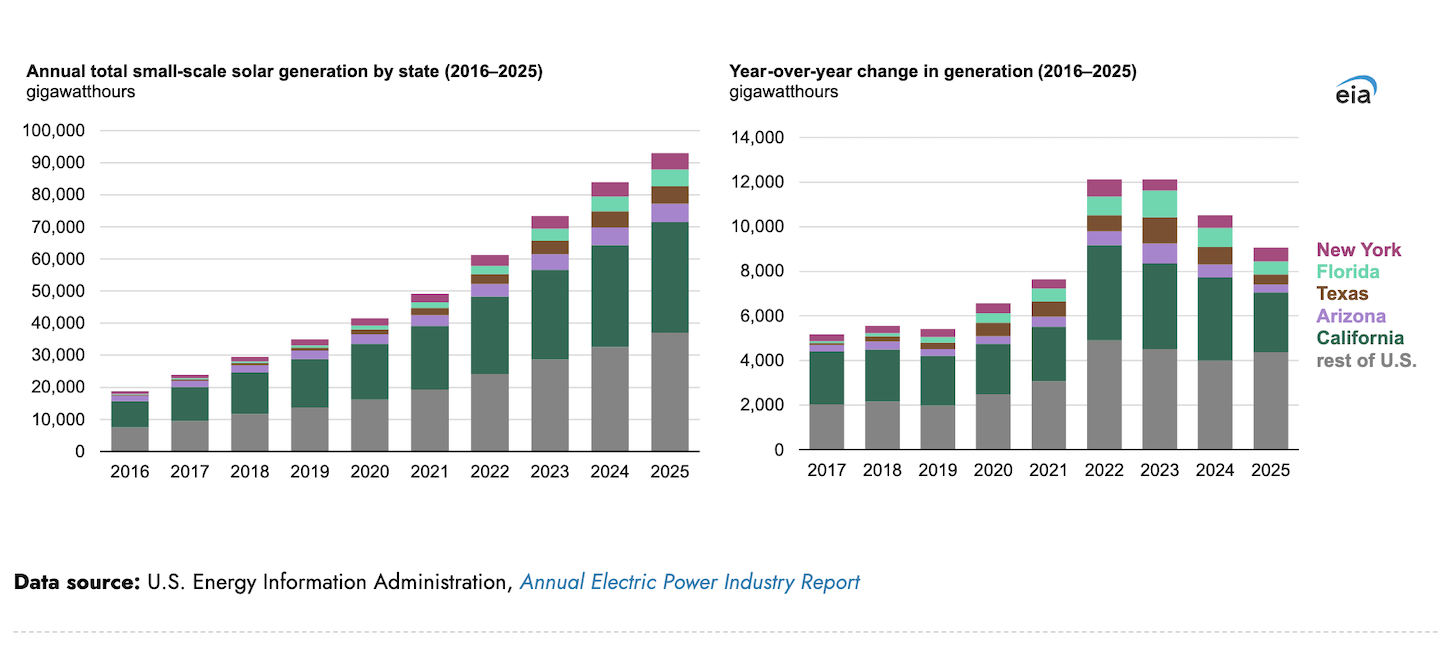
Small-scale solar photovoltaic systems in the United States have experienced significant growth, with generation rising from approximately 18,812 gigawatthours to nearly 93,000 gigawatthours over the past decade. This expansion reflects broader adoption of rooftop solar installations across the country, driven by improving technology and state-level incentive programs designed to encourage renewable energy development.
California dominates the small-scale solar market, accounting for 37% of national generation with approximately 34,411 GWh produced in 2025. The state’s generation grew 8% between 2024 and 2025, corresponding with an increase in installed capacity from 18 to 20 gigawatts. A significant driver of California’s rapid expansion was its Net Energy Metering 2.0 program, which offered higher compensation rates than the subsequent NEM 3.0 tariff. This incentivized developers to complete installations before the transition, resulting in particularly strong growth in 2022 when national generation increased 25% year-over-year.
Arizona ranks second nationally with over 6% of total U.S. small-scale solar generation, while Texas and Florida have emerged as rapid-growth states despite lower historical baselines. Texas generation increased from 391 gigawatthours in 2016 to 5,408 gigawatthours in 2025, while Florida’s generation rose from 205 to 5,198 gigawatthours over the same period. Both states support solar adoption through property tax exemptions and utility-specific programs. New York, despite operating in a region with lower solar resources, ranks fifth nationally due to capacity growth supported by state incentives and technological improvements.
Growth rates have moderated since the peak in 2022. Generation increases continue on a year-over-year basis but at a slower pace than earlier in the decade. States with lower solar resources, including New Jersey, Massachusetts, and Illinois, are also supporting rooftop solar expansion through targeted incentive programs. The EIA estimates generation figures using utility customer surveys combined with modeling tools, as electric utilities do not directly measure rooftop solar output on their distribution systems.
Article Attribution | Read More at Article Source
Article summary produced by Claude AI