

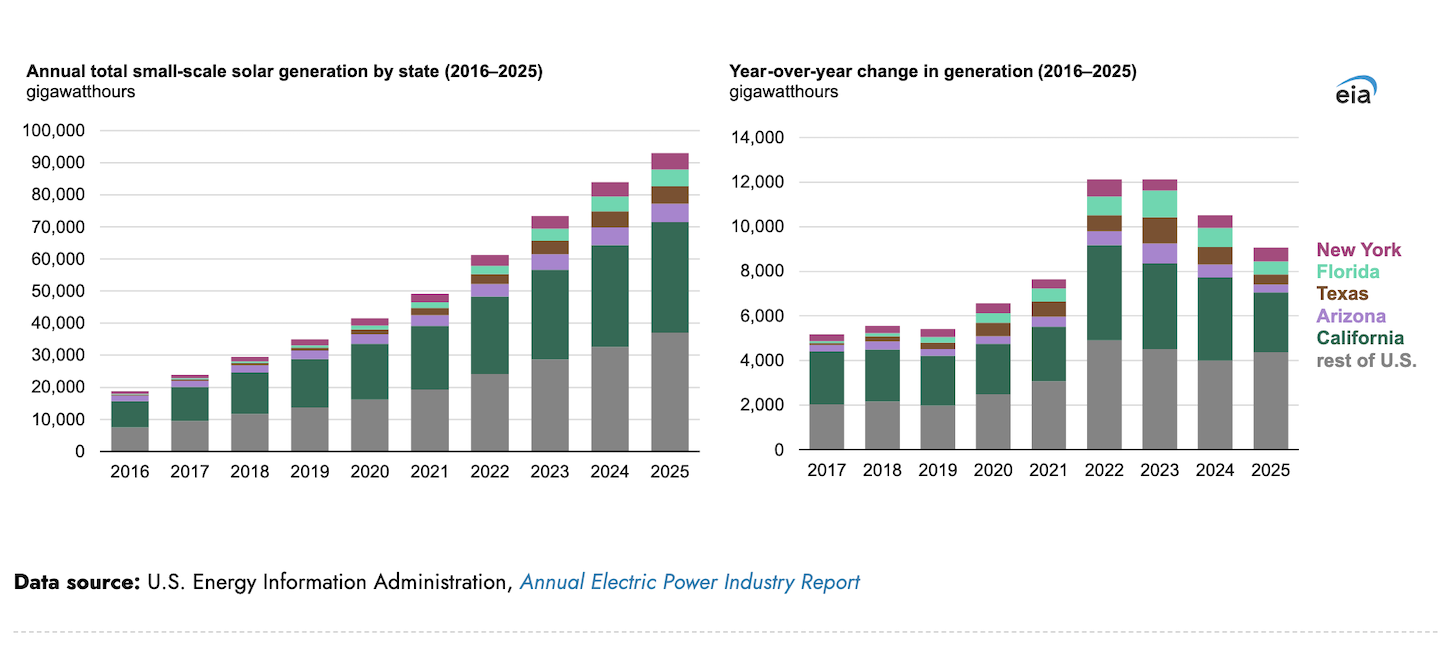
Small-scale solar photovoltaic systems in the United States have experienced significant growth over the past decade, with generation increasing from 18,812 gigawatthours to 92,979 gigawatthours. This expansion reflects a broader shift toward distributed renewable energy generation across residential and small commercial properties.
California dominates the small-scale solar sector, accounting for 37% of total U.S. generation at 34,411 gigawatthours in 2025. The state’s capacity increased from 18 gigawatts in 2024 to 20 gigawatts in 2025, with generation growing 8% year-over-year. This growth was partly driven by the timing of California’s Net Energy Metering 2.0 program transition, which offered more favorable export compensation rates than the subsequent Net Billing Tariff before its expiration in April 2023. Arizona follows as the second-largest producer with over 6% of national generation, while Texas and Florida have experienced rapid expansion, with Texas growing from 391 gigawatthours in 2016 to 5,408 gigawatthours in 2025, and Florida rising from 205 gigawatthours to 5,198 gigawatthours over the same period.
State-level incentive programs have played a crucial role in supporting rooftop solar adoption across different regions. Arizona provides a 25% state income-tax credit alongside additional incentives, while Texas and Florida utilize property tax exemptions and utility-specific programs. States with lower solar resources, including New York, New Jersey, Massachusetts, and Illinois, have also encouraged growth through targeted incentive structures.
Year-over-year generation growth was particularly robust in 2022, when capacity additions led to a 25% increase compared to the prior year. However, the rate of growth has moderated since that peak. The Energy Information Administration relies on utility surveys and modeling tools to estimate generation, as utilities do not consistently track rooftop solar production on their distribution systems.
Article Attribution | Read More at Article Source
Article summary produced by Claude AI