

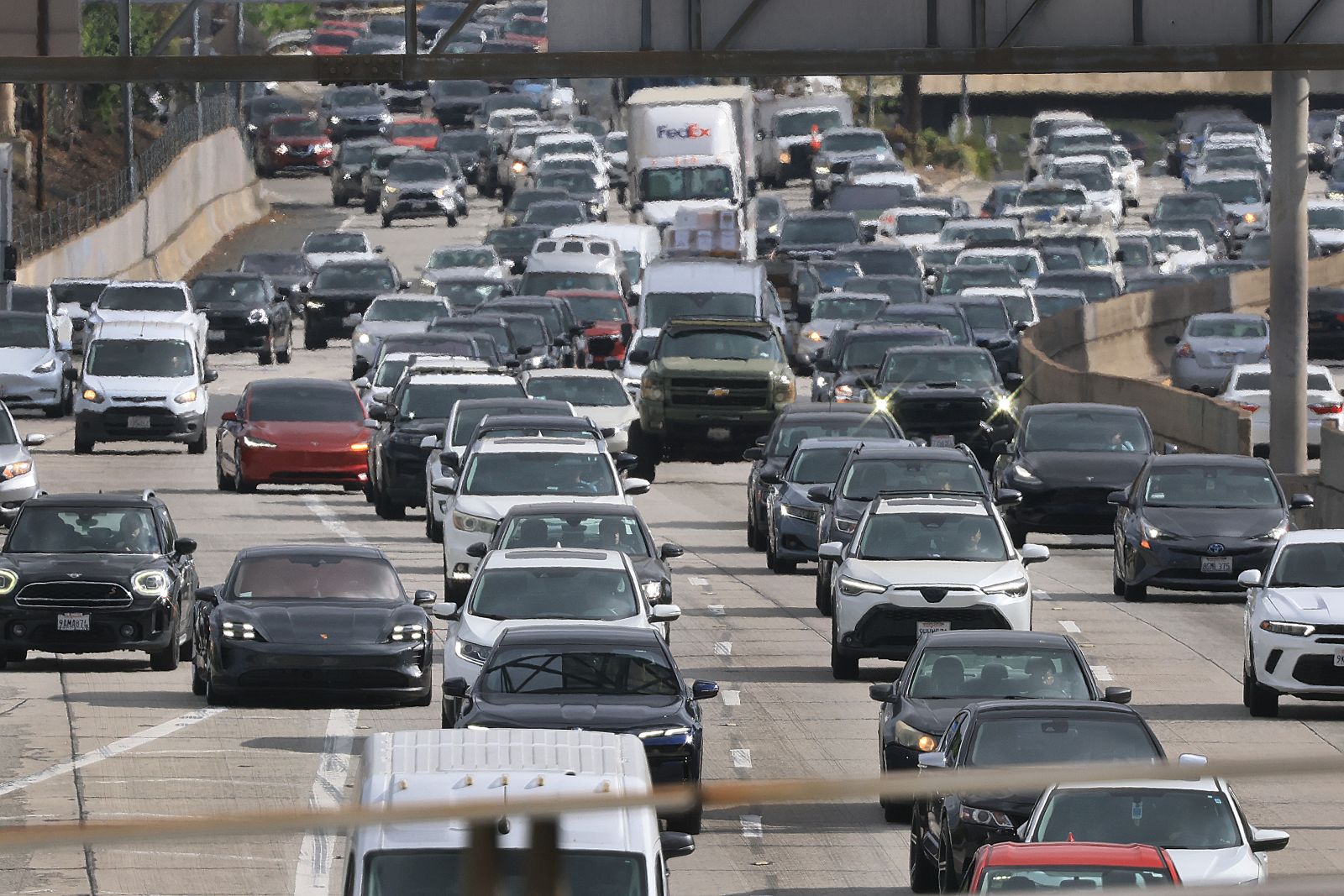
The Trump administration announced a plan this week to ease federal fuel-efficiency requirements for vehicles, effectively eliminating meaningful federal policy on automobile greenhouse gas emissions. Congress had previously removed penalties for automakers who violate fuel-efficiency standards, leaving the federal government with minimal authority over a sector responsible for approximately 16 percent of national greenhouse gas emissions.
California maintains regulatory authority to set its own vehicle emissions standards due to a decades-old congressional exemption granted because of the state’s severe air pollution challenges in the 1950s. While California cannot directly mandate fuel efficiency, its emissions regulations effectively achieve similar outcomes. Nineteen other states plus the District of Columbia have adopted California’s standards, and these jurisdictions collectively represented 40 percent of new car sales across the country in 2022. Many automakers choose to manufacture vehicles compliant with California’s standards nationwide rather than producing separate lines for different regulatory regions.
The Trump administration has actively challenged California’s regulatory authority. Both houses of Congress voted last year to block California’s effort to phase out gasoline-powered vehicles by 2035, following a request from the EPA. California subsequently filed a lawsuit challenging these actions. Though California’s more ambitious phase-out plan has been blocked, the state is working to maintain its previous emissions standards, which would have otherwise expired in 2026. A federal judge blocked a Trump administration effort to overturn these standards in early September.
Automakers have largely remained silent regarding their strategies amid regulatory uncertainty. The industry faces conflicting pressures, including shifting consumer preferences and fluctuating government policies between administrations. Hybrid vehicles have gained popularity, representing 16 percent of passenger vehicle sales by the summer of 2026. Some manufacturers continue investing in electric vehicle platforms despite reduced near-term demand, citing long-term global trends toward zero-emission vehicles.
Experts note that market forces alone may prove insufficient to achieve the emissions reductions necessary for climate goals. The resolution of California’s stricter regulations will likely depend on court decisions. Legal analysts point to potentially unlawful congressional procedures used to revoke the permission underlying California’s regulatory authority, suggesting the state may have strong grounds for restoring its blocked standards.
Article Attribution | Read More at Article Source
Article summary produced by Claude AI