

Verdox has completed a two-month industrial demonstration of its electrochemical carbon-capture technology at Hydro’s Sunndal aluminum smelter in Norway. The test successfully captured carbon dioxide from exhaust with approximately 1% CO₂ content while operating amid the contaminants present in actual smelter gas. The demonstration proves the capture chemistry can function in a genuine industrial setting, distinguishing it from laboratory trials or vendor tests conducted on controlled gas streams. Hydro’s participation and ongoing collaboration add credibility to the results.
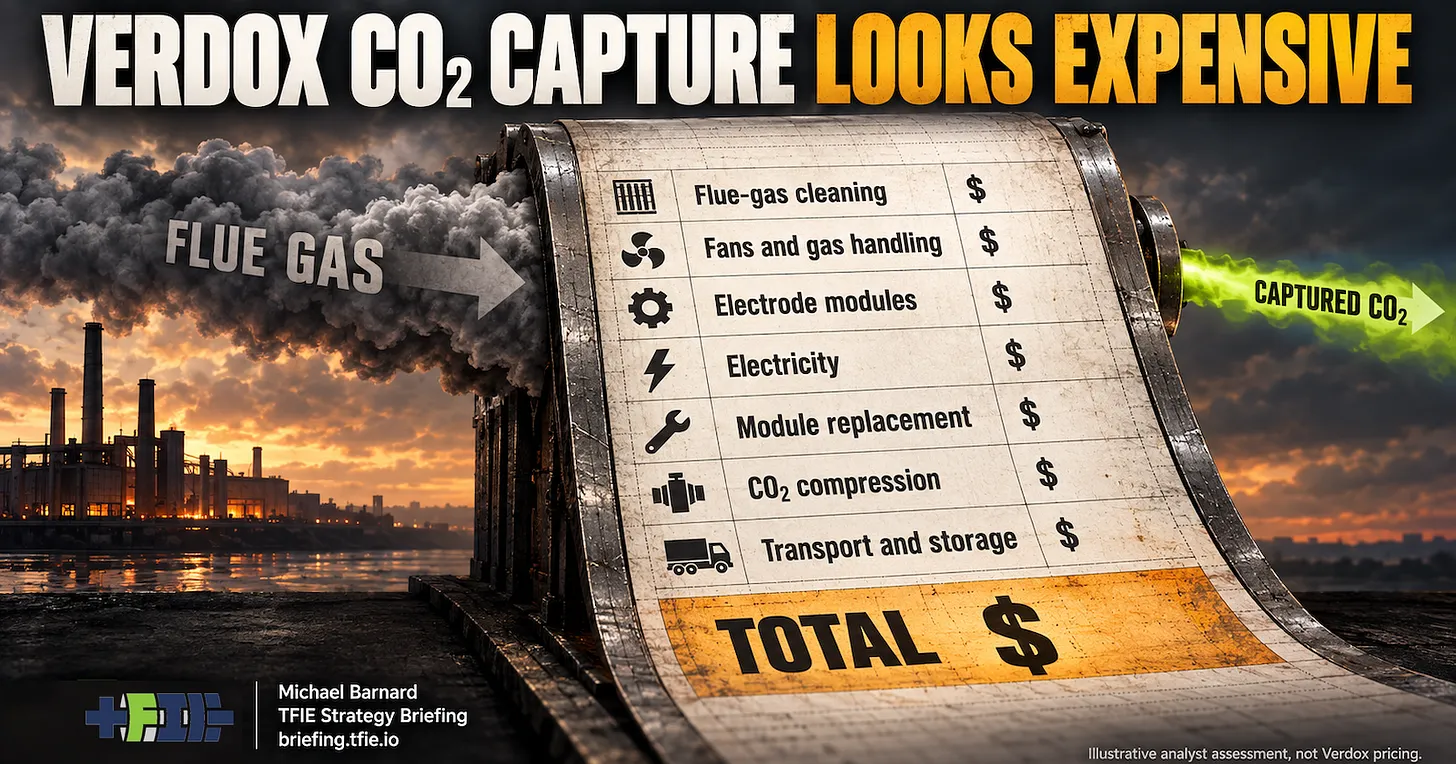
However, the successful demonstration does not address critical questions that will determine whether the technology becomes commercially viable. Unanswered questions include the cost of a full-scale installation, electricity requirements for the complete system, material durability under operating conditions, and equipment specifications needed to handle the enormous volume of dilute exhaust. The low concentration of target CO₂ in the incoming stream requires moving massive amounts of nitrogen, oxygen, water vapor and other gases through cleaning and capture systems while managing pressure losses and contaminant control. The energy consumption, capital equipment demands and operational complexity of fans, ducts and pretreatment systems significantly impact overall economics, even when the electrochemical separation itself performs effectively.
Commercial deployment introduces additional complexity through the chemistry of Verdox’s quinone-bearing material, which captures and releases CO₂ in alternating electrical states. Continuous industrial operation requires multiple processing banks at different cycle stages to maintain steady gas flow while other modules clear residual gas and concentrate CO₂. The frequency of module replacement, productivity per square meter of material, and long-term performance under smelter conditions remain unknown and directly affect capital costs, operating expenses and downtime.
The captured gas must also meet specifications for pipeline transport and geological storage, requiring additional separation, drying and compression steps. Within the aluminum industry specifically, capture technology faces competition from emerging alternative smelting processes. Rio Tinto and Alcoa’s ELYSIS venture began operating an inert-anode cell in 2025, while Hydro’s HalZero program is developing chloride-based alternatives. Investment decisions for capture systems must account for competing process-conversion options available at major capital replacement intervals.
Verdox’s demonstration provides sufficient evidence to warrant continued industrial evaluation. Future assessments should focus on operational measurements including complete gas and CO₂ mass balances, measured plant-wide electricity consumption, pressure losses, product purity, module productivity, equipment availability and replacement rates, along with confirmed storage arrangements on commercial terms.
Article Attribution | Read More at Article Source
Article summary produced by Claude AI