

Verdox has successfully completed a two-month demonstration of its electrochemical carbon-capture process at Hydro’s aluminum smelter in Sunndal, Norway. The technology operated on exhaust gas containing approximately 1% carbon dioxide while managing contaminants present in actual smelter emissions, moving the process beyond laboratory conditions into a relevant industrial setting. Hydro’s participation as both an investor and ongoing partner lends credibility to the trial compared to purely controlled testing environments.
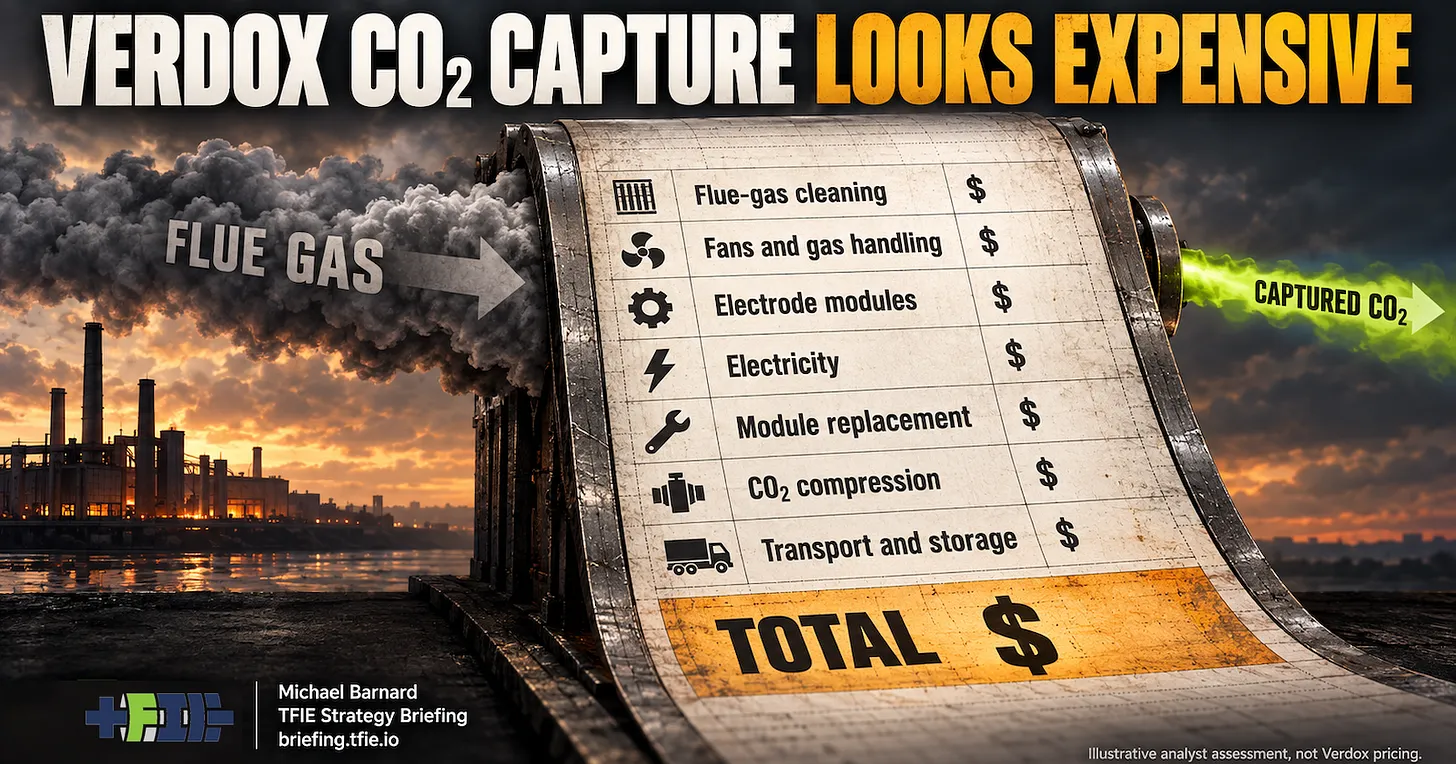
However, the successful demonstration addresses only one component of commercial viability. Critical unknowns remain regarding capital costs, electricity consumption for a full-scale installation, module durability, and equipment requirements for processing the large volume of dilute exhaust gas. The core challenge stems from the low CO₂ concentration requiring substantial handling of nitrogen, oxygen, and water vapor alongside the target molecule. Commercial systems must manage these volumes through cleaning and separation stages while controlling pressure losses and contaminants. Beyond the capture process itself, complete facilities require gas cleaning, compression, product drying, and potentially additional equipment whose inclusion in published energy figures remains unclear.
Operational complexity introduces further variables. Verdox’s material alternates between capturing and releasing CO₂ depending on electrical state, necessitating multiple module banks operating at different cycle stages simultaneously. Real-world durability and replacement frequency in smelter environments differ from laboratory cycling data, directly affecting capital requirements, maintenance costs, and material supply chains. The captured gas must also meet pipeline and storage operator specifications, requiring separation, drying, and compression before transport to geological storage sites.
The aluminum industry context adds another dimension. Existing Hall-Héroult smelting processes produce direct emissions largely from carbon anode consumption, which accounts for roughly three-quarters of direct CO₂ output. Alternative smelting technologies are simultaneously under development, including Rio Tinto and Alcoa’s ELYSIS inert-anode process and Hydro’s HalZero program. Investment decisions on capture systems must therefore account for the viability of competing process-conversion alternatives and facility remaining lifespan. Verdox’s next steps should include complete operational measurements: gas and CO₂ mass balances, facility-wide electricity consumption, pressure losses, product purity, module productivity, availability rates, and confirmed commercial storage pathways.
Article Attribution | Read More at Article Source
Article summary produced by Claude AI