

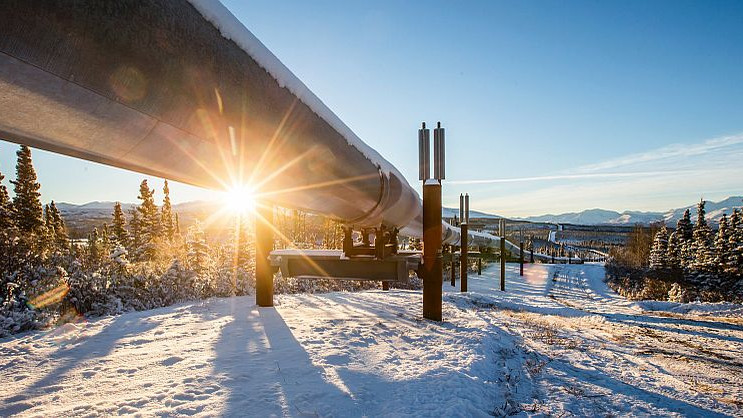
Alaska LNG, a proposed $45 billion–$54 billion liquefied natural gas development project, has gained renewed attention amid US tariff negotiations with South Korea. The Trump administration announced in September that Seoul would contribute over $50 billion toward the initiative, while South Korea’s government outlined conditional interest in October, listing Alaska LNG among potential investments subject to commercial and legal requirements.
The project’s fundamental challenge lies in its exceptional capital intensity and geographic constraints. Connecting North Slope gas reserves to an export terminal at Nikiski in south-central Alaska requires construction of treatment facilities and approximately 1,300 kilometers of pipeline across difficult terrain, including permafrost regions and mountain crossings. About 54 percent of pipeline construction can only occur during summer months, creating significant delay risks. The cost per unit of capacity—approximately $2.7 billion per million tonnes of annual LNG—substantially exceeds that of competing facilities in Qatar and Texas. Questions remain regarding state tax arrangements and cost allocation between the state of Alaska and private developer Glenfarne, which owns 75 percent of the project.
South Korea’s interest stems partly from legitimate energy needs. The nation consumes 47.8 million tonnes of LNG annually and has increasingly relied on US supplies following geopolitical disruptions. In 2025, the US supplied 4.4 million tonnes, though this represented a smaller share than Australian, Malaysian, and Qatari sources. After Qatar’s effective halt of LNG exports in late February, American shipments to South Korea increased substantially.
However, South Korea’s demand outlook faces headwinds. Net-zero policies are gradually reducing consumption, while temporary wartime price increases prompted higher coal-fired generation at the expense of gas burning. Gas-fired power generation in South Korea fell 9 percent year-over-year during summer months. Additionally, competing Pacific LNG sources have emerged, with LNG Canada beginning exports in July 2025 and undertaking expansion to 28 million tonnes annually. While Alaska offers shipping advantages over routes to Europe, Pacific alternatives already exist.
South Korea’s official stance suggests caution. Prior to current negotiations, Seoul’s trade minister characterized Alaska LNG as high risk and economically unviable. The conditional language in October’s announcement reflects ongoing skepticism about commercial viability, and Seoul is reportedly seeking alternative investment options to navigate diplomatic constraints.
Article Attribution | Read More at Article Source
Article summary produced by Claude AI