

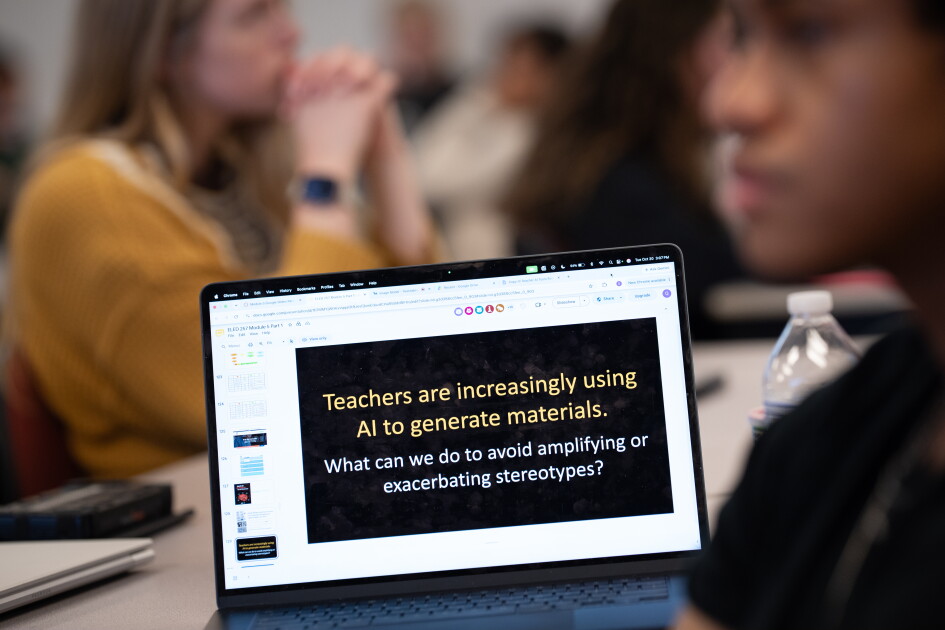
Teacher preparation programs across the United States are grappling with how to incorporate artificial intelligence instruction into their curricula as the technology becomes increasingly prevalent in educational settings. Shannon Kane, an assistant clinical professor of literacy at the University of Maryland, emphasized that the challenge extends beyond preventing students from misusing AI tools. Rather, educators must ensure that prospiring teachers develop critical judgment about when and how to effectively employ these technologies, while also cultivating their own pedagogical identities before delegating tasks to automated systems.
A national survey conducted by the EdWeek Research Center in August and September found that more than half of teacher educators reported preparing aspiring teachers to use AI for generating instructional ideas and developing classroom assignments. Nearly two-thirds indicated their programs address AI and digital literacy instruction for K-12 students. However, significant obstacles persist. Research on whether AI tools actually improve student learning outcomes remains limited, and school districts have adopted wildly divergent approaches to the technology, ranging from outright bans to enthusiastic adoption.
A fundamental challenge stems from teacher preparation programs’ long-standing difficulty integrating technology effectively into instruction. According to a 2023 report, 56 percent of new teachers lack confidence using technology in classrooms upon entry. Justin Reich, executive director of MIT’s Teaching Systems Lab, contends that teachers need robust understanding of learning science before they can meaningfully evaluate AI outputs. Others, like Jennifer Kidd at Old Dominion University, argue that basic AI literacy is now essential, proposing experiential learning activities where students compare their own work against AI-generated alternatives.
Implementation barriers include insufficient faculty support and competing accreditation requirements. About one-third of surveyed teacher educators reported that instructors don’t support AI integration, while nearly a quarter noted that aspiring teachers themselves resist such preparation. Most programs lack standalone AI courses, instead relying on individual instructors to decide whether to incorporate AI into existing coursework. The most widely cited challenge is AI’s rapid evolution, with 57 percent of respondents identifying this as an obstacle, forcing educators to continuously update materials to remain relevant.
Article Attribution | Read More at Article Source
Article summary produced by Claude AI