

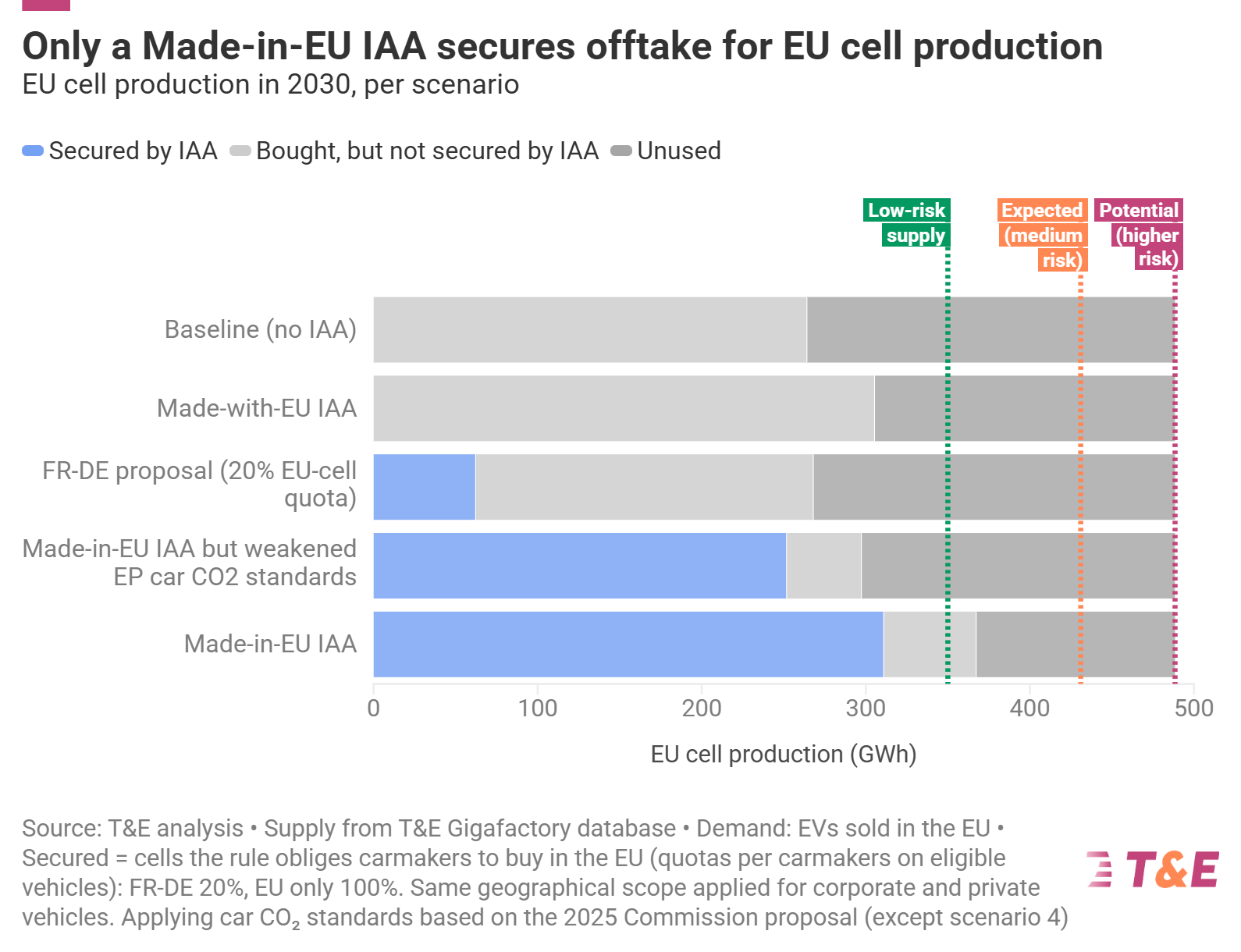
Transport and Environment released analysis indicating that a Franco-German automotive agreement could jeopardize the majority of Europe’s battery manufacturing sector. The deal is projected to secure only 13% of Europe’s planned battery cell production capacity by 2030, leaving approximately 87% vulnerable to competition from overseas producers.
According to the organization’s findings, weak Made-in-Europe requirements within the Industrial Accelerator Act could allow between 100 and 250 gigawatt-hours of battery cells and cathodes to shift production outside European borders. This volume is estimated to represent 1.5 million battery packs that could be manufactured elsewhere instead of domestically.
The analysis identifies a secondary threat stemming from proposed revisions to EU emission reduction standards. Weakening these climate targets could reduce demand for battery cells by 247 gigawatt-hours between 2027 and 2032, equivalent to roughly 3.7 million electric vehicles that would not be produced in the EU during that timeframe. This reduction represents nearly three times the annual capacity of LG Energy Solution’s battery facility in Poland, Europe’s largest plant.
Several European battery manufacturers currently in early production phases face particular risk under the proposed framework, including facilities in Sweden, Germany, and France. The organization expresses concern that emerging domestic companies operating in challenging market conditions could be disadvantaged without sufficient protective measures and demand assurances through the accelerator program.
T&E has called for the EU to reject the Franco-German proposal and maintain stricter local content requirements, limiting exceptions to trusted partners within the EU27, European Economic Area, and the UK. The group warned against further erosion of vehicle CO2 standards, cautioning that Europe’s battery sector could follow the trajectory of its declining solar manufacturing industry without stronger protections.
Article Attribution | Read More at Article Source
Article summary produced by Claude AI