

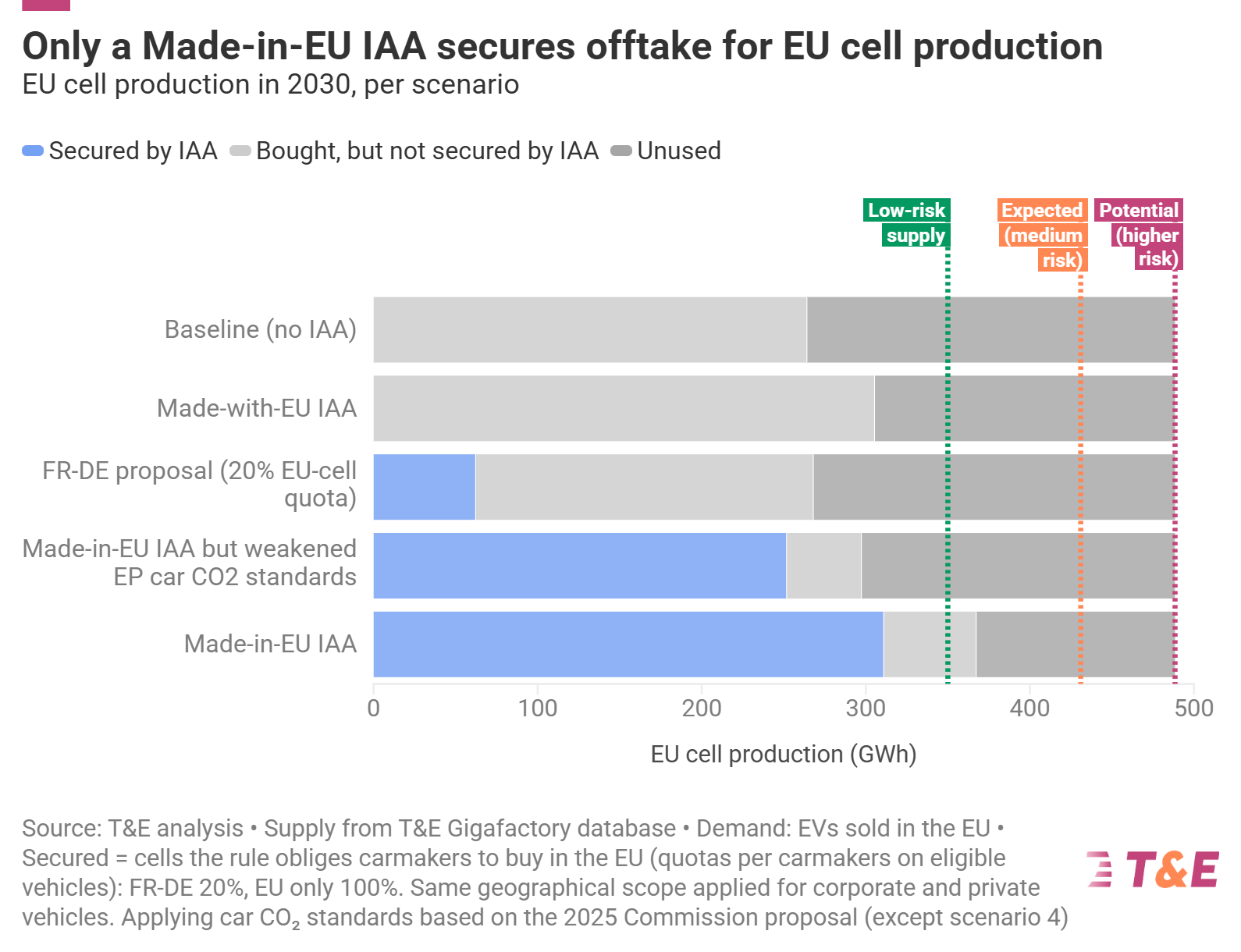
A new analysis reveals that a Franco-German automotive agreement would secure only 13% of Europe’s projected battery cell production capacity by 2030, posing significant risks to the continent’s battery manufacturing sector. The deal’s provisions include weak local content requirements that could allow substantial battery production to shift abroad, with estimates indicating that 100 gigawatt-hours of cells and 250 gigawatt-hours of cathodes could relocate internationally due to insufficient Made-in-Europe standards. This volume is equivalent to approximately 1.5 million battery packs.
The European battery industry faces additional headwinds from separate proposals to relax EU emission reduction targets. These weaker standards could decrease demand for battery cells by 247 gigawatt-hours between 2027 and 2032, a reduction representing nearly 3.7 million electric vehicles produced within the EU. This reduction is nearly three times the annual production capacity of Europe’s largest battery plant, operated by LG Energy Solution in Poland.
The agreement comes at a vulnerable moment for Europe’s battery manufacturing sector, as most facilities expected to contribute to 2030 production targets have not yet entered full production. Planned factories including Lyten in Sweden, PowerCo Salzgitter in Germany, and Verkor Dunkirk in France could face viability challenges under the terms of the deal. Industry advocates argue the situation mirrors the decline of Europe’s solar panel manufacturing and warn that inadequate policy support during this critical development phase threatens long-term competitiveness and job creation.
Calls have been made for EU leadership to reject the Franco-German proposal in favor of maintaining stricter requirements established by the EU Commission, implementing comprehensive Made-in-EU sourcing standards with limited exceptions for trusted partners, and preserving current automobile CO2 emission reduction targets.
Article Attribution | Read More at Article Source
Article summary produced by Claude AI