

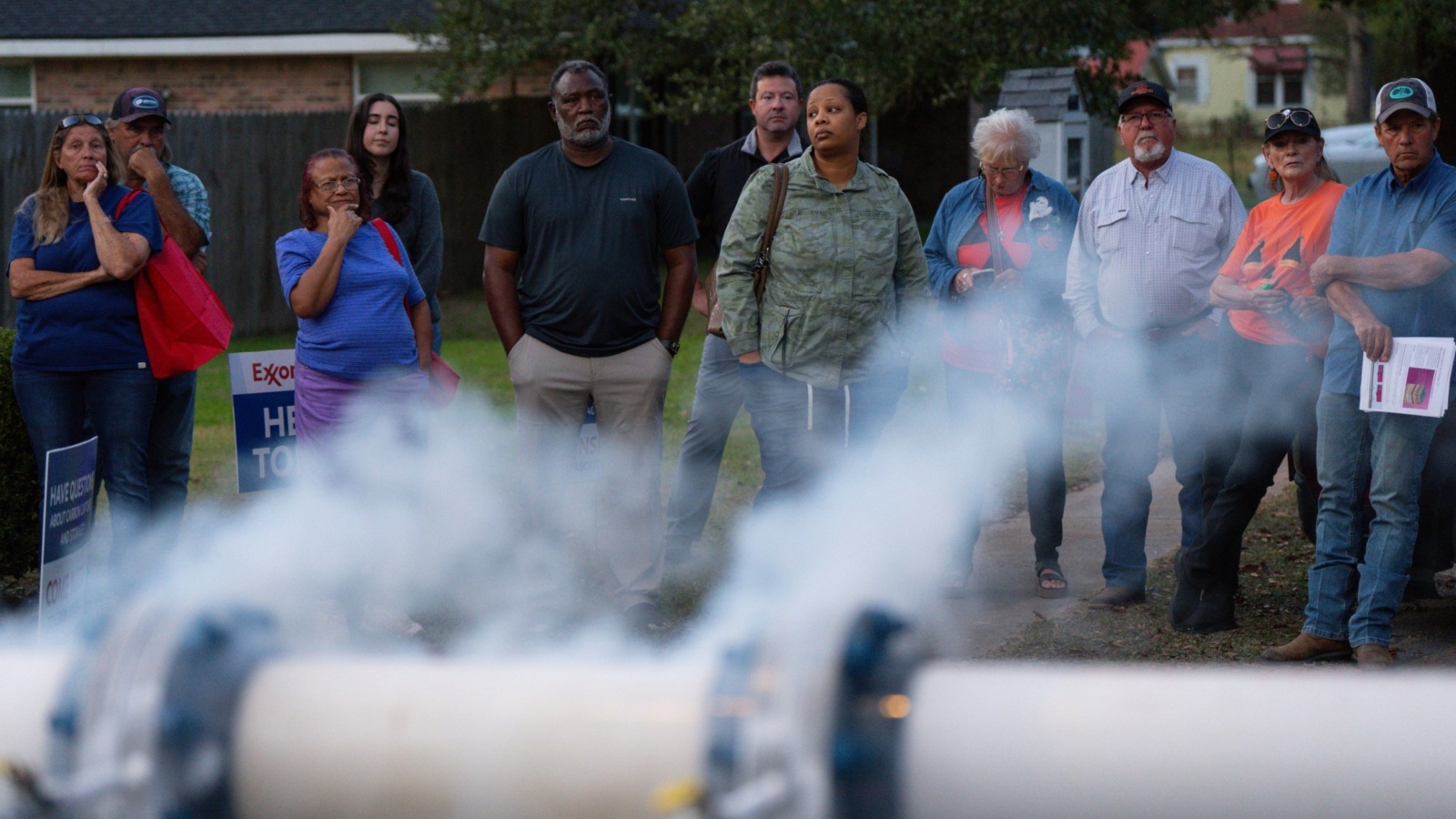
Exxon Mobil is preparing to operate what could be Texas’s first commercial carbon dioxide storage project near Beaumont, marking a significant step for the technology that the energy industry promotes as a climate solution. The Texas Railroad Commission granted the permit in September after obtaining federal regulatory authority late the previous year. The project involves injecting carbon dioxide underground for permanent storage, a process the state has sought to expedite through revised permitting procedures.
Residents of the nearby community of Cheek, a predominantly Black area with many working-class and elderly inhabitants, have requested that the Railroad Commission reconsider its approval. Community leaders and residents expressed concerns about potential groundwater contamination, air quality hazards, and the adequacy of emergency response capabilities in the area. Douglas Cormier, president of the Cheek Texas Community Association, stated that residents were surprised by the project’s proximity to homes and do not wish to serve as test subjects for the technology. Some residents view the project as threatening generational wealth accumulated through inherited family land holdings.
Scientific perspectives on carbon capture and storage remain divided. Some experts, including Harvard University historian Naomi Oreskes, have characterized the technology as a distraction from climate change mitigation efforts. Recent investigations documented that the resources required for carbon capture and storage to significantly reduce emissions may be infeasible. However, proponents argue the technology represents a necessary component of comprehensive climate strategies, supported by federal tax credits and suited to East Texas’s existing infrastructure and geology.
The situation raises broader questions about regulatory oversight and community engagement. The Railroad Commission stated it has expertise in protecting drinking water during injection well operations, though watchdog agencies have documented a historical pattern of inadequate community protection measures. Railroad Commission Chair Christi Craddick criticized Exxon Mobil for insufficient communication with residents before voting to approve the permit. The company’s permit requires automatic shut-off systems, underground plume monitoring, and around-the-clock operator availability, with coordination requirements involving local emergency officials and training programs through Texas A&M.
Article Attribution | Read More at Article Source
Article summary produced by Claude AI