

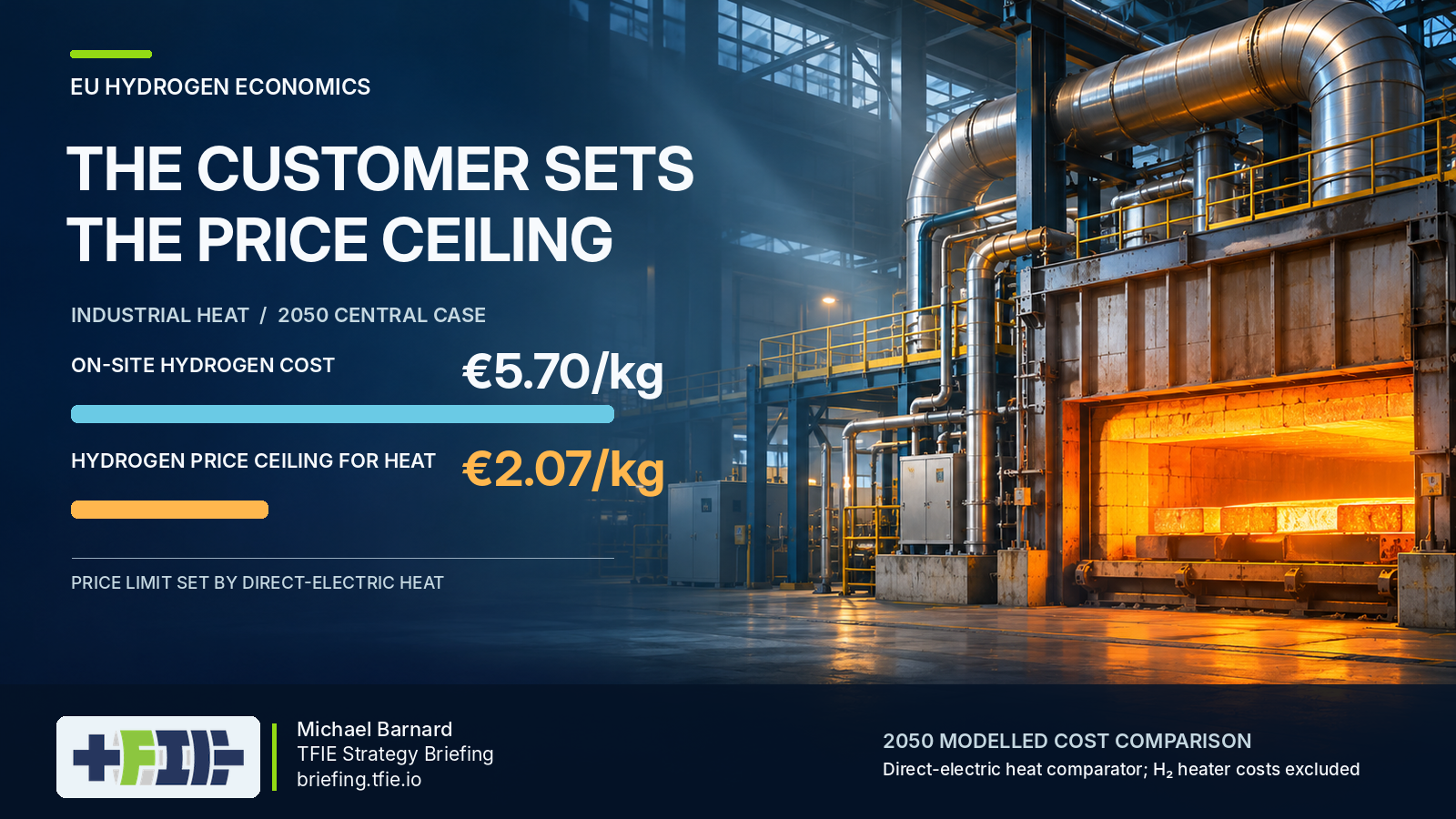
Europe faces a substantial challenge in commercializing hydrogen for industrial applications, as production costs dramatically exceed the prices customers can competitively pay. Analysis of a central 2050 scenario shows on-site hydrogen production at €5.70 per kilogram, beginning with electricity costs of €3.18/kg and adding electrolyser capital recovery, maintenance, and other operational expenses. However, industrial facilities using hydrogen as process heat can only afford approximately €2.07 per kilogram to remain competitive against direct-electric heating alternatives, creating a €3.63/kg price gap.
The cost mismatch reflects a fundamental commercial test that hydrogen producers must address before seeking financing. The International Energy Agency’s Global Hydrogen Review has incorporated customer cost acceptability into its assessment and finds maximum acceptable hydrogen prices below $2/kg across most industrial applications without policy support. This gap persists even in favorable scenarios, exposing a critical flaw in focusing solely on production-cost reduction targets without understanding demand-side constraints.
Different industrial sectors face distinct competitive benchmarks. European ammonia production can only compete with imported alternatives when hydrogen input costs range from €2.62 to €4.00 per kilogram, depending on origin and production method. Ironmaking faces similar sourcing decisions, with hydrogen price ceilings ranging from €1.43 to €4.45 per kilogram depending on the specific application and available alternatives. These thresholds represent hard commercial limits rather than aspirational targets.
The distinction between hydrogen as a chemical reagent versus fuel for heat remains significant. Industrial heating applications can typically be served more efficiently through direct electrification, eliminating conversion losses inherent in hydrogen production and combustion. Policy mechanisms including carbon pricing, procurement mandates, and subsidies can create demand unrelated to market economics, though such support should be transparently disclosed rather than characterized as competitive.
For project developers and lenders, the implications are immediate. Proposed hydrogen plants cannot achieve commercial viability when production costs exceed buyer affordability by several euros per kilogram. Successful projects require enforceable customer contracts at prices covering supply costs, demonstrable cost reductions, or durable policy support mechanisms. Industrial procurement should begin with competing production routes and resulting price ceilings before considering hydrogen infrastructure investments.
Article Attribution | Read More at Article Source
Article summary produced by Claude AI