

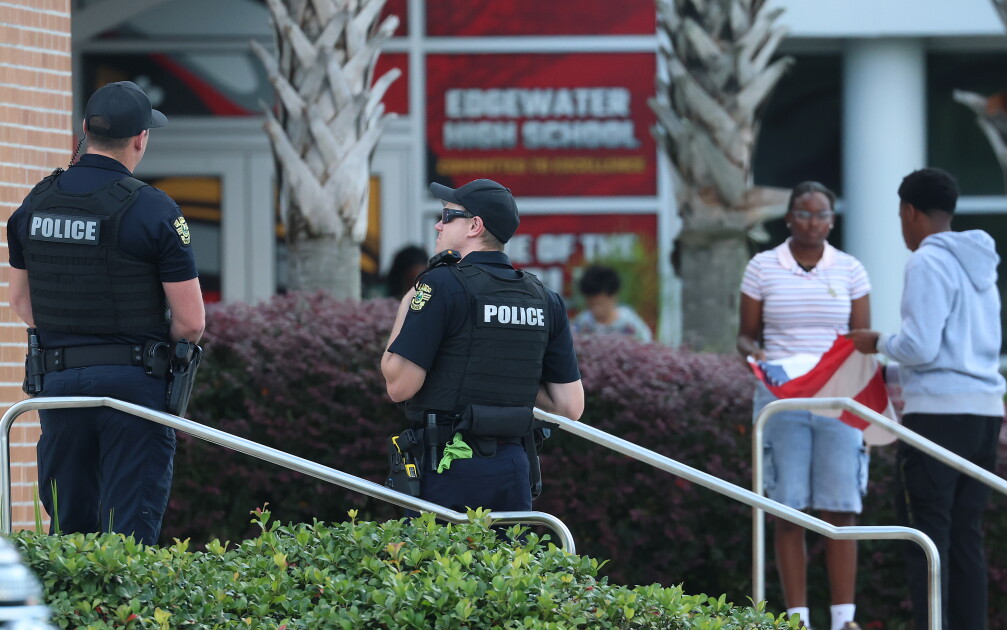
Florida public schools are concerned about the sustainability of their school resource officer programs following the passage of Amendment 3, which significantly reduces property tax revenue for municipalities and sheriff’s offices that jointly fund these positions with school districts.
Since 2018, Florida has mandated that all public school campuses maintain either a school resource officer or armed security guard. Most Central Florida school districts have opted for sworn law enforcement officers, citing the importance of specialized training for armed personnel on school grounds. The requirement followed the 2018 massacre at Marjory Stoneman Douglas High School, which resulted in 17 deaths. The state later modified its law to allow trained teachers to serve as school guardians, though they must complete over 140 hours of firearms training through a Florida sheriff’s office.
Most school districts already contribute substantially to the cost-sharing arrangement. Orange County Public Schools, for example, pays approximately $75,000 per officer—roughly two-thirds of the total cost—to municipalities and the sheriff’s office, while spending about $17 million annually beyond the state allocation. Seminole County Public Schools contributes approximately half the cost per officer. District leaders have described the state requirement as an underfunded mandate, and tensions have already emerged over rising costs, with several municipalities requesting additional funding during contract negotiations.
With Amendment 3 now approved, local law enforcement agencies facing budget constraints are expected to shift more financial responsibility to school districts. Seminole County Sheriff Dennis Lemma warned county commissioners earlier in the year that he might eliminate 300 positions if the tax measure passed. School board officials have stated that absorbing full costs would be financially impossible given existing budget pressures, potentially forcing districts to replace trained officers with school guardians to reduce expenses.
Some districts have already transitioned to school guardian programs, while others maintain in-house police forces unaffected by municipal budget cuts. Advocates for school safety have noted that while sworn officers provide community engagement benefits that guardians cannot replicate, federal funding opportunities and alternative arrangements may help districts navigate the funding gap created by Amendment 3.
Article Attribution | Read More at Article Source
Article summary produced by Claude AI