

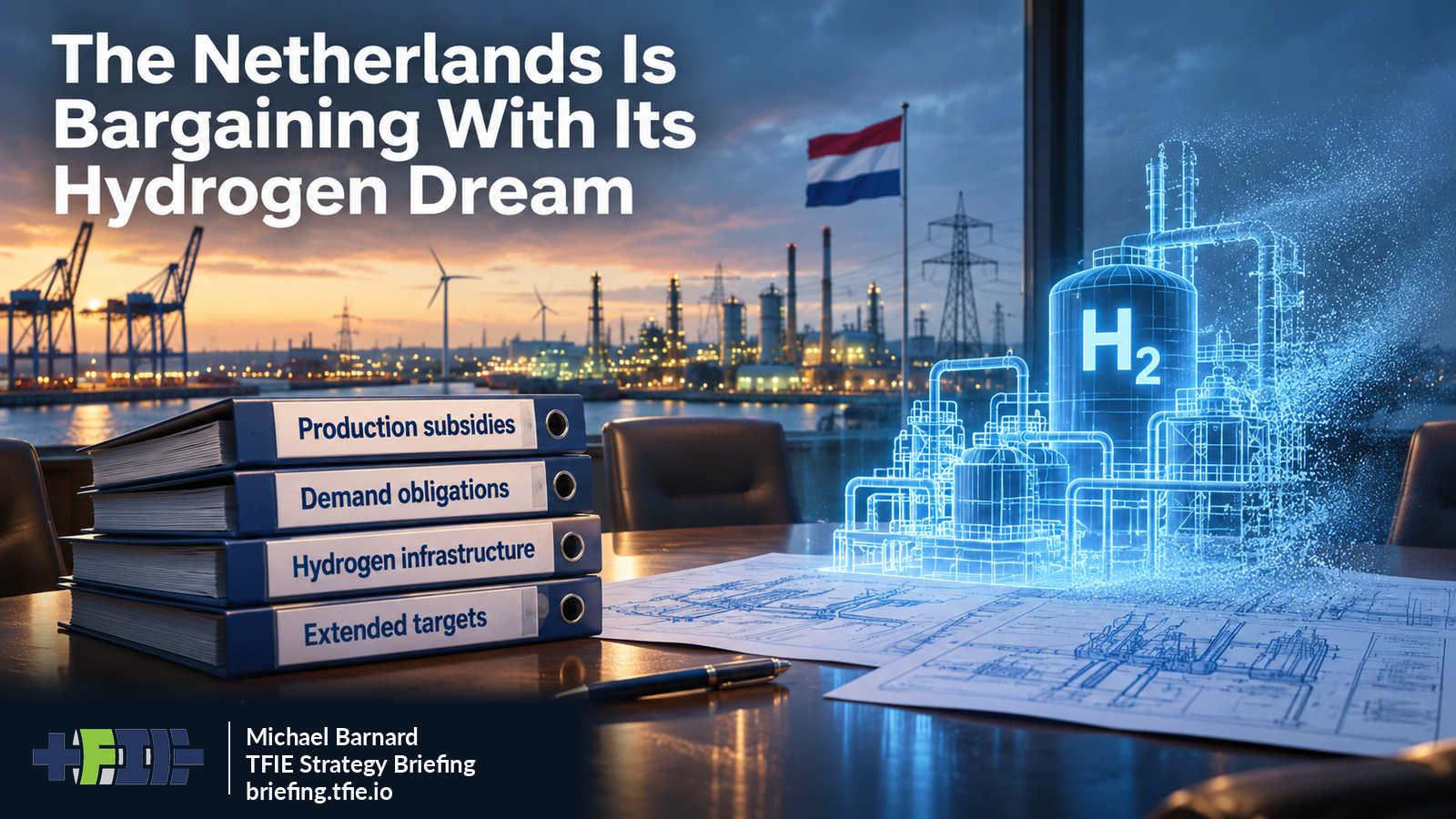
The Dutch government awarded €783.5 million in subsidies to seven green hydrogen projects in 2022, with the goal of delivering 1,150 MW of electrolysis capacity. Four years later, the program has faced significant setbacks: four projects accounting for 550 MW have been cancelled, and none of the original seven facilities are currently operating. Only approximately €150 million of the allocated funds had been disbursed when parliamentary answers were published earlier in the month.
The project failures reflect fundamental problems with the economic assumptions underlying the initial subsidy awards. Government officials originally expected renewable hydrogen to cost around €2 per kilogram by 2030, becoming competitive with fossil-derived hydrogen within a decade. However, the actual economics appear considerably worse. Producing one kilogram of hydrogen through electrolysis requires approximately 50 to 55 kilowatt-hours of electricity. Even at an assumed €50 per megawatt-hour for electricity—a particularly low estimate for reliable supply to industrial facilities—the power costs exceed €2.50 to €2.75 per kilogram before accounting for capital recovery, maintenance, water treatment, compression, and delivery. The original policy envisioned hydrogen serving energy applications where direct electricity would typically be more cost-effective.
Declining demand has compounded the production challenges. The government’s September energy planning significantly reduced expected hydrogen demand in industrial applications compared to earlier projections. The proposed pipeline network to distribute hydrogen also faces deteriorating economics, with estimated investment costs rising from €1.5 billion to €3.8 billion, according to recent assessments. Pipeline startup losses could reach €2.5 billion against a €750 million grant.
Despite this unfavorable record, the government has allocated an additional €780 million for a future subsidy round. The strategy includes production subsidies, requirements for some industrial customers to purchase renewable hydrogen, and support for a national pipeline network. Critics argue this approach perpetuates commitments to hydrogen volumes that commercial buyers have not demonstrated they can afford.
Alternative decarbonization paths exist for Dutch industry. Energy-intensive manufacturing could shift to locations with cheaper clean electricity and import finished products, while industrial heat pumps and direct electric processes could replace hydrogen in many applications. Steel and chemical refining would require less hydrogen as petroleum demand declines. The government was urged to evaluate actual industrial needs and available decarbonization routes before funding additional production capacity.
Article Attribution | Read More at Article Source
Article summary produced by Claude AI