

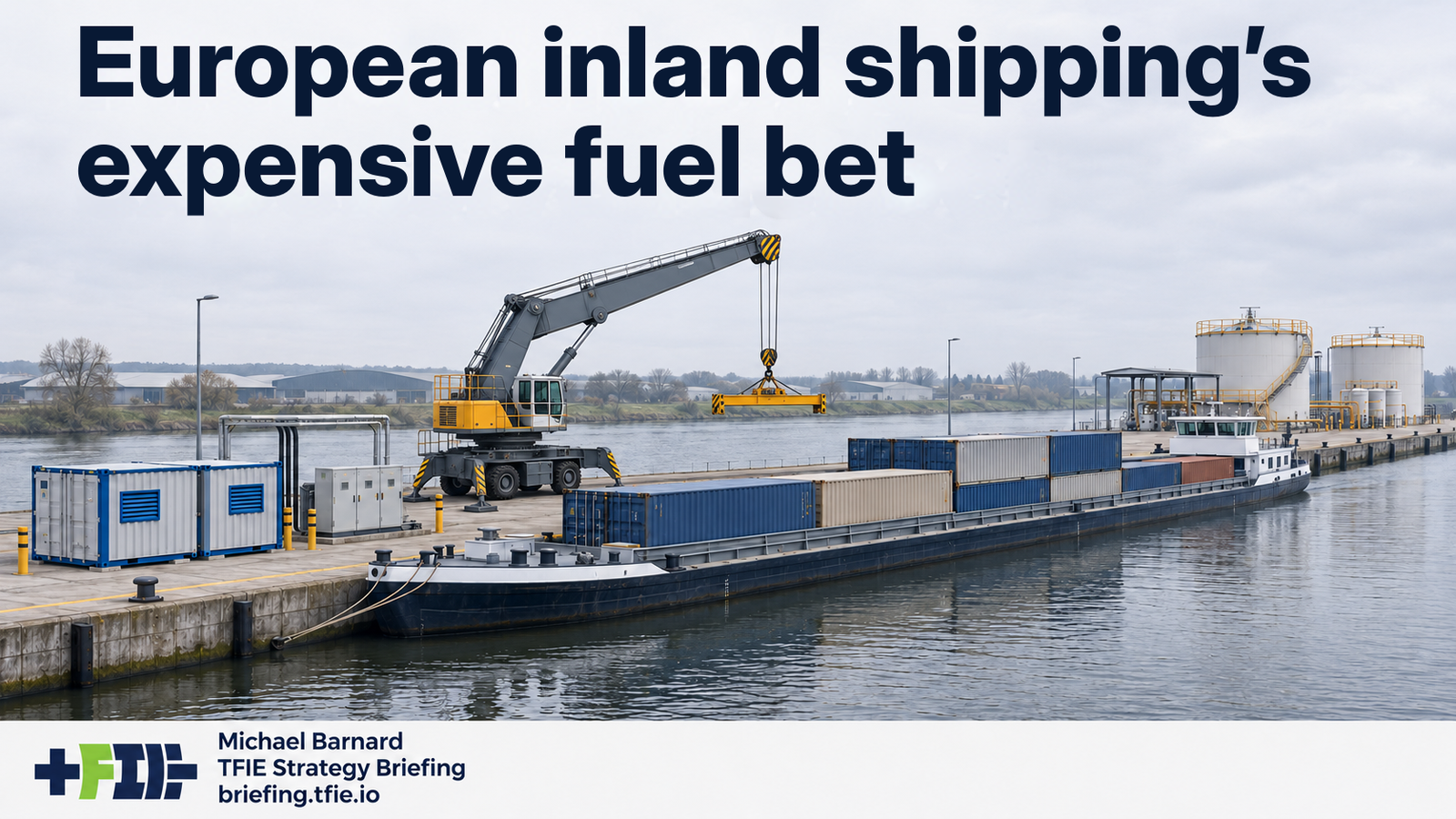
Recent analyses of Europe’s inland shipping transition contain significant pricing discrepancies that may influence policy and investment decisions, according to assessment of models commissioned by transport authorities and EU-linked projects.
Comparisons of propulsion technologies for a 110-meter dry-cargo vessel reveal substantial gaps between modeled costs and observed market prices. When actual October 2026 Dutch market prices for hydrotreated vegetable oil (HVO) are applied, the fuel costs €2,515 per day—considerably higher than the €1,964 per day calculated for battery swapping in the same vessel. The modeling exercise originally suggested HVO held a cost advantage, but real-world fuel pricing reverses that conclusion, making battery swapping approximately €551 per day cheaper. This pricing differential carries real consequences, as fuel typically represents 28 to 35 percent of operating costs in inland shipping depending on vessel type.
The modeling patterns extend beyond HVO to synthetic fuels, where cost assumptions face internal contradictions. One scenario projects green methanol at €350 per ton while simultaneously using green hydrogen prices of €3.50 per kilogram. Since producing synthetic methanol requires roughly 190 kilograms of hydrogen per ton, hydrogen input costs alone approach €665—nearly double the assumed finished-fuel price before accounting for synthesis, carbon dioxide, financing and delivery expenses.
Battery cost estimates also show significant variance across studies. While some analyses place 2030 marine battery storage at €210 to €520 per kilowatt-hour, alternative modeling incorporating standardized marine safety systems and vessel integration suggests €100 per kilowatt-hour is achievable, a €265 per kilowatt-hour difference that translates to €1.06 million on typical installations.
Experts recommend shifting analytical priorities toward freight demand forecasting before fuel demand modeling. Cargo composition is expected to shift substantially by mid-century as coal, refining and primary metals decline while construction and trade increase. The Netherlands and regional authorities are reconsidering transition strategies, with current analysis pointing toward electricity as the primary pathway for inland shipping decarbonization through 2050.
Article Attribution | Read More at Article Source
Article summary produced by Claude AI