

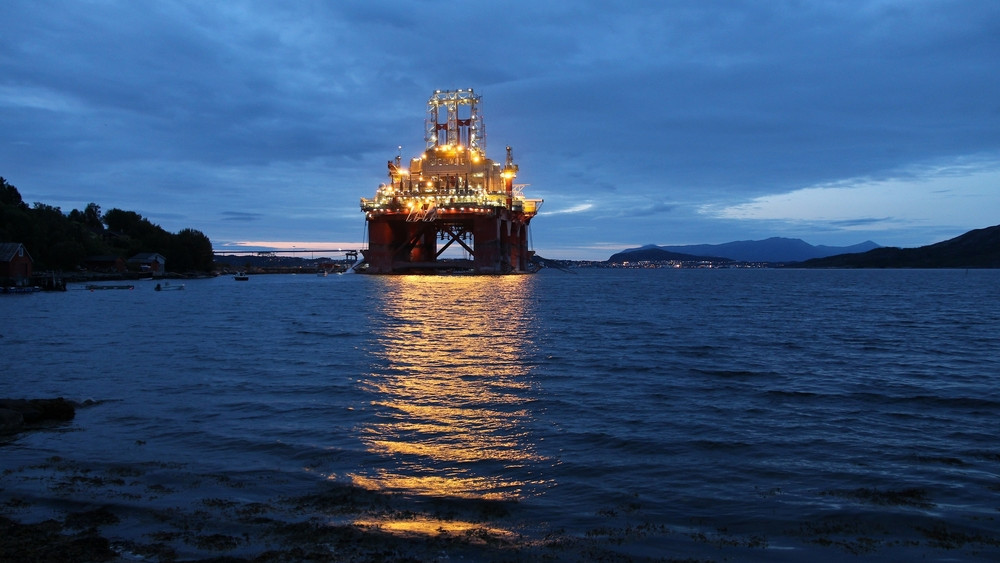
Norway’s upstream sector faces a substantial production shortfall over the coming years, according to analysis from Rystad Energy. The country’s oil and gas industry has relied on major discoveries made over past decades, with the most recent significant find occurring more than a decade ago in the Barents Sea. Since then, exploration efforts have shifted toward smaller deposits developed in proximity to existing infrastructure, enabling faster and less costly production startup. While this strategy has provided near-term support, projections indicate it will be insufficient to prevent output declines through 2040.
Rystad Energy’s base-case scenario projects a production gap of 1.9 million barrels of oil equivalent per day by 2040. Various modeling scenarios demonstrate the limited impact of accelerated development timelines alone. Even when combining doubled exploration activity with halved development timelines, the projected shortfall remains substantial at 1.4 million barrels per day. The analysis underscores that increased exploration volume, particularly through higher-risk wildcat drilling targeting larger prospects away from existing infrastructure, is critical to addressing the long-term decline. Infrastructure-linked exploration, while important for near-term production, cannot deliver the volumes necessary to reverse longer-term trends.
Norway’s historical success in large-scale discoveries has concentrated between 1969 and 2010, with all major finds exceeding 1 billion barrels of oil equivalent occurring during this period. Recent exploration since 2016 has yielded approximately 320 million barrels of oil equivalent annually, substantially below historical averages. Despite holding significant remaining offshore resources and achieving exploration success rates above global averages, Norway’s recent discoveries have averaged notably smaller volumes than the international norm. The country’s petroleum tax system and economic conditions remain favorable, but the challenge centers on discovery size rather than drilling economics.
Recent developments suggest potential strategic adjustments. Major operators have committed to drilling approximately five high-impact wells annually over the next five years, signaling increased interest in larger-risk prospects. The government has offered 70 new exploration blocks in the latest licensing round, with awards anticipated early next year. A new petroleum white paper scheduled for 2027 will provide an opportunity to reassess exploration priorities. The European Union’s revised Arctic policy, announced on 20 October, has moderated its previous stance on Arctic hydrocarbon development, potentially supporting exploration in the Barents Sea region where significant undiscovered resources remain.
Article Attribution | Read More at Article Source
Article summary produced by Claude AI