

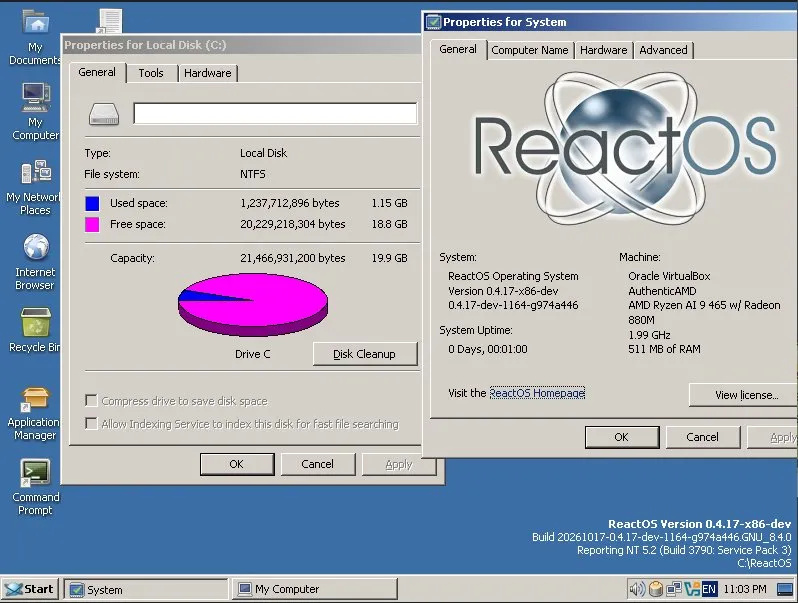
ReactOS, a community-developed open source operating system designed to replicate Windows functionality, has achieved a major technical advancement by enabling direct installation onto NTFS file system partitions. This capability represents progress toward the project’s long-term objectives and addresses a constraint that had persisted throughout its development cycle.
Previously, ReactOS installations were restricted to FAT32 partitions, a limitation that created practical challenges given the project’s goal of achieving binary compatibility with Windows Server 2003. NTFS, the proprietary Microsoft-developed file system that became standard in modern Windows systems, originated with Windows NT 3.1 in 1993 and was substantially refined with Windows XP in 2001. The inability to install directly onto NTFS partitions represented a notable gap in the platform’s functionality relative to contemporary Windows environments.
While the new driver functionality is now available, the ReactOS team has noted significant limitations. The implementation currently lacks caching capabilities, which results in reduced performance, and does not yet support journaling or security features. The development team has also cautioned users about the possibility of undiscovered bugs, suggesting that the driver remains in a relatively early stage of maturity.
The addition of NTFS installation support concludes a development effort spanning nearly a decade. The project initially incorporated read-only NTFS support in 2016, followed by boot support through FreeLoader in 2022. These incremental advancements eventually culminated in the ability to perform complete operating system installations on NTFS partitions.
ReactOS remains an ongoing volunteer-driven initiative coordinated through public platforms including GitHub and project forums. The extended timeline required to achieve this milestone illustrates the substantial complexity involved in reimplementing an operating system from the ground up, explaining the project’s sustained status as an alpha-stage release.
Article Attribution | Read More at Article Source
Article summary produced by Claude AI