

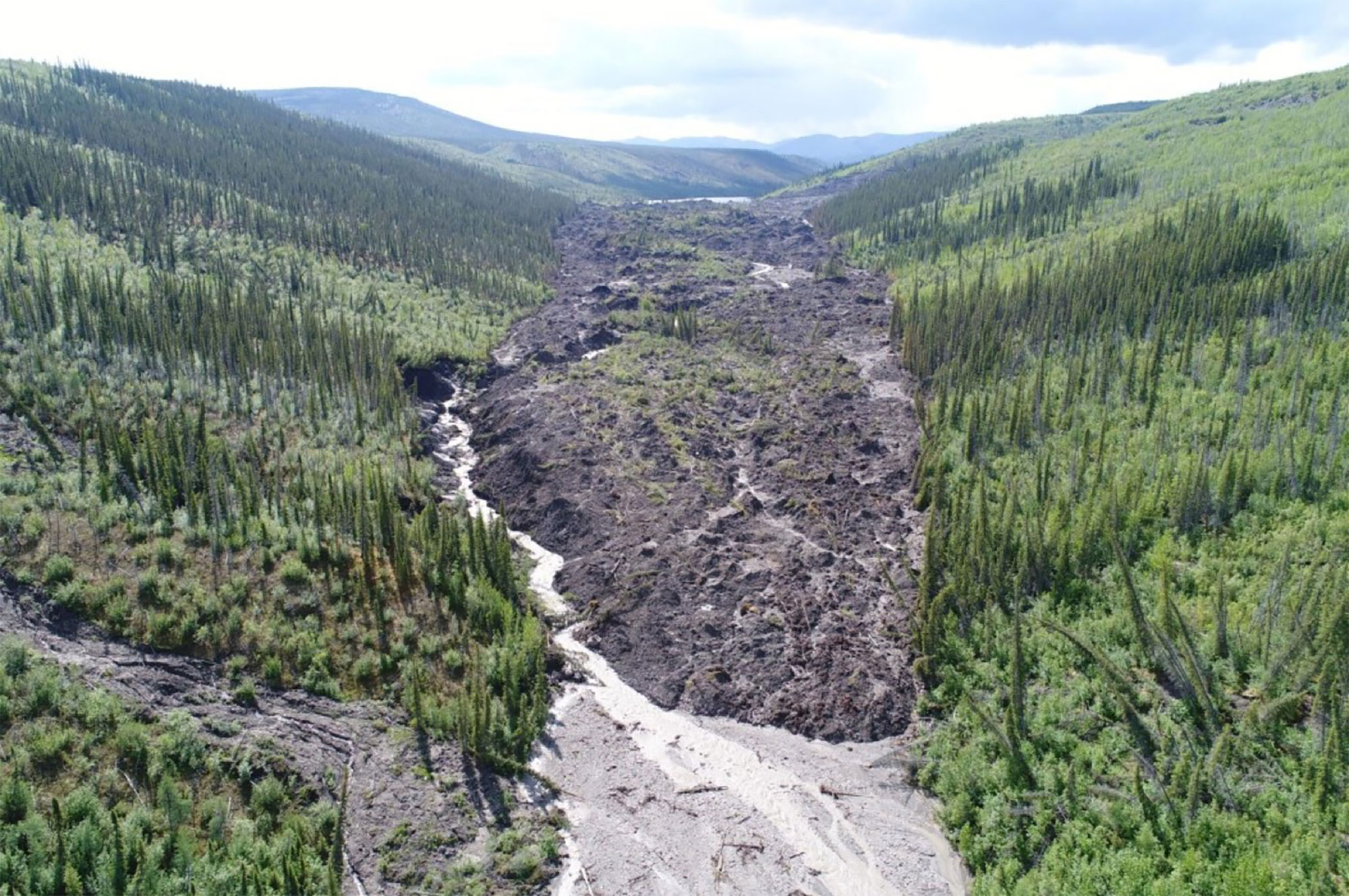
Researchers studying landslides in Canada’s Northwest Territories have documented a previously unknown type of geological failure involving permafrost, the permanently frozen ground covering vast areas of the Northern Hemisphere. Two major detachment slides identified in the region each stretched between three-quarters of a mile and 2 miles in length, displacing approximately 30 million cubic yards of earth combined. These events represent what scientists describe as a new category of landscape collapse driven by permafrost degradation rather than conventional water-and-debris flows.
The slides originated from a 1995 wildfire that removed vegetation shading the permafrost. Over approximately two decades, heat gradually penetrated the frozen ground from below, creating tension cracks and warm water pools that further destabilized the soil structure. The accumulated warming eventually triggered catastrophic failure along the Johnson River in 2017 and Redstone River in 2018, with the collapses occurring over hours or days rather than gradually. Researchers identified enormous frozen blocks up to 650 feet long embedded in the slide material, indicating the failure initiated from the permafrost’s base rather than its surface.
The phenomenon reflects broader changes occurring across Arctic regions as warming accelerates at rates four times faster than the global average. Permafrost zones spanning an area two and a half times larger than the continental United States are thawing rapidly, releasing greenhouse gases trapped in frozen organic material. Following each detachment slide, exposed permafrost walls remain vulnerable to additional sun exposure and potential further collapse, expanding the area of instability.
The cascading consequences extend beyond immediate landscape changes. As permafrost thaws, microorganisms decompose accumulated organic matter and release carbon dioxide and methane, potentially establishing feedback loops that amplify warming. Simultaneously, expanding northern vegetation increases wildfire fuel loads, while peat-rich fires can smolder underground throughout winter and reignite seasonally. Scientists remain uncertain about the total greenhouse gas emissions these permafrost detachment slides might generate as climate change continues across northern regions.
Article Attribution | Read More at Article Source
Article summary produced by Claude AI