

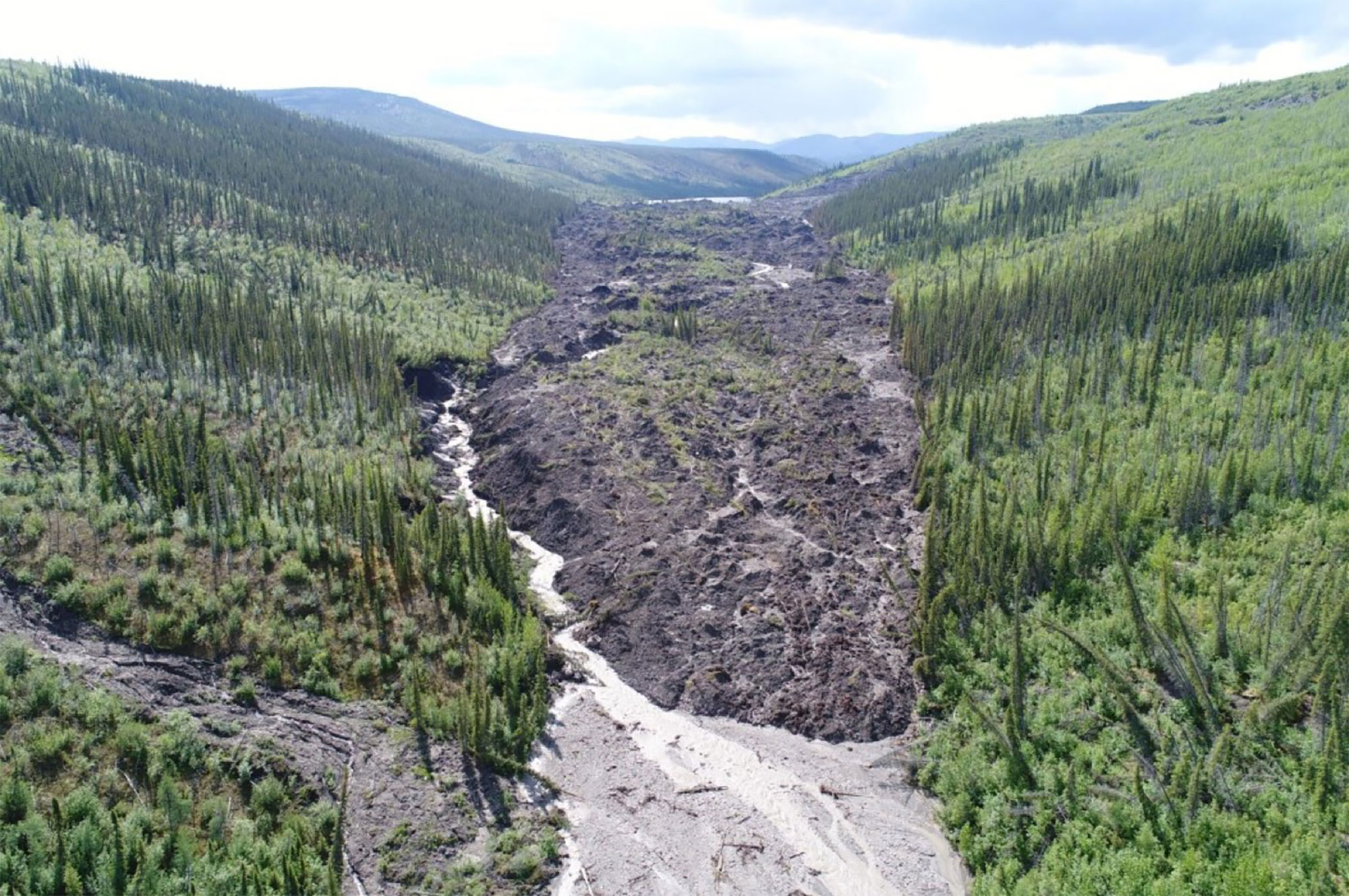
Researchers have documented a previously unknown type of landslide in Canada’s Northwest Territories that occurs when permafrost undergoes catastrophic failure. Two major events were studied, one spanning three-quarters of a mile and another stretching 2 miles, collectively displacing 30 million cubic yards of earth. These permafrost detachment slides differ from conventional landslides in that they result from the degradation of frozen soil rather than water and debris rushing down hillsides.
The slides in question originated from a 1995 wildfire that stripped vegetation covering the permafrost. This vegetation normally acts as thermal insulation during summer months. Over approximately 20 years, the absence of this protective layer allowed heat to penetrate to the base of the permafrost. Even slight warming at depth created tension cracks and surface pools of warmer water, which infiltrated further into the frozen ground. The permafrost then moved downhill at accelerating rates before suddenly collapsing along the Johnson River in 2017 and Redstone River in 2018. Researchers recovered frozen chunks up to 650 feet long at the collapse sites, indicating the failure originated from beneath the surface rather than above.
The phenomenon represents a dramatic manifestation of rapid Arctic warming, which is occurring four times faster than the global average. Permafrost covers an area across the Northern Hemisphere approximately two and a half times the size of the continental United States. As these frozen zones thaw, microbes consume organic material within, releasing greenhouse gases. The collapse of permafrost also exposes additional frozen material to sunlight, creating conditions for further failures and additional carbon release.
The cascading effects extend beyond direct carbon emissions. Arctic vegetation is advancing northward at miles per decade, and increased shrub growth can trap snow, further insulating permafrost from winter cold. Northern wildfires, which trigger these detachment slides, increasingly burn through carbon-rich peat deposits. These fires can persist underground through winter, re-igniting during spring thaws. Scientists are investigating how much additional greenhouse gas might be released from permafrost detachment slides as microbial activity increases in the aftermath of these landscape-altering events.
Article Attribution | Read More at Article Source
Article summary produced by Claude AI