
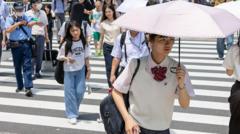
Japan’s weather agency designated this week as the country’s first occurrence of a “kokushobi,” or “cruelly hot day,” a term introduced in April to categorize days when temperatures reach 40 degrees Celsius or higher. The threshold was met on Tuesday in the central Japanese cities of Tajimi, Gujo, and Toyoda, with meteorological officials forecasting continued elevated temperatures extending into the following week.
The new classification represents an addition to Japan’s existing heat-related terminology. The country previously had designations for temperatures exceeding 25, 30, and 35 degrees Celsius, with days above 35 degrees known as “moshobi” or “extremely hot days.” The additional category uses the term “koku,” which translates to harsh or cruel, to denote the most severe heat conditions. Nearly 300 of Japan’s 914 weather observation points recorded “moshobi” conditions on the same day.
Health authorities have responded to the dangerous conditions by issuing heatstroke alerts across more than 40 prefectures. Officials have recommended increased use of air conditioning, adequate water consumption, salt intake, and limitation of outdoor activities. The Tokyo Fire Department reported that 287 individuals aged three to 103 were admitted to hospitals for apparent heatstroke on Tuesday—the highest daily count recorded this year. An ambulance overload alert was subsequently issued on Wednesday.
The intensification of Japan’s summer heat reflects broader global patterns of increasingly dangerous extreme weather events. Last year, the nation recorded its highest-ever temperature of 41.8 degrees Celsius in Isesaki, while workplace heatstroke incidents reached a record 1,803 cases, resulting in 19 fatalities. In response to ongoing heat challenges, Tokyo’s municipal government has encouraged office workers to adopt casual summer attire, including T-shirts and shorts, in place of traditional business suits.
Article Attribution | Read More at Article Source
Article summary produced by Claude AI