
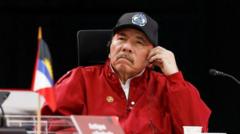
Nicaragua’s National Assembly, controlled by the government, is considering legislation that would prohibit opposition parties from participating in elections. A vote on the measure is planned for the first week of August.
The legislative initiative follows recent comments by President Daniel Ortega, who stated that opposition groups would have no further opportunity to compete in elections. The 80-year-old leader, who has held power since 2007, characterized the opposition as externally financed and conspiratorial. He indicated that new laws would be enacted to prevent what he termed “coup mongers” from gaining power, regardless of international financial support. Ortega made these remarks during a speech commemorating the 1979 Sandinista revolution.
The United Nations High Commissioner for Human Rights, Volker Türk, issued a statement opposing the initiative, emphasizing that individuals across the political spectrum must retain the right to vote and seek office. The U.S. State Department similarly criticized Ortega’s position, with Secretary of State Marco Rubio characterizing the statements as evidence of authoritarianism and noting that Ortega and his wife Rosario Murillo have “abandoned even the pretense of popular consent.”
Nicaragua’s National Assembly leadership defended the proposed measure, with Assembly head Gustavo Porras stating that legislators and electoral authorities were working to prevent opposition advancement. The 2021 presidential election, the most recent held in November of that year, resulted in Ortega’s victory in what observers characterized as a heavily controlled contest. Multiple opposition figures were detained, disqualified, or forced into exile ahead of that election, leaving only minor candidates permitted to run.
In November 2025, during Ortega’s current five-year term, the National Assembly approved a constitutional reform extending presidential terms to six years and establishing Rosario Murillo as “co-president,” a position allowing her to assume leadership if Ortega is deemed “permanently absent.” Opposition figures abroad have publicly rejected the latest legislative plans, with exile-based politicians characterizing the measures as evidence of Ortega’s intent to consolidate single-party rule and suppress dissent.
Article Attribution | Read More at Article Source
Article summary produced by Claude AI