
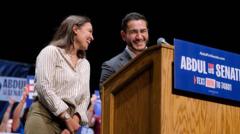
The Democratic Party faces internal divisions as its left wing gains primary momentum this summer, exemplified by a competitive Michigan Senate race between progressive doctor Abdul El-Sayed and moderate Congresswoman Haley Stevens. The primary contest scheduled for 4 August will determine who faces Trump ally Mike Rogers in the November general election for a seat Democrats consider essential to regaining Senate control.
El-Sayed’s campaign emphasizes universal healthcare, wealth taxation, and opposition to US military aid to Israel, drawing endorsements from prominent progressive figures including Senator Bernie Sanders and Representative Alexandria Ocasio-Cortez. His affordability-focused platform resonates with voters struggling with healthcare, grocery, and housing costs—issues consistently ranking high in polling for the midterm elections. Stevens, by contrast, emphasizes experience and has secured backing from Michigan’s governor and corporate donors, positioning herself as the more electable alternative.
The race highlights broader party tensions between the centrist establishment and progressive wing. While left-wing candidates have secured victories in recent primaries across multiple states, questions remain about their appeal to working-class swing voters in politically diverse Midwestern battlegrounds. Michigan voted for Democrat Joe Biden in 2020 but shifted to Trump four years later, making it a critical test case for whether progressive messaging can recapture disaffected voters.
The Israel-Gaza conflict presents a particularly divisive issue in Michigan, home to the nation’s second-largest Arab-American population. El-Sayed has characterized Israeli actions as genocide and attacked Stevens’ ties to pro-Israel advocacy groups, while Stevens maintains support for unconditional US aid to Israel. Political analysts note the Democratic Party faces a difficult balancing act in appealing to both Jewish and Arab constituencies on this issue.
Party unity concerns persist among Democrats and analysts. While some voters express enthusiasm for the progressive movement’s energy and policy focus, others worry whether such momentum can translate to general election victories against Republicans. Political strategist Larry Sabato emphasized that Democrats must reunify their fractured coalition to reverse recent electoral losses, warning that failure to repair party divisions could result in continued defeats through 2028.
Article Attribution | Read More at Article Source
Article summary produced by Claude AI