
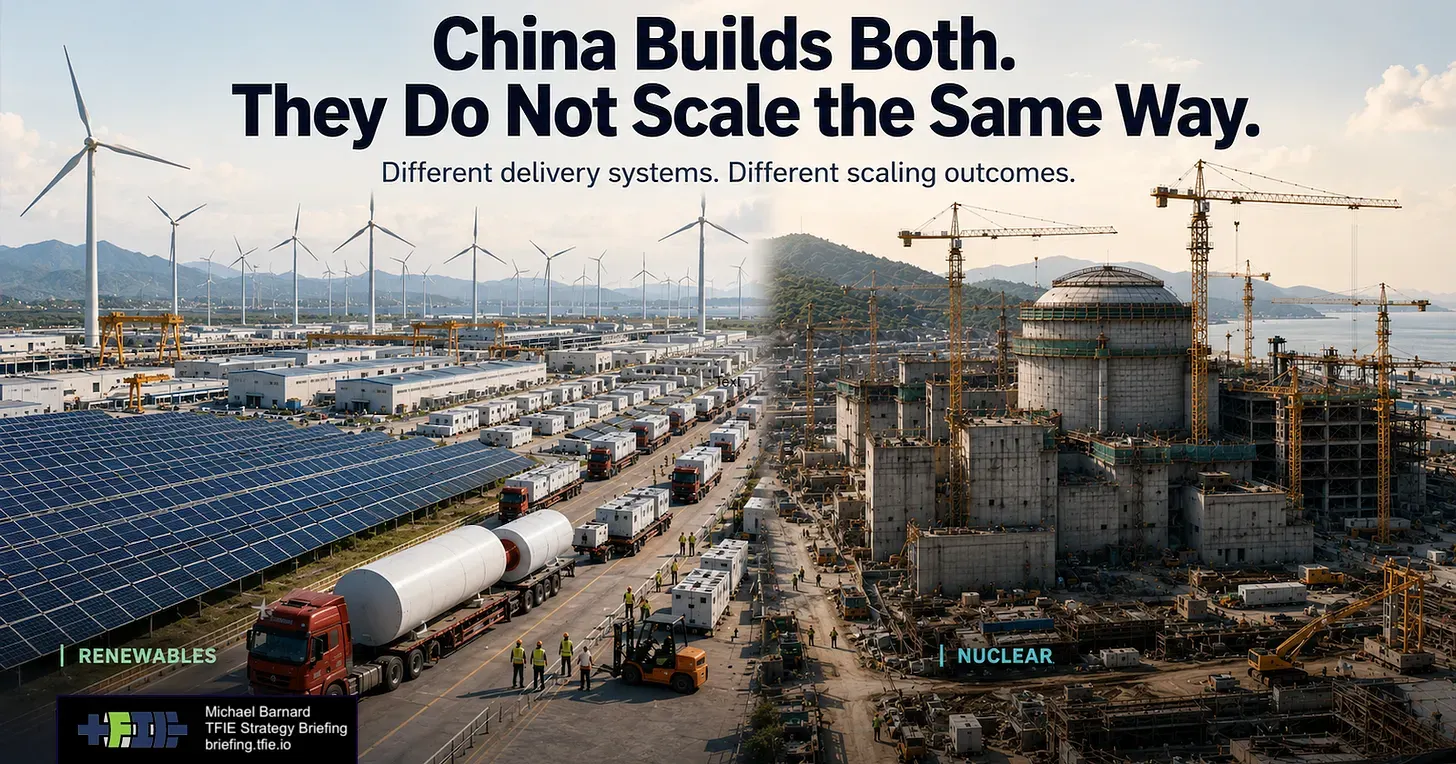
China’s energy development reveals a marked divergence between its renewable and nuclear power expansion trajectories, despite both receiving substantial state backing and favorable policy conditions. Wind and solar capacity additions have repeatedly surpassed official targets, sometimes by significant margins, while nuclear capacity has consistently fallen short of stated goals.
The quantitative gap between the two technologies has widened substantially. During 2025, new wind capacity represented approximately 282 terawatt-hours of annual generation capacity, while new solar added around 414 terawatt-hours. By contrast, new nuclear capacity that year corresponded to roughly 13 terawatt-hours. Over the period spanning 2022 through 2025, cumulative wind and solar additions represented about 1,912 terawatt-hours of annual generation potential compared to approximately 73 terawatt-hours from nuclear, yielding a ratio of roughly 26 to one.
The structural differences between these energy systems explain much of this disparity. Renewable installations operate through parallel, modular production chains where factories manufacture components, multiple projects proceed simultaneously, and installation crews move continuously between sites. Nuclear capacity, conversely, arrives through sequential megaprojects requiring extended civil construction, equipment installation, testing phases, fuel loading, and grid connection procedures. Individual delays or design issues can affect meaningful portions of the nuclear programme.
China maintains an extensive reactor construction programme and continues approving new units, suggesting sustained commitment to nuclear expansion. However, a notable distinction exists between approvals and actual commissioning. When renewable targets are missed, policymakers typically establish more ambitious subsequent targets. When nuclear targets are exceeded, targets remain unchanged. China’s two major domestic reactor families and multiple design variants also limit standardization benefits that could accelerate construction timelines.
Forecast methodologies should reflect these different delivery mechanisms. Renewable projections should build from demonstrated manufacturing and installation capacity, testing grid absorption capabilities. Nuclear forecasts should originate from named reactors under construction, their documented progress rates, and commissioning sequences. Both technologies will expand, but their trajectories warrant distinct analytical frameworks rather than interchangeable target-based assumptions.
Article Attribution | Read More at Article Source
Article summary produced by Claude AI