

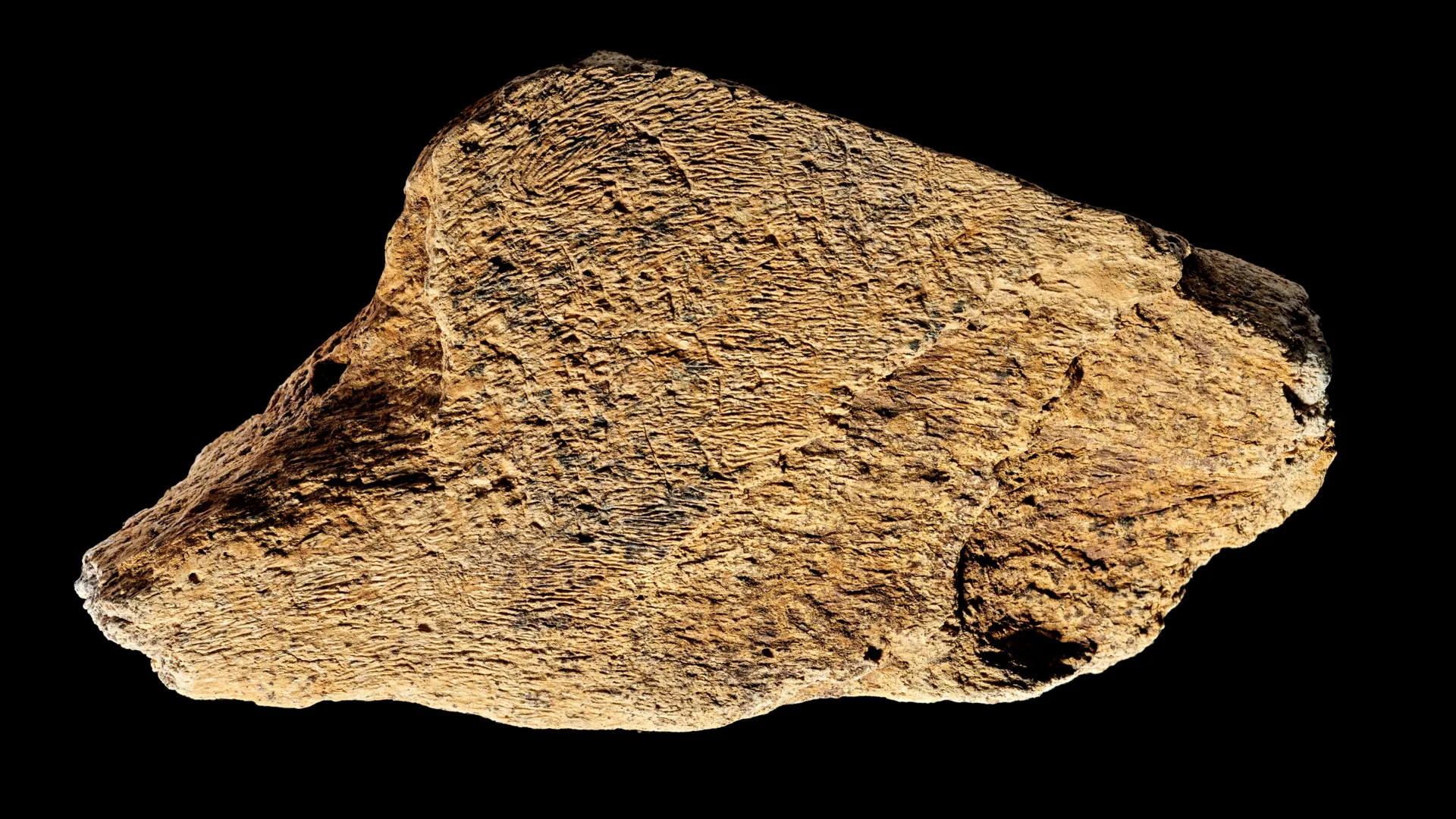
Researchers from UCL and the Natural History Museum in London have analyzed a prehistoric hammer fashioned from elephant bone discovered in southern England. The artifact, dating back approximately 500,000 years, represents the oldest elephant bone tool ever identified in Europe and provides insight into the technical capabilities and resourcefulness of early human ancestors.
The tool was likely created by early Neanderthals or Homo heidelbergensis. Rather than functioning as a heavy striking implement, it served as a specialized softer-striking tool used to repair and sharpen stone handaxes and other cutting implements when their edges became dull. The fossilized object measures approximately 11 centimeters long and features a roughly triangular shape, with surface marks indicating deliberate shaping by early humans. Analysis using 3D scanning technology and electron microscopes revealed distinctive notches, impact damage, and tiny pieces of flint lodged within the marks—evidence of repeated use as a hammer for working stone tools.
The bone fragment, composed primarily of cortical bone, likely came from either an elephant or mammoth based on its unusual thickness. Researchers determined that the tool functioned as a “retoucher,” a device used to strike the edges of worn stone tools and knock off small flakes to restore their cutting effectiveness. Because bone is softer than stone, it allowed toolmakers to work more precisely without causing excessive damage. Elephant bone proved particularly suitable for this purpose due to its dense outer layer, which was harder and more durable than bones from animals commonly available in the region.
The discovery underscores the sophisticated decision-making of early humans. Elephants and mammoths were not common in prehistoric southern England, yet early inhabitants chose to collect, preserve, and shape this rare material. This selection of an uncommon resource for a specialized purpose demonstrates advanced abstract thinking and resourcefulness. The artifact was recovered during the early 1990s but only recently recognized as a tool after detailed examination.
The finding expands understanding of elephant bone technology in Europe. While such tools have been documented in Africa dating back 1.5 million years, European examples remain exceptionally rare. Prior to this discovery, no European elephant bone tool was known to predate approximately 450,000 years, and most earlier examples were found in warmer southern regions. The Boxgrove artifact therefore extends both the chronological record and geographical range of this technology in Europe, revealing that early British inhabitants were selecting rare materials and producing highly refined implements hundreds of thousands of years ago.
Article Attribution | Read More at Article Source
Article summary produced by Claude AI