

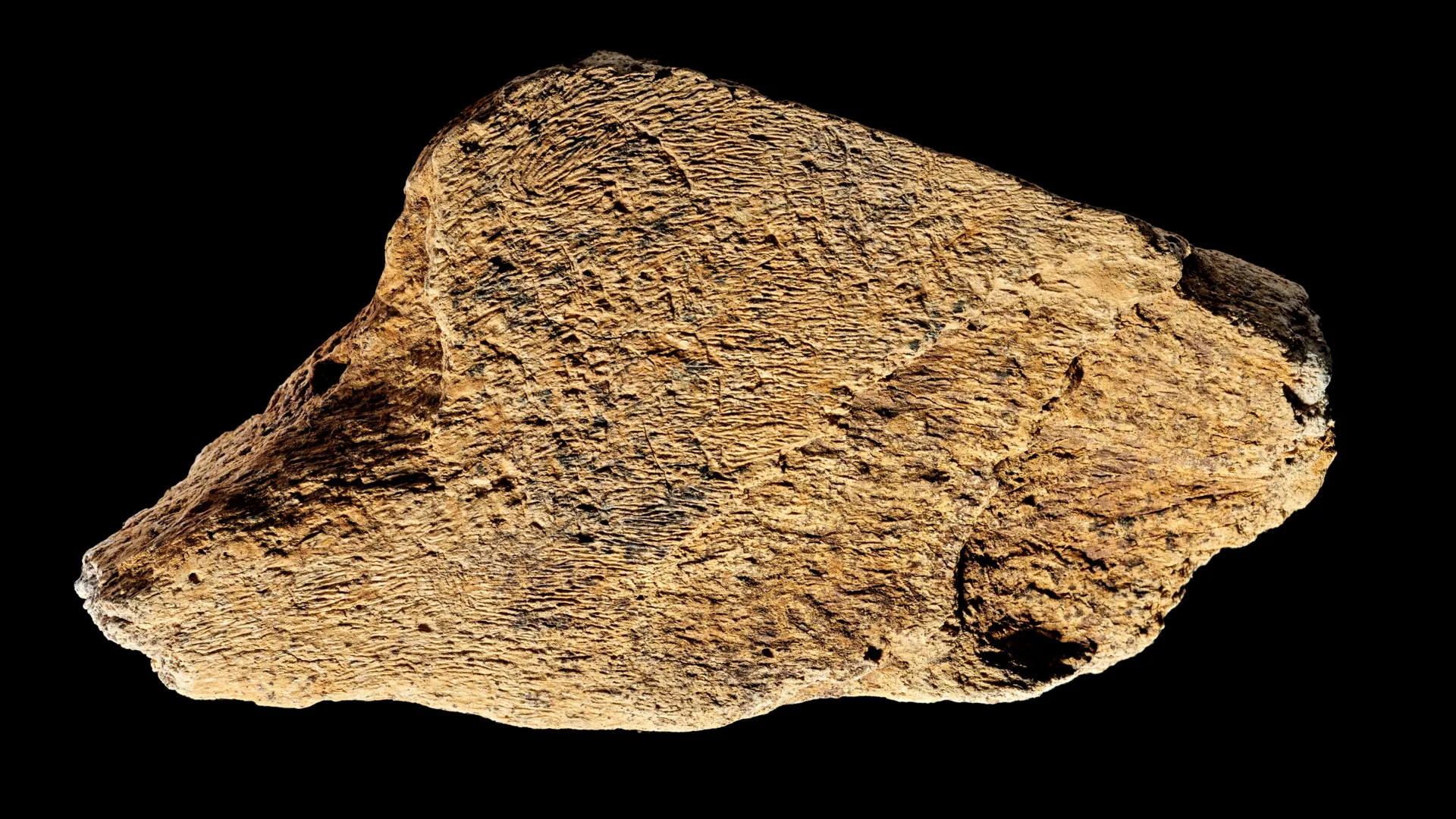
Researchers from UCL and the Natural History Museum in London have identified a prehistoric hammer fashioned from elephant bone discovered in southern England, dating back nearly 500,000 years. The artifact represents the oldest known elephant bone tool ever found in Europe and provides insights into the technical capabilities and resourcefulness of early human ancestors, likely belonging to either early Neanderthals or Homo heidelbergensis populations. The fossilized object has a roughly triangular shape, measuring approximately 11 centimeters in length, six centimeters wide, and about three centimeters thick. The fragment consists primarily of cortical bone, the dense outer layer of skeletal material, with an unusual thickness suggesting it originated from either an elephant or mammoth. Researchers were unable to determine the exact animal species or anatomical source due to insufficient remaining material. First recovered during the early 1990s, the artifact’s true purpose remained unrecognized until scientists conducted a detailed reexamination of materials from the site.
Advanced analysis using 3D scanning technology and electron microscopes revealed distinctive notches, impact damage, and other evidence indicating repeated use as a striking tool. Microscopic flint fragments lodged within the marks provided strong evidence that the bone had been employed to strike and reshape stone implements on multiple occasions. The tool likely functioned as a retoucher, used to strike worn stone tool edges and knock off small flakes to restore cutting surfaces through a technique known as knapping. Bone implements prove more suitable than stone for this specialized task, as their relative softness permits more precise work without excessive damage.
The decision to collect, preserve, and shape such a rare material demonstrates the cognitive abilities and planning capacity of these early humans. Elephants and mammoths were not common in prehistoric southern England, indicating that toolmakers recognized elephant bone’s superior durability compared to more readily available animal bones and reserved it for specialized purposes. The artifact originates from Boxgrove, an extensively excavated archaeological site near Chichester in West Sussex, though no elephant bone tool had been previously identified there. The discovery significantly expands the known history and geographical range of elephant bone technology in Europe, as prior to this finding, no European elephant bone tool was documented as older than approximately 450,000 years, with most early examples found in warmer southern regions.
Article Attribution | Read More at Article Source
Article summary produced by Claude AI