

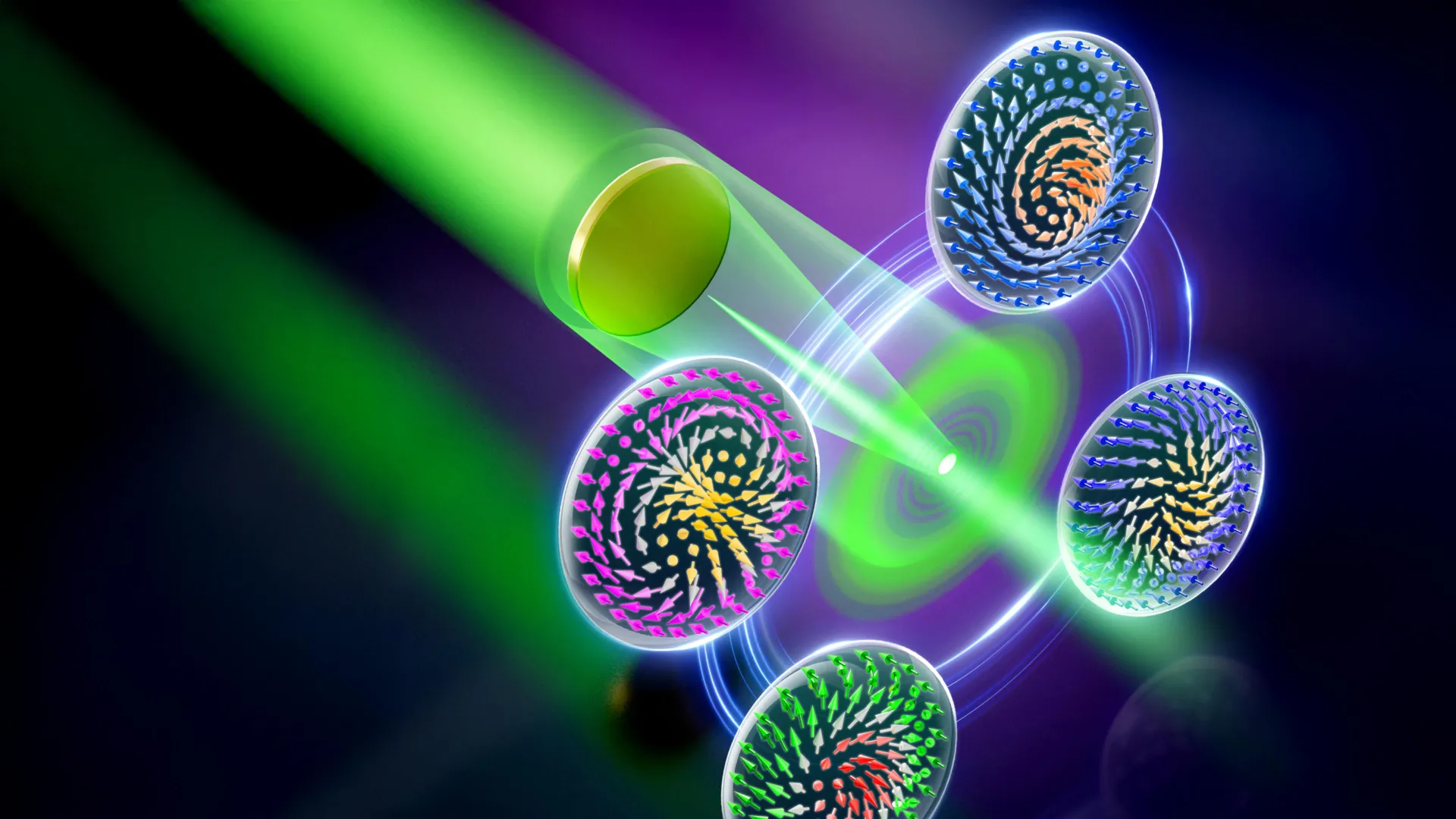
Scientists at Nanyang Technological University in Singapore have demonstrated a simplified approach to generating optical skyrmions, stable swirling patterns formed within light properties that researchers believe could support future data storage, communications, and computing applications. The team, led by Assistant Professor Shen Yijie, utilized a classical optical phenomenon rather than expensive engineered materials, making the technology more accessible to the scientific community.
The breakthrough centers on the Poisson spot, an optical effect documented over two centuries ago in which a bright point appears at the center of a shadow cast by a circular object when illuminated by coherent light such as a laser. By shining a laser at a small circular disc, the NTU researchers generated optical skyrmions without requiring complex metamaterials or specialized techniques. This classic phenomenon played a significant historical role in debates about light’s nature, providing evidence that light bends and spreads as it passes around objects through the process of diffraction.
The study, published in Optica, revealed that the Poisson spot setup naturally produced four related topological patterns simultaneously: spin skyrmions, Stokes skyrmions, electric field skyrmions, and magnetic field skyrmions. These structures represent different aspects of light’s properties, including its rotational characteristics and polarization. Computer simulations displayed these patterns as swirling arrays demonstrating how various light properties change direction across the light spot, offering researchers a unique opportunity to study how different optical skyrmions form and interact within a single system.
By enabling the production and comparison of multiple skyrmion types in one system, the research may help scientists discover new connections between light’s electric, magnetic, and other physical properties. The simplified method allows precise control over skyrmion size, shape, and behavior by adjusting the light field conditions. The findings establish a foundation for future investigations into topological light and could contribute to advances in photonics, materials science, information processing, and next-generation computing technologies.