

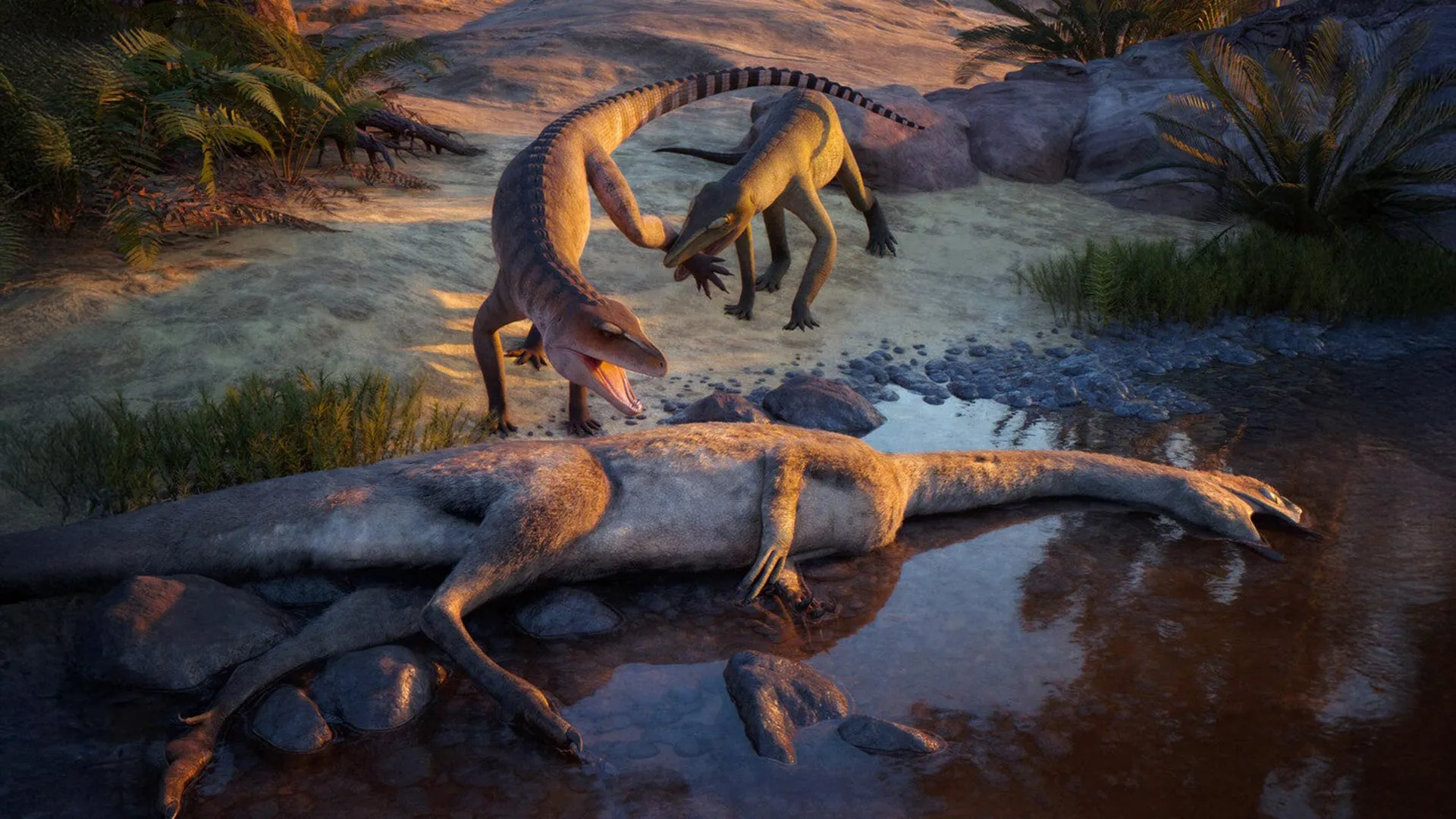
Paleontologists at Yale University have formally identified a new species of extinct proto-crocodile found fossilized alongside another early crocodile relative at Ghost Ranch in northern New Mexico. The newly named species, Eosphorosuchus lacrimosa, was discovered within rocks that have been part of the Yale Peabody Museum’s collection since their excavation in 1948. Despite being available for study for approximately 75 years, the specimen had never been fully analyzed until recently.
The fossil contains the remains of two predators that lived during the late Triassic Period, approximately 210 million years ago. Both animals were roughly jackal-sized and appear to have died simultaneously, possibly during a flash flood or mudslide. The first specimen was previously identified as Hesperosuchus agilis, characterized by a longer snout and powerful hind legs. The second animal, now recognized as Eosphorosuchus lacrimosa, displayed notably different anatomical features, including a shorter snout, more heavily reinforced skull, and enlarged jaw muscles adapted for capturing larger prey.
Yale researchers utilized advanced CT imaging technology to examine structures that remained embedded within the rock matrix. This analysis revealed multiple anatomical distinctions that differentiated Eosphorosuchus from known specimens of Hesperosuchus. The CT scans allowed scientists to digitally reconstruct the fossil bone by bone, uncovering previously unrecognized characteristics that supported classification as a distinct species.
The discovery carries significant scientific value because the two animals appear to have inhabited the same ecosystem during the same time period. The contrasting skull and jaw structures suggest that closely related predators were already developing specialized feeding strategies, which may have allowed them to hunt different prey and reduce direct competition. This coexistence provides rare evidence of ecological diversification among early crocodile relatives during the beginning of the ‘Age of Reptiles,’ when ancestor lineages of modern crocodiles and dinosaurs were both expanding into new ecological niches.
Article Attribution | Read More at Article Source
Article summary produced by Claude AI