

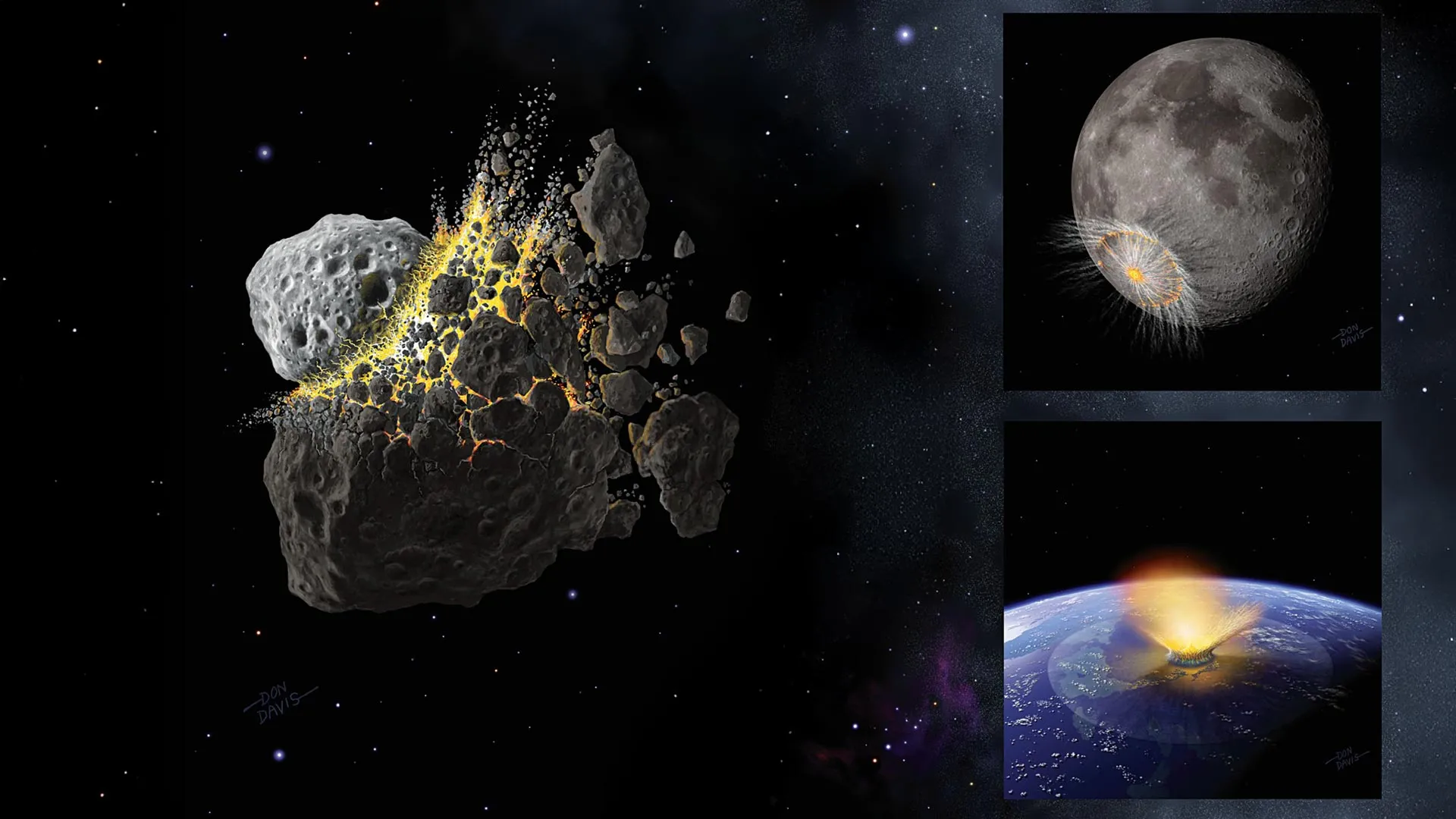
Researchers at the Southwest Research Institute have proposed that the breakup of a parent asteroid forming the Eulalia asteroid family triggered a prolonged bombardment of the inner solar system roughly 800 million years ago. The collision in the main asteroid belt sent substantial quantities of debris toward Earth, the Moon, and Mars, with potential implications for geological change and biological evolution across multiple worlds.
Understanding the role of ancient impacts in shaping planetary history presents significant challenges. Evidence from impacts exceeding 650 million years in age is difficult to recover because Earth’s surface undergoes constant transformation through volcanic activity, plate tectonics, and weathering processes that erase or obscure ancient impact craters. By contrast, the Moon’s static surface, lacking active plate tectonics or substantial atmosphere, preserves a more complete record of ancient collisions. Earlier research indicated the Moon experienced heightened large impact activity around 800 million years ago, based on crater age estimates and impact glass samples collected during Apollo missions.
The study employed computational modeling to connect the lunar evidence with asteroid belt dynamics. The Eulalia family’s formation resulted from a collision involving a primitive carbonaceous chondrite-like object positioned near Jupiter’s 3:1 mean motion resonance, a gravitational configuration that acts as a pathway for debris to escape the asteroid belt. Approximately half the fragments from the breakup entered this resonance immediately, while an additional quarter gradually migrated into it over 100 to 150 million years through the Yarkovsky effect, a subtle orbital shift caused by uneven heat emission from asteroids.
Earth would have experienced substantially more impacts than the Moon due to greater size and gravitational attraction, with estimates suggesting roughly twenty Earth impacts for every large lunar strike. While physical evidence of these collisions has largely vanished from Earth’s surface, the timing of the proposed bombardment coincides with documented periods of significant cooling and major biological transitions. On Mars, such impacts would have generated substantial seismic activity and correspond with increased volcanic episodes. The research provides a framework for investigating how major asteroid belt collisions may have influenced the long-term evolution of terrestrial planets, though the study does not definitively establish causation between the bombardment and observed environmental changes.
Article Attribution | Read More at Article Source
Article summary produced by Claude AI