

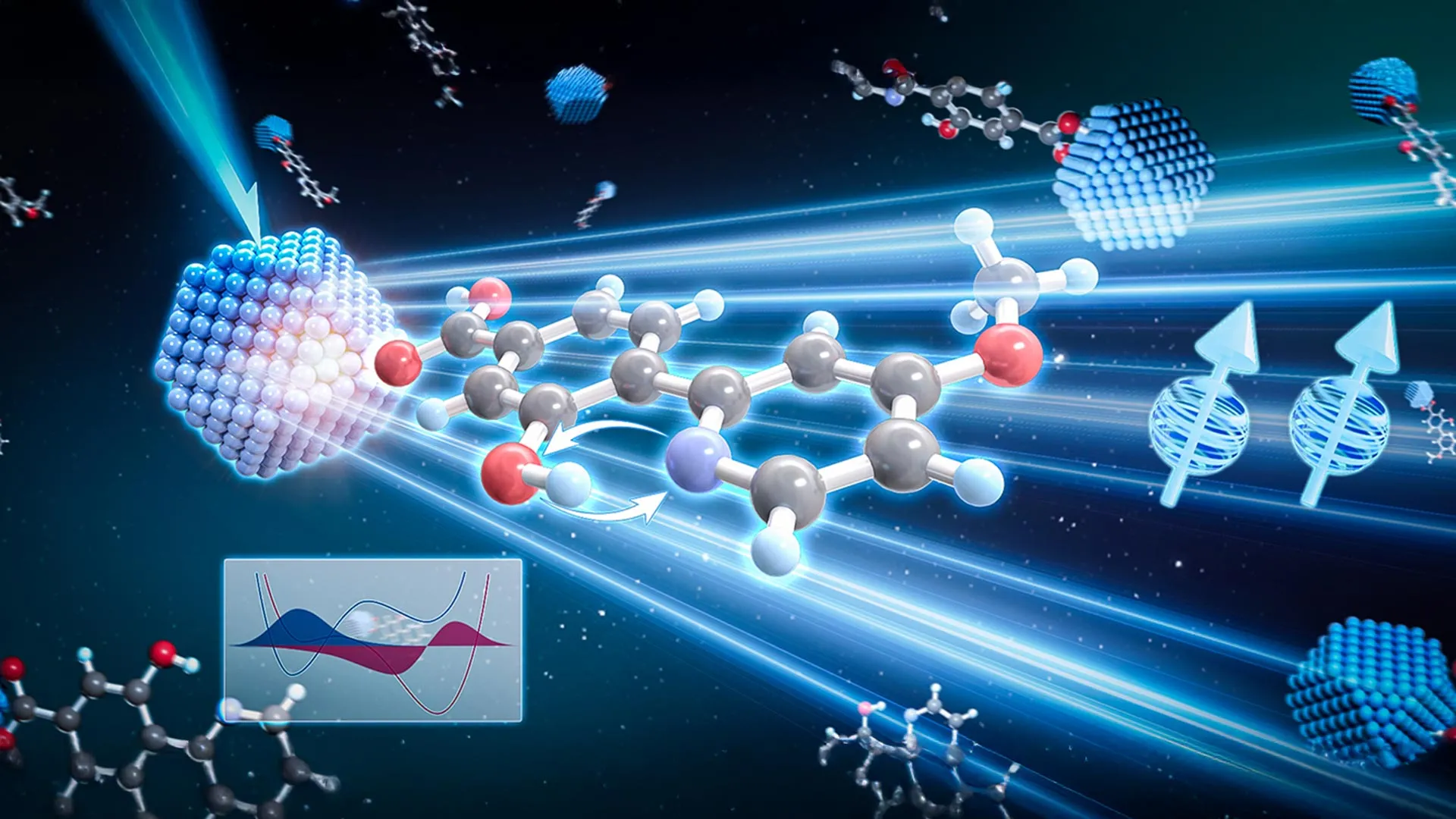
Scientists at the Dalian Institute of Chemical Physics have discovered a previously unknown mechanism for transferring energy in both natural and synthetic systems. The process, termed proton shuttle-assisted triplet energy transfer (PS-TET), represents an advancement in understanding how proton movement can influence triplet energy transfer, a major pathway for energy movement in complex materials.
The research team, led by Prof. Kaifeng Wu, studied energy movement from zinc selenide colloidal quantum dots to phenol-pyridine molecular acceptors. When the quantum dots absorb light, they enter an excited state, triggering a series of coordinated molecular movements. A hole shifts from the zinc selenide to phenol while a proton simultaneously moves from phenol to pyridine. Subsequently, an electron transfers from zinc selenide to the resulting phenoxyl radical, and the proton returns to its original position. This linked sequence of movements results in the overall transfer of triplet energy from the quantum dots to the acceptor molecules.
A striking feature of this mechanism is that the proton shuttle operates through quantum mechanical tunneling rather than conventional heat-driven processes. The research team determined this by observing that the transfer rate remained largely unchanged across different temperatures and by conducting calculations involving proton vibrational wavefunction overlap integrals. This finding demonstrates that quantum effects can be harnessed to control charge and energy transfer in complex materials even under ambient conditions.
The implications of this discovery extend to several technological applications. In some cases, enhancing triplet formation could improve the efficiency of photoredox reactions and environmental catalysis. In other applications such as organic solar cells and lasers, controlling or suppressing unwanted triplet states could enhance device performance. The research suggests that scientists may gain greater control over triplet formation by either incorporating or removing proton shuttle mechanisms as needed for specific applications.
Article Attribution | Read More at Article Source
Article summary produced by Claude AI