

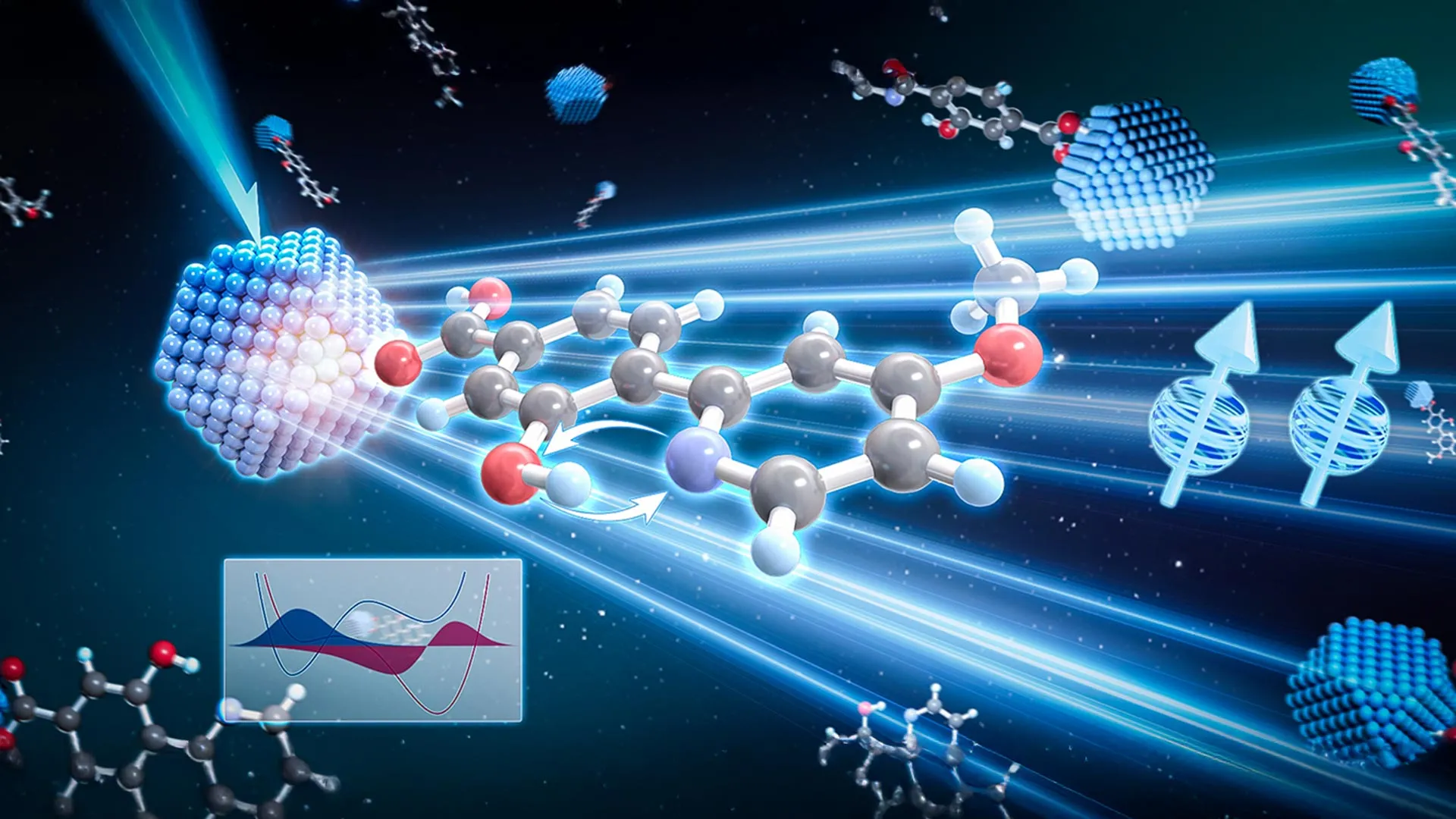
Scientists at the Dalian Institute of Chemical Physics have identified a previously unknown energy transfer mechanism involving the coordinated motion of protons and electrons. The discovery, published in Nature Materials, describes a process called proton shuttle-assisted triplet energy transfer (PS-TET) that operates in quantum dot systems coupled with organic acceptor molecules.
The research builds on earlier work examining proton-coupled electron transfer (PCET) and related phenomena that influence energy conversion in biological systems and synthetic materials. While triplet energy transfer represents a major pathway for energy movement in both natural and engineered systems, the specific role of proton motion in this process had remained poorly understood until this investigation.
In the study, researchers observed the mechanism operating as energy moved from zinc selenide quantum dots to phenol-pyridine dyadic acceptors attached to their surfaces. When the quantum dots absorb light, a coordinated sequence of transfers occurs: a hole moves from the quantum dot to phenol while a proton simultaneously shifts to pyridine, followed by electron transfer back to the quantum dot and proton return to its original position. This temporary proton movement dramatically increases both the speed and efficiency of triplet energy transfer compared to systems lacking this shuttle mechanism.
The temperature-independence of the PS-TET rate indicates that the proton moves through quantum mechanical tunneling rather than conventional thermal processes. Calculations examining proton vibrational wavefunction overlap integrals supported this quantum mechanical interpretation, demonstrating that quantum effects can control energy transfer at room temperature in complex materials.
The findings may have significant applications across multiple technologies. Enhanced triplet generation efficiency could improve photoredox catalysis and environmental remediation processes. Conversely, in organic optoelectronic devices such as solar cells and lasers, controlling triplet formation could allow scientists to suppress unwanted triplet states that reduce performance. The work suggests that manipulating proton shuttle mechanisms could provide a tunable method for regulating triplet energy transfer as needed for specific applications.
Article Attribution | Read More at Article Source
Article summary produced by Claude AI