

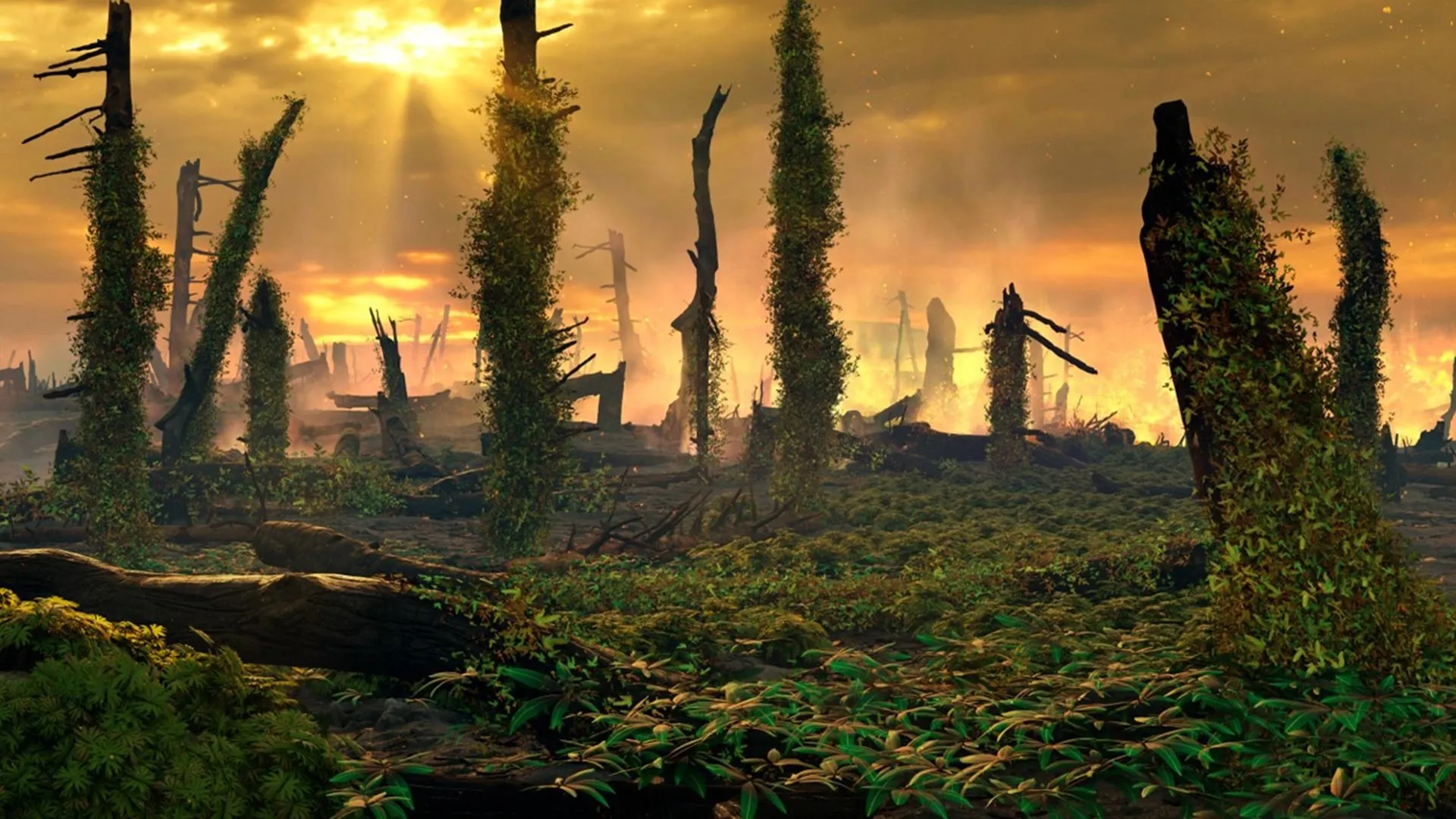
An international research team from Utrecht University has documented extensive wildfire activity across Northwest Europe during the end-Triassic mass extinction, which occurred roughly 201 million years ago. The extinction event followed massive volcanic eruptions linked to the fragmentation of the supercontinent Pangea, which released substantial carbon dioxide and raised global temperatures by an estimated 5 to 10 degrees Celsius. As forests collapsed under these conditions, ferns rapidly colonized damaged regions, establishing savannah-like ecosystems that proved highly susceptible to fire. The research was published in Nature Geoscience on July 21, 2026.
To reconstruct ancient fire patterns, researchers examined four sediment drill cores, including a 640-meter-long sample recently collected from the United Kingdom. They analyzed fossil charcoal and polycyclic aromatic hydrocarbons, compounds produced by wildfire smoke, alongside fossil pollen and spore records. These traditional methods indicated increased wildfire activity during the main extinction phase coinciding with fern expansion. However, recognizing limitations in these conventional approaches, the team developed an innovative technique using color analysis of fossil pollen and spores through the Palynomorph Darkness Index, which measures the “darkness” of organic microfossils to track ancient fire intensity.
The analysis revealed an unusual pattern: while fossils typically darken with burial depth due to heat and pressure, the researchers discovered a distinct “Dark Zone” where pollen and spores became progressively darker during the extinction interval before returning to pale coloring afterward. This pattern appeared consistently across all four cores despite their distinct geological histories, suggesting an external environmental cause. Comparison with charcoal and smoke compound levels confirmed that the darkening corresponded precisely with the fern spike and elevated fire indicators, representing an extended period of severe wildfire activity lasting tens of thousands to possibly hundreds of thousands of years.
Ferns proved ideal colonizers for fire-damaged landscapes, capable of rapid regrowth from underground root systems even after visible portions burned. These pioneer species created extensive fern-dominated savannahs with thick, dry mats that furnished abundant fuel for subsequent massive fires, establishing a destructive feedback cycle. Climate warming and forest loss created openings for fern proliferation, which then supplied dry material for repeated wildfires, after which ferns rapidly recovered and expanded further. Researchers characterize this period as demonstrating how combined climate change, deforestation, and invasive opportunistic species can create conditions for catastrophic wildfire cycles.
Article Attribution | Read More at Article Source
Article summary produced by Claude AI