

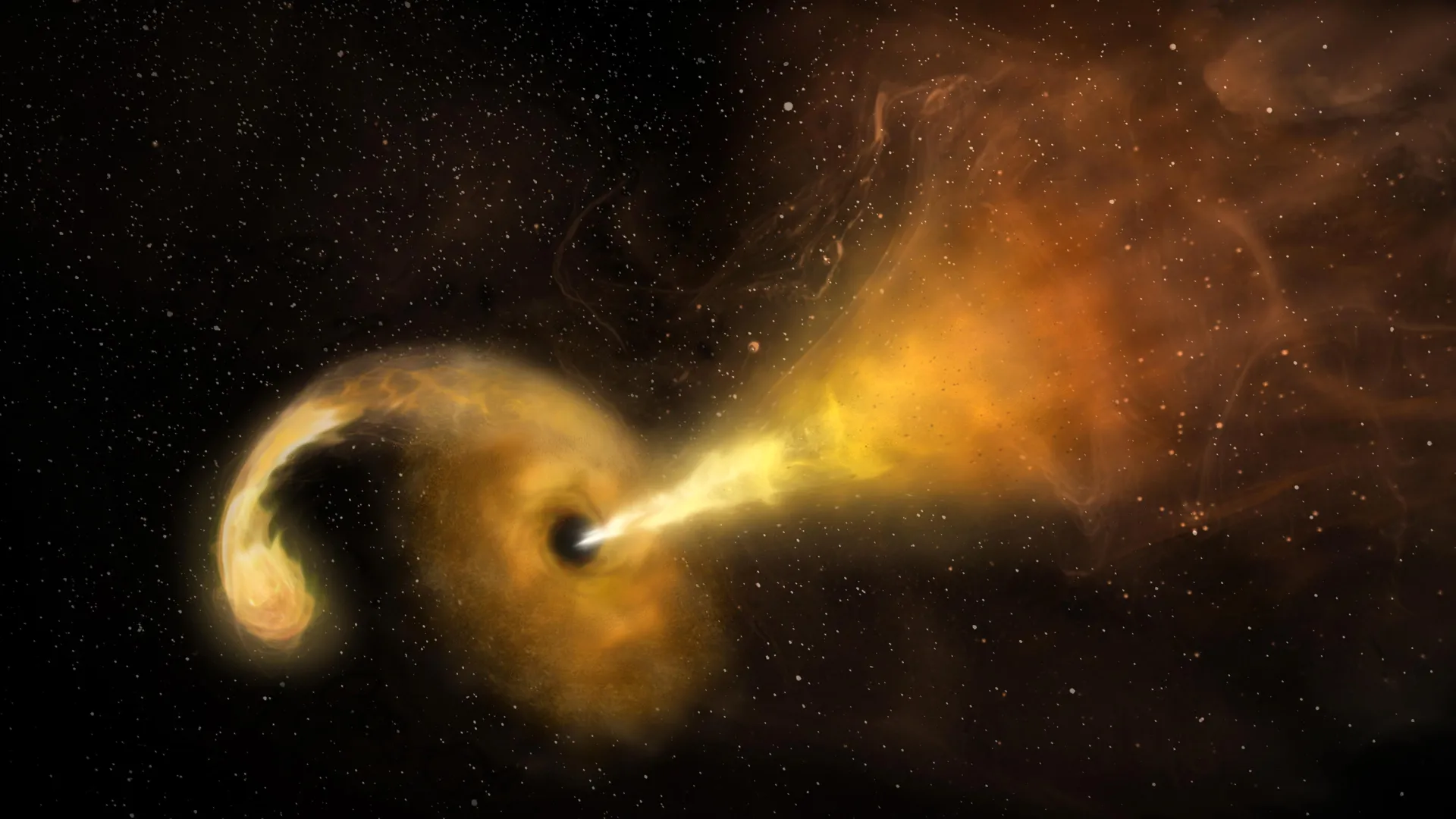
NASA’s Neil Gehrels Swift Observatory has identified an unusual supermassive black hole located more than 30,000 light-years from the center of its host galaxy as it consumed a nearby star. The discovery represents the first confirmed detection of a tidal disruption event—where a star is torn apart by a black hole’s gravity—occurring at such an extreme distance from a galactic core. The black hole has a mass approximately 1 million times that of the Sun.
The initial detection occurred in November 2025, when the Zwicky Transient Facility sky survey identified an exceptionally bright flare in a galaxy roughly 750 million light-years from Earth. An artificial intelligence algorithm flagged the unusual burst of light as a potential tidal disruption event despite its unexpected location in the galaxy’s outskirts. The flare subsequently brightened significantly in ultraviolet light, reaching peak brightness equivalent to approximately 10 billion suns. Follow-up observations from the SOAR telescope in Chile and NASA’s Swift Observatory confirmed the event’s nature, with Swift’s ultraviolet instruments measuring the flare’s temperature at approximately 30,000 degrees Celsius.
The discovery challenges previous assumptions about supermassive black hole locations. Before 2024, all confirmed tidal disruption events had occurred within galactic cores, partly because astronomers concentrated searches in those regions. A 2024 detection of a star being destroyed 2,600 light-years from its galaxy’s center prompted researchers to expand their search methods, leading to this more extreme finding.
Astronomers propose that the displaced black hole originated in a different galaxy and relocated through galactic mergers. Either multiple galaxies merged and gravitational interactions ejected the lightest black hole outward, or a dwarf galaxy is currently merging with the larger system. The research was led by Robert Stein at the University of Maryland and NASA’s Goddard Space Flight Center, with results published on July 27 in The Astrophysical Journal Letters.
Future observations using the Vera C. Rubin Observatory and NASA’s Nancy Grace Roman Space Telescope are expected to identify additional displaced black holes, potentially revealing how common such wandering black holes are throughout the universe.
Article Attribution | Read More at Article Source
Article summary produced by Claude AI