

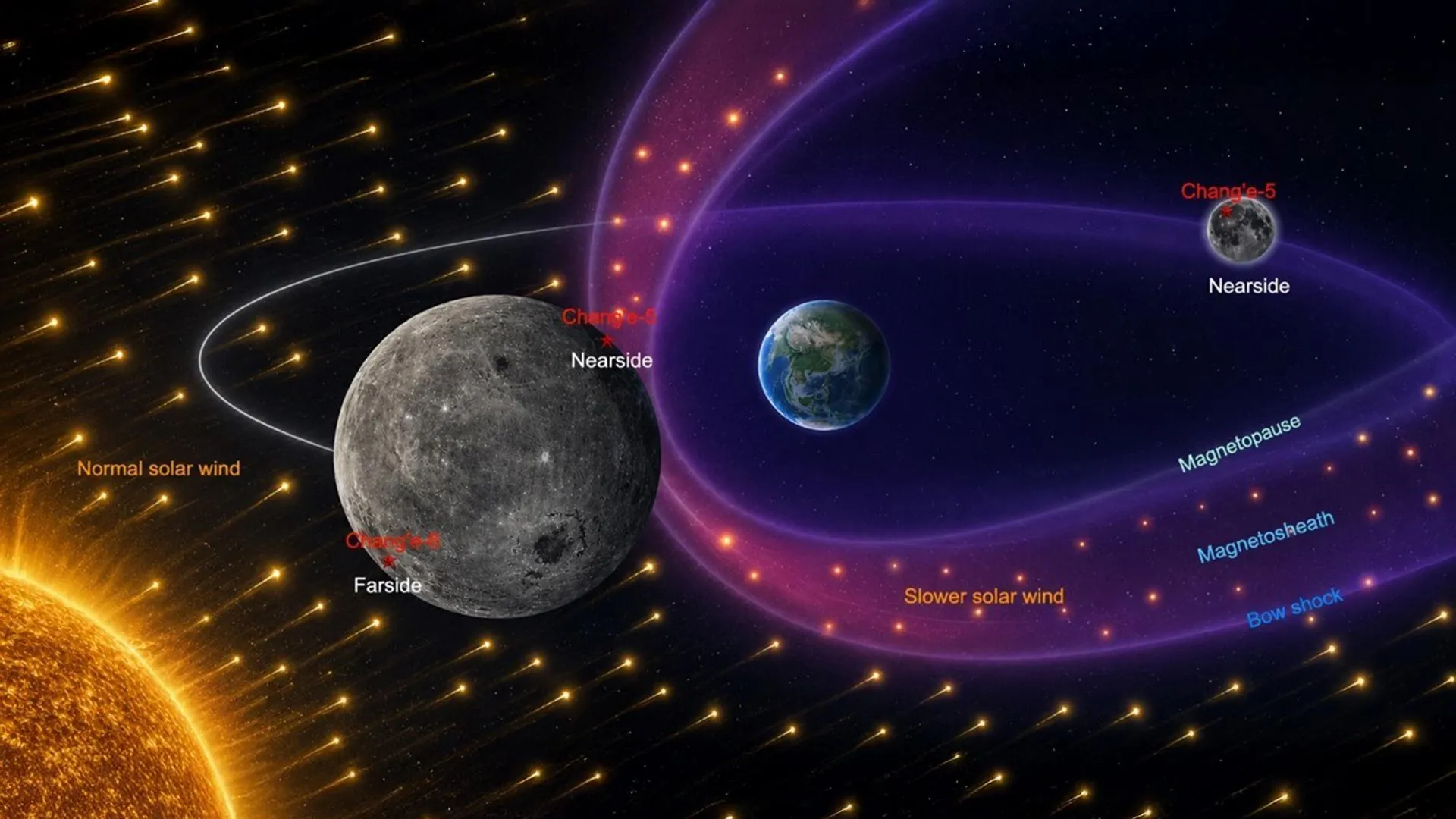
New analysis of lunar samples collected by China’s Chang’e-6 mission has provided the first direct evidence of how Earth’s magnetosphere influences solar wind exposure across the Moon’s two hemispheres. The findings, published in Nature Geoscience, indicate that particles reaching the Moon’s surface vary significantly in speed and energy depending on which side of the Moon they strike, with Earth’s magnetic field playing a key role in this disparity.
Researchers from the Institute of Geology and Geophysics of the Chinese Academy of Sciences examined noble gas concentrations and isotopic compositions in approximately 1.935 grams of regolith collected from the South Pole Aitken basin on the lunar far side. By comparing these samples with previously studied material from the near side, scientists could directly test whether solar wind implantation patterns differed between the two hemispheres. The analysis revealed clear isotopic differences, particularly in neon ratios, with the far-side samples displaying a 20Ne/22Ne ratio of 11.34 ± 0.22, considerably lower than measurements from near-side samples and indicating more intense isotopic fractionation.
The research demonstrates that Earth’s magnetosphere creates a protective effect on the Moon’s near side through what scientists term the “speed-governing” mechanism. As the Moon orbits Earth, its near side passes through the magnetosheath, a buffer zone where solar wind velocity decreases from approximately 400 kilometers per second to around 200 kilometers per second. This reduced speed prevents charged particles from penetrating as deeply into the lunar surface. The far side, which constantly faces away from Earth, remains exposed to the undisturbed solar wind, allowing faster and more energetic particles to reach much greater depths within the regolith. Estimates suggest approximately 25 percent of total solar wind exposure at the near-side landing site involved this slower flow, while the far-side location showed no such protective effect.
Beyond documenting current solar wind dynamics, the findings suggest that lunar soil may serve as a long-term archive of Earth’s magnetic field evolution. The researchers propose that noble gas isotopes trapped in lunar regolith could function as fossil records of historical interactions between solar wind and Earth’s magnetosphere, potentially offering a new method for studying variations in Earth’s magnetic environment across geological timescales.
Article Attribution | Read More at Article Source
Article summary produced by Claude AI