

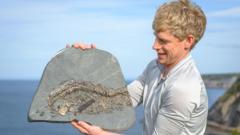
Matthew Myerscough, a civil engineer, has become an amateur paleontologist after turning away from mountaineering following a serious avalanche accident. In 2014, Myerscough was buried beneath snow during an incident on Yr Wyddfa, remaining unconscious for approximately 20 minutes. The experience left him with post-traumatic stress disorder, prompting him to seek therapeutic activities away from high-altitude pursuits.
Myerscough eventually gravitated toward fossil hunting at Lavernock Point in the Vale of Glamorgan, where he discovered that the focused, meditative nature of the activity helped him manage his mental health symptoms. He describes the process as producing a calming effect comparable to mindfulness practices, allowing worries and stresses to diminish as he concentrates on a specific task.
While fossil hunting benefited his wellbeing, it also led to a significant paleontological discovery. Myerscough and two fellow enthusiasts identified a jawbone specimen embedded in limestone at Lavernock Point dating back 201 million years to the early Jurassic period. Through consultation with experts, the bone was identified as belonging to a rhomaleosaurus, a carnivorous marine reptile commonly known as a sea dragon. The specimen represents the first such discovery documented in Wales, and research continues at the National Museum Cardiff with hopes of publishing an academic paper.
Myerscough emphasizes that successful fossil hunting relies primarily on visual pattern recognition and careful observation rather than specialized equipment. His approach involves examining rock formations with a hand lens while carrying standard outdoor gear. He notes that Lavernock Point offers accessible opportunities for recreational fossil hunters to discover loose specimens, from vertebrae to fossilized prehistoric shark remains.
Myerscough has authored a book titled “In Search of Sea Dragons: A Fossil Hunter’s Odyssey,” focusing on the experiential aspects of paleontological discovery rather than technical methodology. He advocates for transparency within the fossil hunting community, arguing that collectors often withhold details about their findings and recovery processes. His work seeks to document not only what was discovered but also the personal and practical dimensions of the discovery experience.
Article Attribution | Read More at Article Source
Article summary produced by Claude AI