

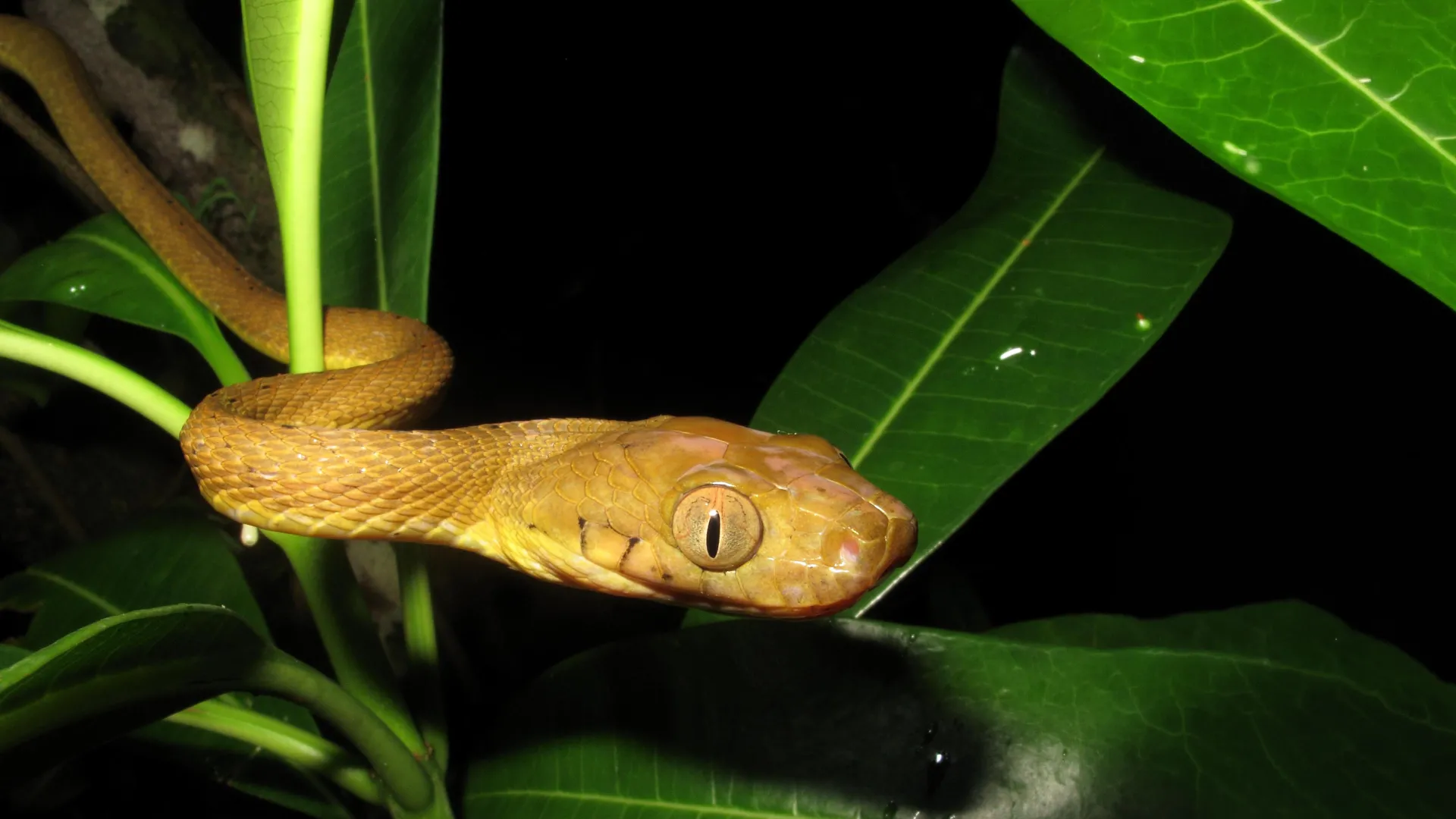
The brown tree snake has long been recognized as one of the world’s most significant invasive species. Native to Australia and the South Pacific, the creatures likely arrived in Guam following World War II by stowing away on military transport. Since their arrival, the snakes have devastated native bird populations, driving numerous species to local extinction, and continue to damage infrastructure by climbing power lines, causing hundreds of electrical outages annually. In certain regions, population densities have reached as high as 30,000 individuals per square mile.
The invasion has posed a longstanding puzzle for scientists because the original population in Guam appeared to stem from only a small founding group. Typically, such limited genetic diversity would trigger severe inbreeding effects that restrict a species’ adaptive potential. A study released on July 24 through Science Advances, led by researchers at the University at Buffalo in collaboration with the U.S. Geological Survey, challenges these assumptions. Using advanced long-read sequencing technology, the team examined extensive sections of the snake’s genetic code and identified thousands of structural variants—sections of DNA that have been duplicated, eliminated, or reorganized. Notably, many of these variations concentrated in genes governing immune responses and olfactory capabilities, suggesting the species possesses concealed genetic flexibility.
The findings indicate that long-read sequencing, which examines larger continuous stretches of DNA, reveals genetic variations that traditional sequencing methods missed. Structural variants collectively impact nearly eight times more genomic material than single base-pair changes. The research identified more than 19,000 structural variants in the brown tree snake genome, concentrated especially in genes controlling smell and immunity. The heightened olfactory diversity may help explain why snakes in Guam exhibit cannibalistic behaviors far less frequently than their native counterparts, as enhanced smell recognition could prevent predation within their own population.
The discovery carries dual implications. While the hidden genetic diversity may make invasive control efforts more challenging due to increased species adaptability, it also offers encouraging insights for conservation of endangered species. The researchers note that highly inbred populations may possess underappreciated genetic reserves supporting environmental responsiveness. Future research comparing genetic profiles of snakes from native populations could determine whether these structural variants existed before the invasion or emerged afterward as a result of severe population bottlenecking.
Article Attribution | Read More at Article Source
Article summary produced by Claude AI