

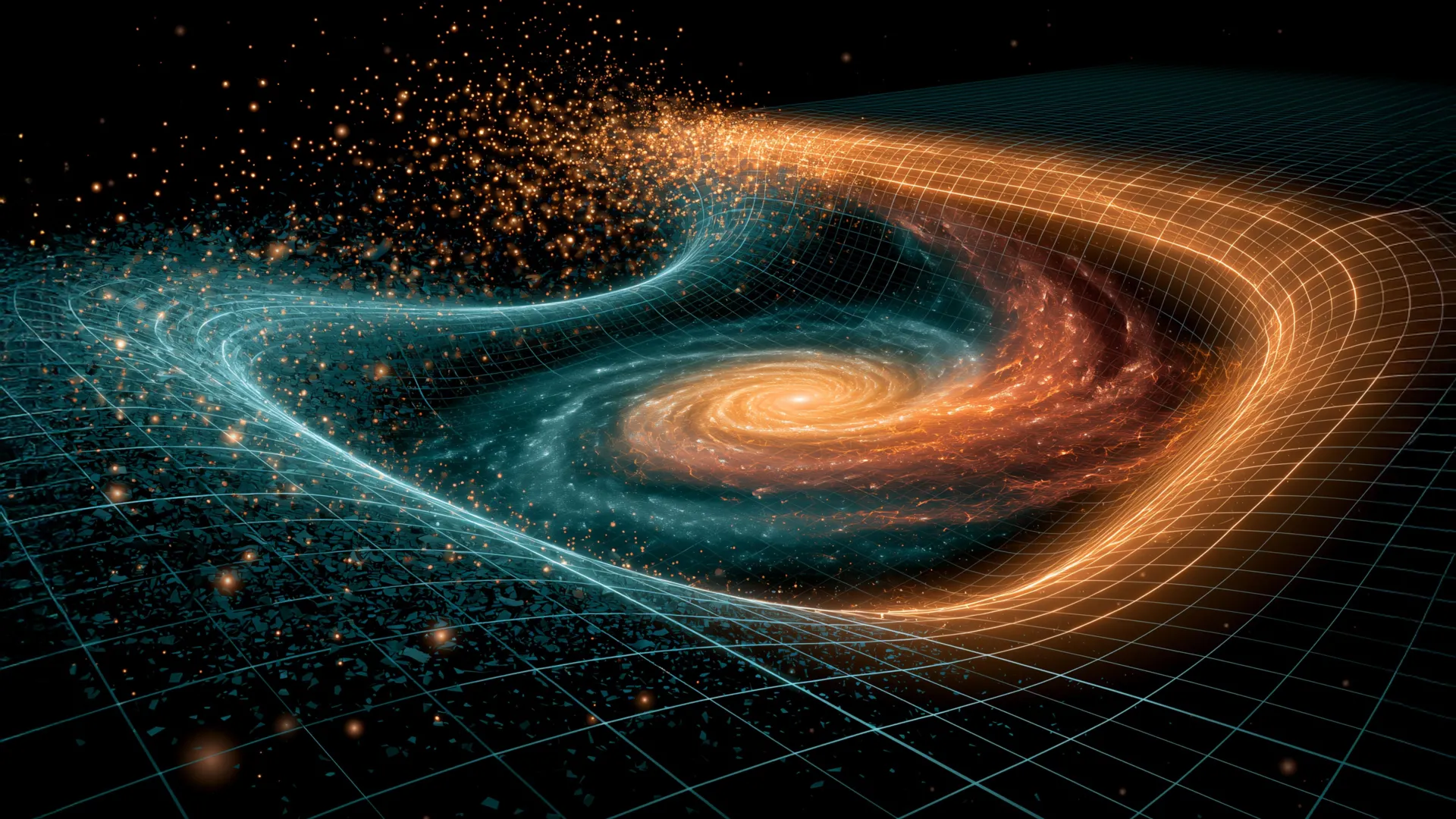
Researchers at Queen Mary University of London have proposed a theoretical approach to address a longstanding puzzle in physics: how the Universe can produce increasingly complex structures—galaxies, stars, planets, and life—while obeying the second law of thermodynamics, which states that total entropy in an isolated system generally increases over time.
Professor Ginestra Bianconi’s work, published in Physical Review D, examines a framework called Gravity from Entropy (GfE), an approach to quantum gravity that treats gravitational effects as emerging from microscopic properties of spacetime geometry rather than as a fundamental force. The theory draws on statistical mechanics and connects gravity to information and entropy at the quantum level. A key finding suggests that while the Universe’s total entropy rises over time, the entropy density per unit of volume actually decreases as space expands, potentially resolving the apparent contradiction between increasing disorder and increasing complexity.
The theoretical framework builds on earlier discoveries linking gravity and thermodynamics, particularly work from the 1970s showing that black holes possess entropy and emit thermal radiation. GfE extends this connection by proposing that gravity emerges from an informational tension between the actual spacetime metric and metrics produced by matter fields and spacetime curvature. Under extreme conditions, the theory produces a dynamic dark energy contribution that differs from predictions made by General Relativity.
Bianconi’s analysis indicates that spacetime components obey versions of thermodynamic laws within the GfE framework. As the Universe expands, its total volume increases, allowing entropy to rise even as it becomes distributed more thinly across expanding space. This mechanism could explain how localized regions of order and complexity can develop without violating fundamental physical principles.
While the research remains in early theoretical stages, the results suggest that gravity and spacetime may have thermodynamic and informational foundations. Researchers propose this interpretation could provide new avenues for connecting general relativity, quantum mechanics, and cosmology within a unified framework.
Article Attribution | Read More at Article Source
Article summary produced by Claude AI