

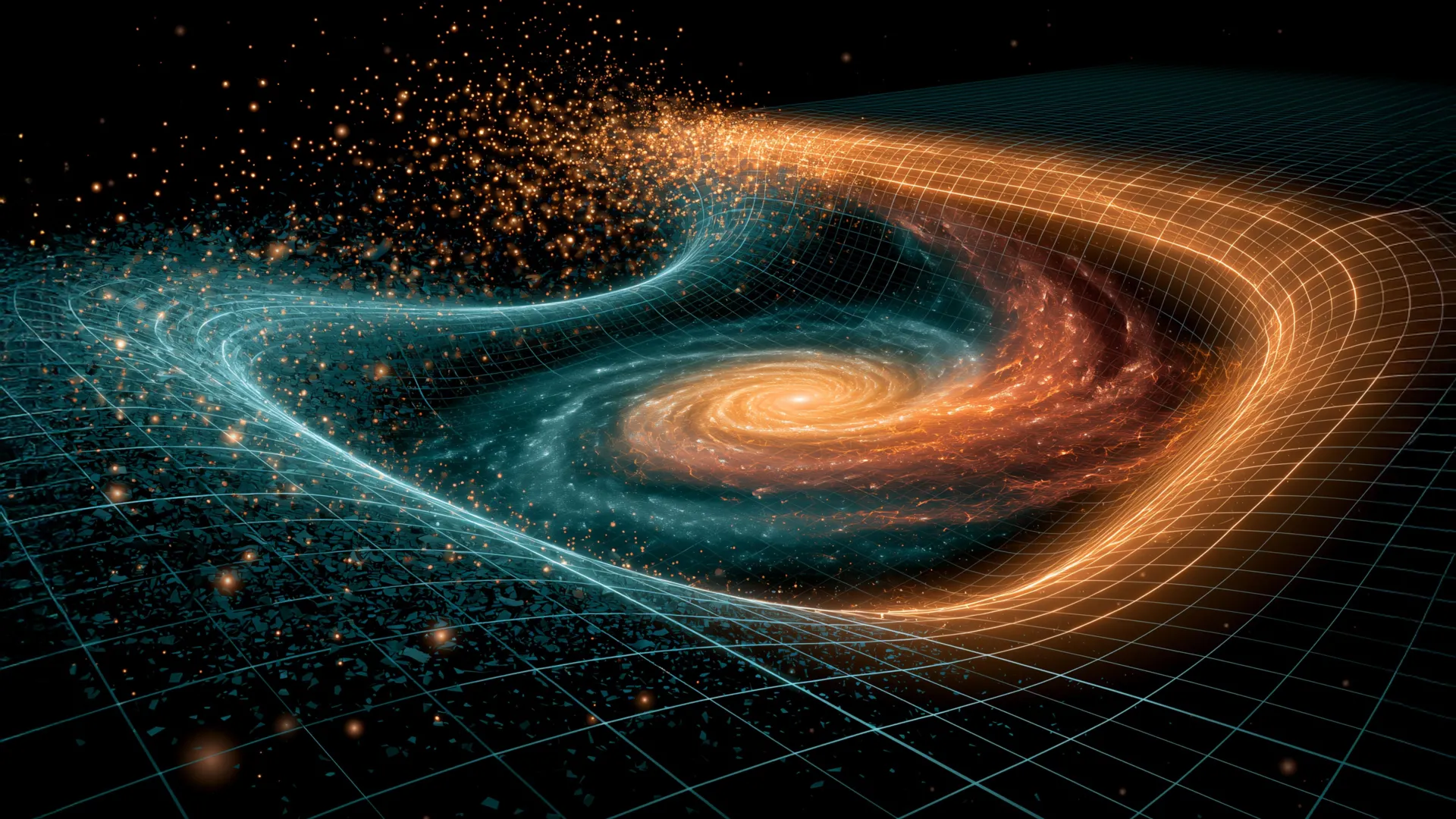
Researchers led by Professor Ginestra Bianconi at Queen Mary University of London have developed a theoretical framework addressing a fundamental puzzle in physics: how the Universe can generate increasingly complex structures—galaxies, stars, planets, and life—while adhering to the second law of thermodynamics, which dictates that total entropy in isolated systems must increase over time.
The investigation employs Gravity from Entropy (GfE), a proposed approach to quantum gravity that treats gravitational effects as emergent phenomena arising from the microscopic properties of spacetime geometry rather than viewing gravity solely as a fundamental force. The theory connects gravity to information and entropy at the quantum level, drawing on principles from statistical mechanics. Bianconi’s analysis, published in Physical Review D, identifies a crucial distinction: while the Universe’s total entropy rises continuously, the entropy per unit of volume decreases as the Universe expands, potentially resolving the apparent conflict between thermodynamic law and cosmic organization.
The theoretical foundation builds on decades of established physics connecting gravity and thermodynamics. Pioneering work by Jacob Bekenstein and Stephen Hawking in the 1970s demonstrated that black holes possess entropy and emit thermal radiation, revealing deep connections between spacetime, information, gravity, and heat. Gravity from Entropy extends this relationship by proposing that gravity emerges from informational tension between actual spacetime geometry and other geometric structures, expressed through the Quantum Geometric Relative Entropy.
Within the GfE framework, the expanding Universe’s growing volume allows total entropy to increase while local entropy density decreases within each spatial unit. This unusual thermodynamic pattern offers a mechanism for understanding how localized regions can develop complexity without violating fundamental physical principles. The theory also predicts dynamic dark energy contributions under extreme conditions, potentially generating testable cosmological predictions.
Researchers emphasize that the framework suggests gravity and spacetime may possess informational and thermodynamic foundations. While remaining at an early theoretical stage, this approach could contribute toward unifying general relativity, thermodynamics, quantum mechanics, and cosmology into a more comprehensive theoretical structure.