

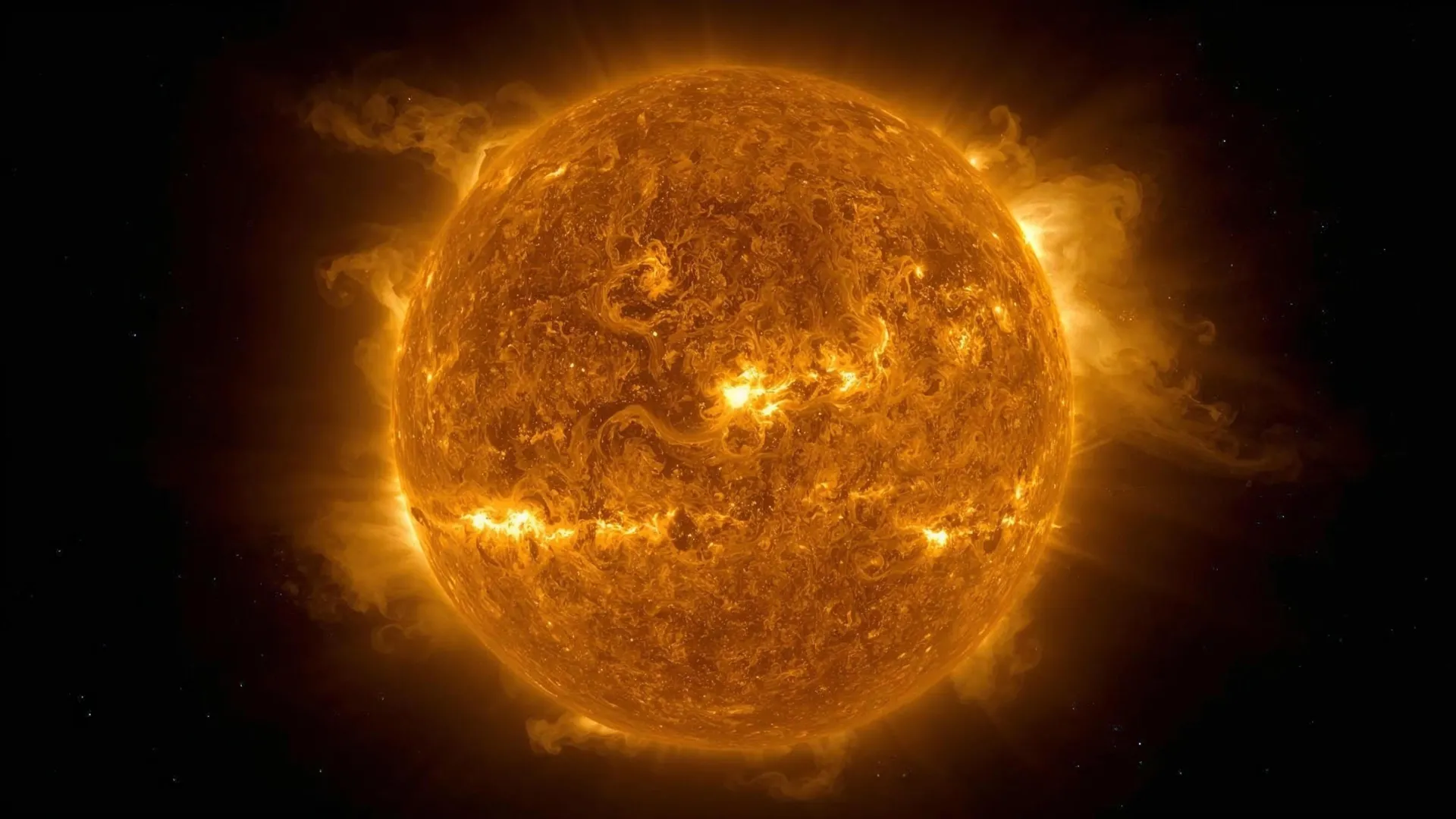
Scientists at Uppsala University have revised their estimate of the Sun’s silver content, finding it to be 55 percent higher than earlier calculations indicated. The discovery stems from the development of a more sophisticated model of the solar atmosphere combined with advanced atomic physics calculations. Since heavy elements comprise only about 1.5 percent of the Sun’s mass, precise measurements of these materials are crucial for understanding stellar composition and cosmic chemical evolution.
The research team, led by Sema Caliskan during her doctoral studies, employed spectroscopy to measure silver levels by analyzing how atoms in the solar atmosphere absorb specific wavelengths of sunlight. Each element produces a distinctive pattern of dark spectral lines, functioning as a chemical fingerprint. Previous estimates relied on simplified atmospheric models, but the new approach incorporates a dynamic model of the Sun’s outer layers alongside improved atomic physics calculations. The methodology accounts for non-equilibrium effects in which light itself influences the silver atoms responsible for creating the absorption lines used in abundance calculations.
The findings address a long-standing discrepancy in solar system chemistry. Earlier measurements suggested the Sun contained considerably less silver than chemically primitive meteorites found on Earth. Since both the Sun and these ancient meteorites formed from the same primordial cloud of gas and dust roughly 4.6 billion years ago, the compositional mismatch had posed a challenging puzzle for astronomers. The revised silver abundance now aligns more closely with the levels detected in these meteorites.
The research has broader implications for understanding heavy element formation and distribution throughout the galaxy. Elements heavier than helium are created within stars and during stellar explosions before being incorporated into subsequent generations of cosmic material. The Uppsala team plans to apply the same analytical method to other stars of varying types and ages to trace how silver and other heavy elements have been formed and distributed throughout the Milky Way over cosmic time.
Article Attribution | Read More at Article Source
Article summary produced by Claude AI