

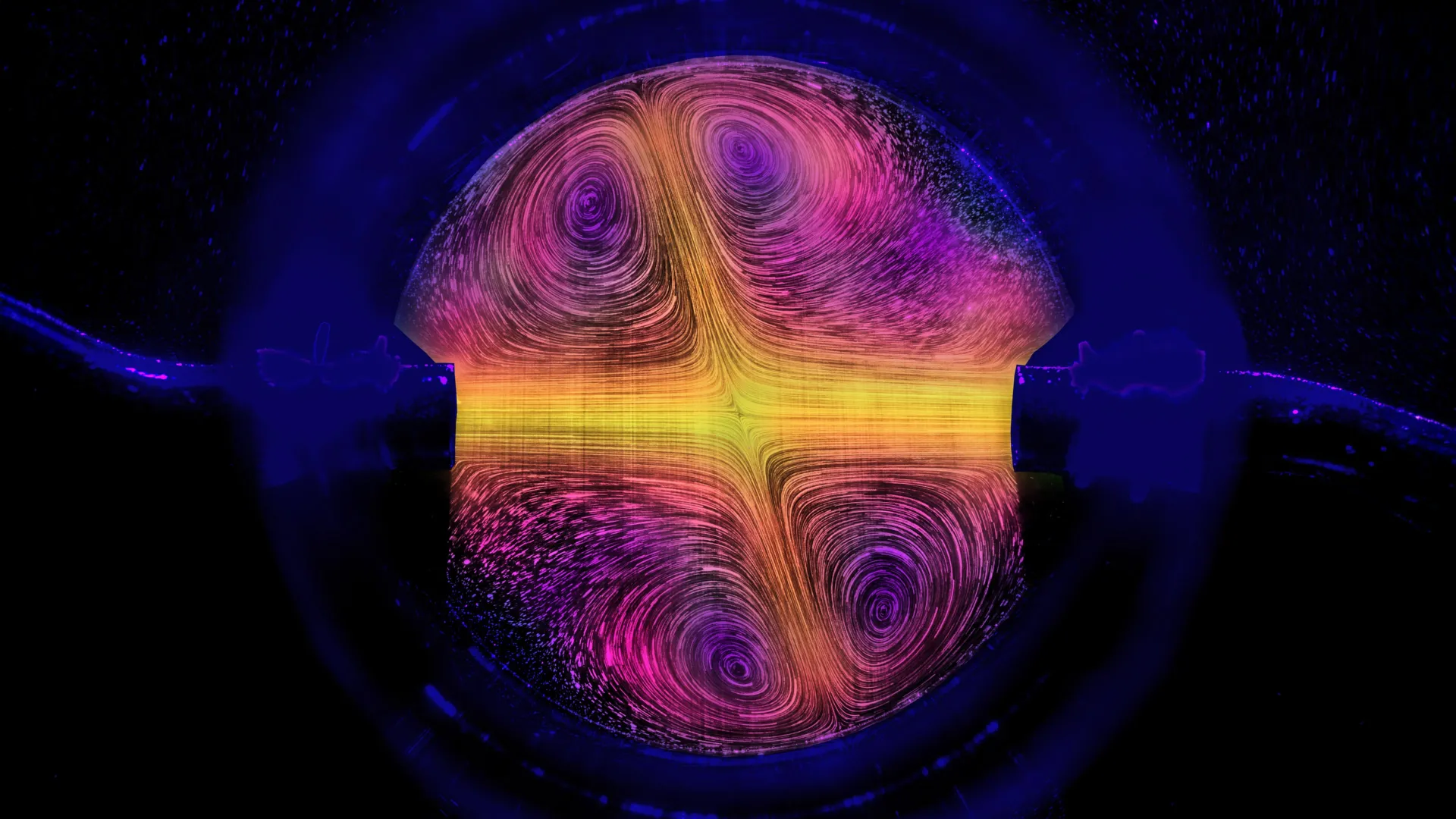
A team of mathematicians from New York University and the Colorado School of Mines has resolved a long-standing physics question known as Feynman’s Sprinkler Problem through experiments with various sprinkler designs. The research, published in the Proceedings of the National Academy of Sciences, investigates what occurs when a sprinkler operates in reverse, drawing water inward rather than expelling it outward. The findings have implications beyond academic curiosity, offering insights into how moving fluids interact with physical structures and potentially benefiting the design of energy-conversion devices.
Feynman’s Sprinkler Problem gained prominence during the 1980s after physicist Richard Feynman described his own unsuccessful experimental attempts to understand the phenomenon. Earlier work published in 2024 established that a reverse sprinkler rotates approximately 50 times more slowly than a conventional sprinkler, despite both relying on related physical principles. In a conventional sprinkler, water jets exiting the arms create forces that cause rotation, similar to rocket propulsion. A reverse sprinkler functions as an “inside-out rocket,” with water jets traveling inward and colliding in the central chamber where the arms connect.
The research team, led by Leif Ristroph at NYU’s Courant Institute, built and tested multiple sprinklers featuring varied arm geometries, including the curved and looping tubes characteristic of “silly sprinklers” sold as novelty lawn devices. Each sprinkler was tested in both forward and reverse configurations, with researchers measuring rotational behavior, observing internal and external water flow, and quantifying torque when sprinklers were held stationary. This comprehensive testing allowed the team to evaluate competing theoretical explanations for sprinkler motion.
The experiments supported what the researchers call the momentum flux theory, which emphasizes how swirling water carries momentum through the sprinkler system. This theory successfully explained rotation patterns across all tested sprinkler shapes. Two alternative theories—one proposed by physicist Ernst Mach in the 1880s and another associated with Feynman—failed to account for the observed reverse rotations and torques. The study conclusively demonstrated that water behavior near the outer sections of sprinkler arms did not significantly influence the device’s motion.
Beyond resolving the historical scientific question, the findings offer practical applications for engineering. Understanding how objects respond to fluid flows can inform the development of turbines and other devices designed to capture or convert energy from flowing liquids. The research also revealed that altering arm shapes can modify and direct water jets, potentially allowing engineers greater control in designing fluid-based systems. The work involved graduate students Jesse Smith and Mingxuan Zuo from NYU, as well as undergraduate Will Kuhlke.
Article Attribution | Read More at Article Source
Article summary produced by Claude AI