

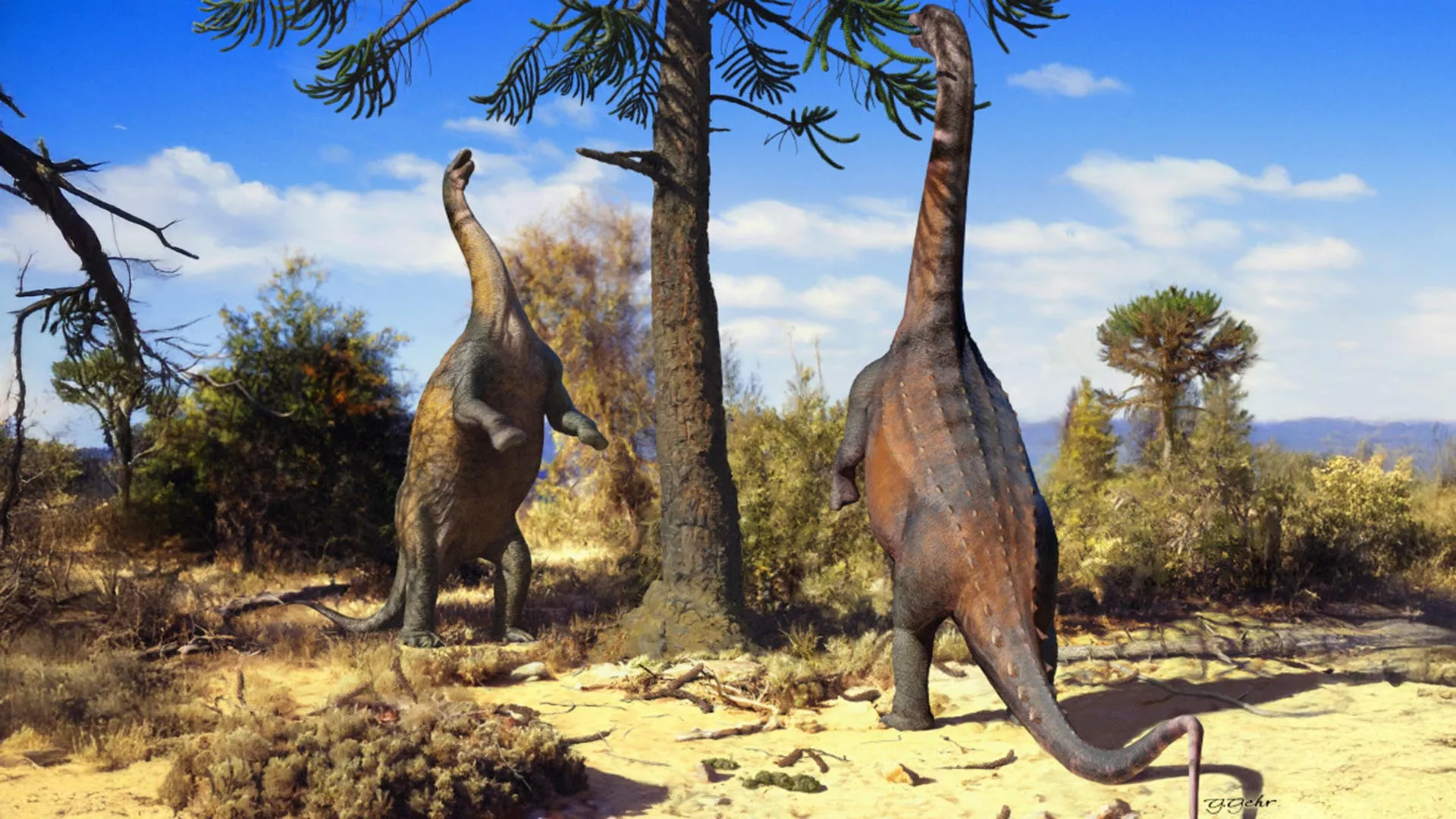
Scientists have found evidence that two South American sauropods from approximately 66 million years ago possessed the ability to rear up onto their hind legs and maintain that posture for extended periods. The species examined were Uberabatitan from Brazil and Neuquensaurus from Argentina, both modest in size relative to the largest sauropods but still comparable in scale to modern elephants, with adult Uberabatitans reaching approximately 26 meters in length.
An international research team from Brazil, Germany, and Argentina employed finite element analysis, an engineering technique commonly used to test structural integrity, to assess the biomechanical forces involved in bipedal posturing. The researchers created digital reconstructions of femurs from seven sauropod species using fossil specimens housed in natural history museums. Their simulations examined both external forces, such as gravity and body weight, and internal forces generated by muscle contraction during the rearing position.
The findings indicated that younger animals experienced significantly lower stress levels when standing upright compared to their adult counterparts. The two South American species demonstrated particularly robust thigh bones capable of better distributing the mechanical forces involved in bipedalism. As sauropods matured and gained mass, the stress placed on their femurs increased substantially, suggesting that while larger individuals may have retained the capacity to stand on their hind legs, they likely could not maintain the position comfortably or for extended durations.
Researchers propose multiple functions for this bipedal capability, including accessing vegetation at greater heights, displaying dominance or attractiveness to potential mates, and deterring predators by appearing larger and more threatening. When supported by both hind legs and tail simultaneously, the animals would have formed a tripodal stance offering increased stability. The study acknowledged certain limitations, noting that models did not account for cartilage and other joint structures that could have influenced stress distribution during bipedal posturing.
Article Attribution | Read More at Article Source
Article summary produced by Claude AI