

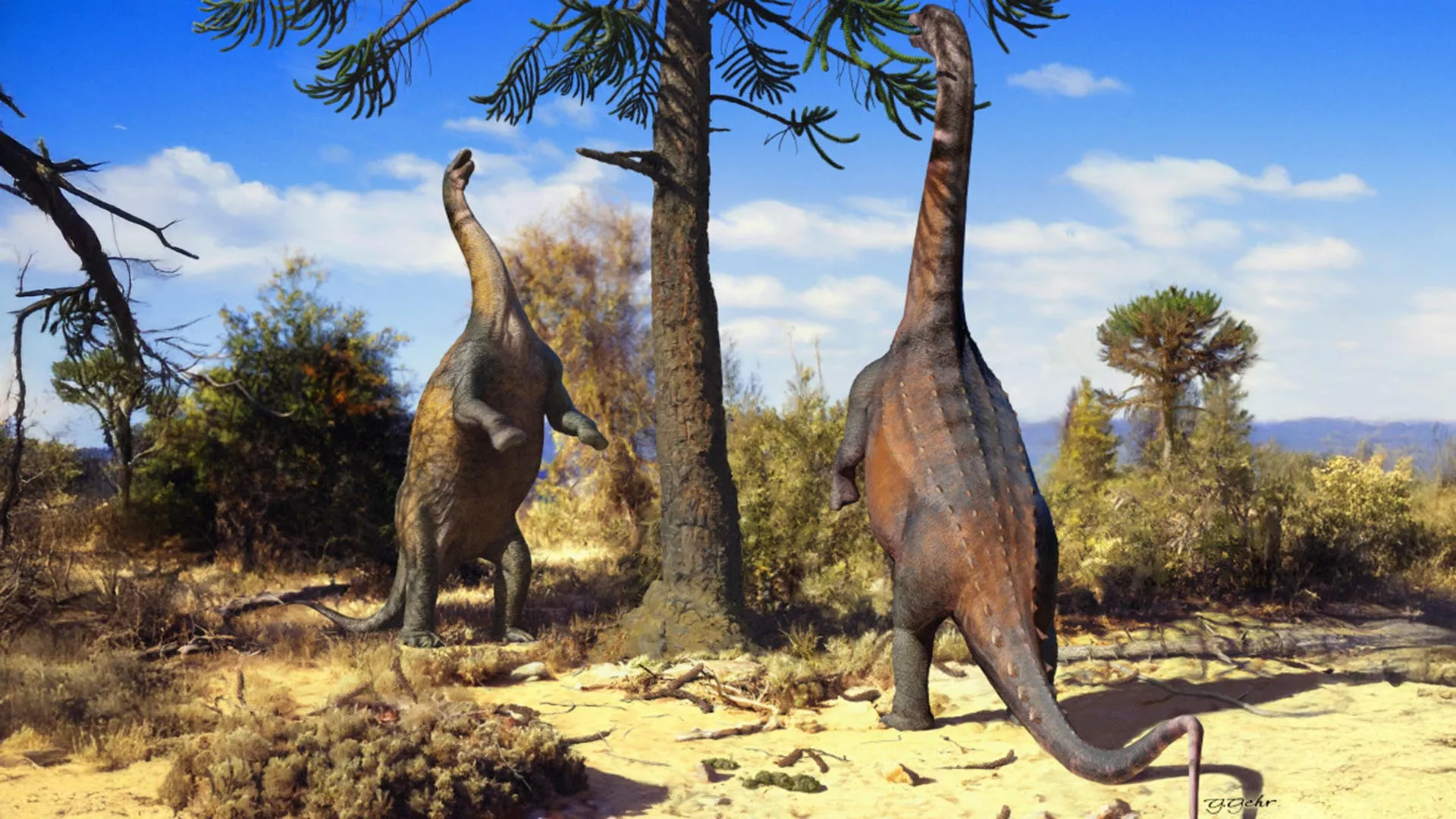
Scientists investigating two South American sauropod species from approximately 66 million years ago found evidence that these long-necked dinosaurs possessed the physical capability to rear up onto their hind legs and maintain that posture for extended periods. The research focused on Uberabatitan from Brazil and Neuquensaurus from Argentina, both considerably smaller than the largest known sauropods yet still comparable in size to modern elephants, with adult Uberabatitans reaching lengths of roughly 26 meters.
The international research team, comprising scientists from Brazil, Germany, and Argentina, employed finite element analysis, an engineering technique commonly used to test structural integrity, to examine stress levels on the femur bones of seven sauropod species during upright posture. The methodology involved creating digital reconstructions of fossilized femurs from museum collections and simulating both external forces, such as gravity and body weight, and internal forces generated by muscle contraction. By analyzing these combined pressures, researchers determined how much stress each dinosaur’s thigh bone would experience when standing upright.
The findings revealed that younger sauropods possessed more robust femurs capable of better distributing stress, making upright stance more sustainable and comfortable. As these animals matured and their bodies enlarged, the physical demands of bipedal posture increased substantially, though larger sauropods may still have been capable of briefly assuming this position. Adult Uberabatitan individuals likely experienced stress levels comparable to other giant sauropods, suggesting their capacity for prolonged upright standing diminished significantly with age and size.
Researchers identified multiple potential reasons why sauropods may have stood upright, including accessing vegetation at greater heights, performing mating displays or reproductive behaviors, and presenting an intimidating appearance to potential predators. A tripodal stance, using both hind legs and the tail for support, would have provided additional stability during these behaviors. The researchers acknowledged limitations in their models, noting that factors such as cartilage and tail support were not incorporated into the simulations, though they emphasized that the comparative methodology remains effective for understanding dinosaur behavior patterns.
Article Attribution | Read More at Article Source
Article summary produced by Claude AI