

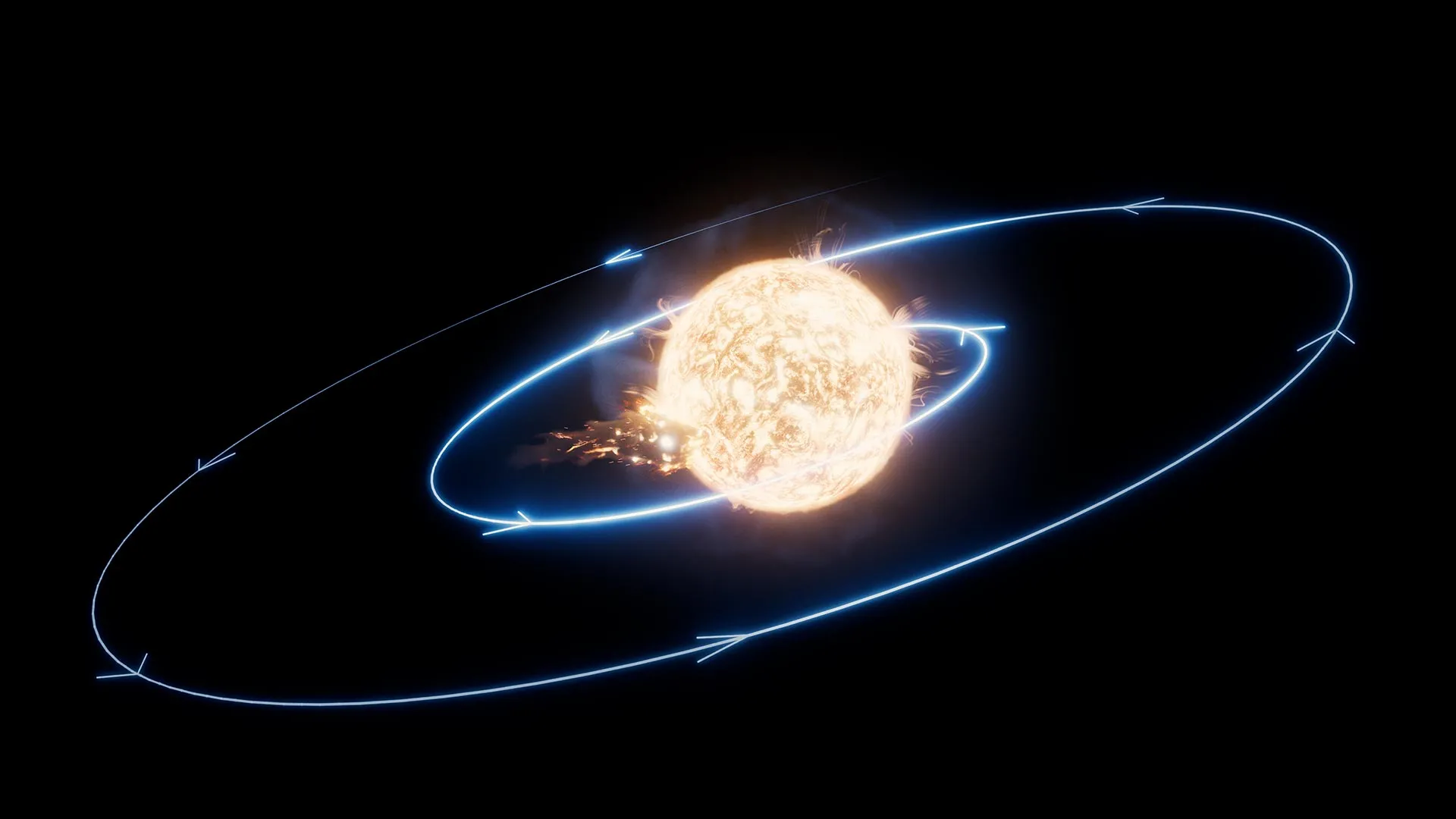
An international research team led by University of Michigan astronomer Brooke Kotten has identified compelling evidence that the star TOI-5882 absorbed a planet. The key indicator lies in the star’s chemical composition, which contains significantly more lithium than would be expected for a star of its type and age. Since planets naturally contain higher concentrations of lithium than stars do, the excess element serves as a chemical signature of planetary consumption.
The process by which stars engulf planets, termed engulfment by astronomers, occurs extremely rapidly on cosmic timescales, typically unfolding over days or weeks. This brevity makes it nearly impossible to directly observe such events, requiring researchers instead to search for chemical traces and other residual evidence. The lithium enrichment detected in TOI-5882 provides the kind of clue that allows scientists to infer what occurred after the fact.
To confirm that TOI-5882’s lithium levels were genuinely unusual, the research team compared the star against a control group of 62 stars with similar ages, masses, and temperatures. Using spectroscopy to analyze the star’s light and chemical composition, they found that TOI-5882 ranked at least in the 97th percentile for lithium concentration among the comparison stars. The findings remained consistent across multiple analytical methods, indicating the result was robust rather than dependent on specific data selection.
The research team, comprising 14 scientists from the United States and Chile, theorized that a brown dwarf orbiting TOI-5882 may have played a role in the engulfment. This massive gaseous object, more than 20 times Jupiter’s mass, could have disrupted a planet’s orbit and caused it to plunge into the star. Based on the lithium detected, the consumed planet likely ranged in mass from a couple of Earth masses up to the size of Neptune.
The findings carry broader implications for understanding planetary systems. Earth’s own solar system is expected to experience a comparable fate billions of years in the future, when the sun expands into a red giant. The research also revealed that a few other stars in the comparison group showed unexpectedly high lithium levels, suggesting that processes beyond planetary engulfment may also enrich stars with the element, presenting additional questions for future investigation.