

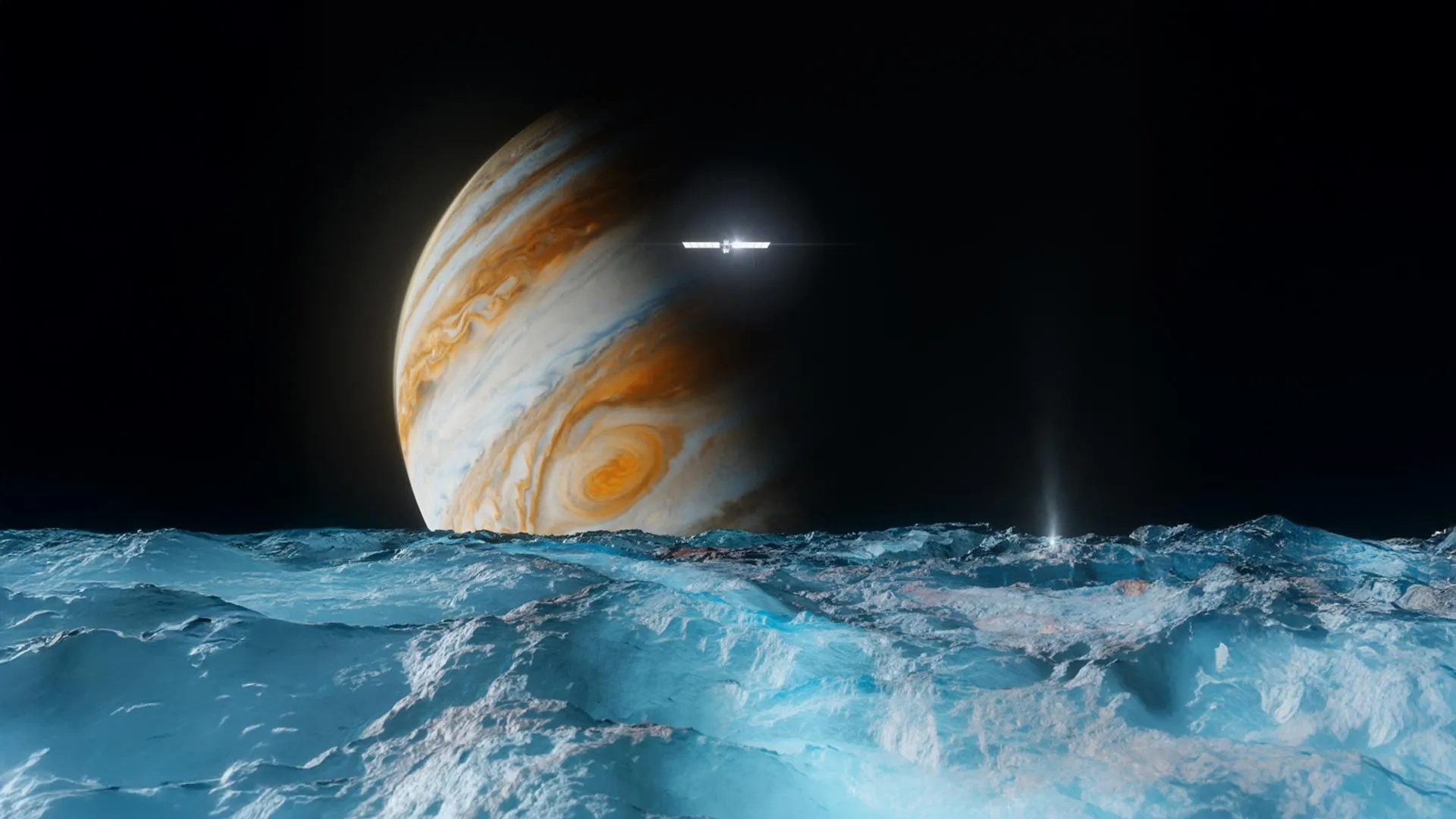
A study led by Rutgers University scientist Lujendra Ojha, published in Nature Astronomy, challenges prevailing assumptions about how water from Europa’s buried ocean might access the moon’s upper ice layers. Using computer simulations, the research team examined whether liquid water could travel upward through fractures in the ice shell and accumulate in shallow reservoirs accessible to future spacecraft investigations.
Ojha and colleagues focused on a theoretical process in which water from the deep ocean rises through narrow cracks called dikes, similar in concept to how molten rock travels through Earth’s crust during volcanic activity. However, the simulations revealed significant obstacles to this journey. The research indicates that water moving upward would do so turbulently and chaotically rather than in smooth, organized flows as previous models suggested. This turbulent movement would cause rapid heat transfer to the surrounding cold ice walls, cooling the water extremely quickly as it approaches the surface.
As the ascending water loses heat, it may become supercooled and begin forming frazil ice crystals. According to the study, these accumulating crystals could block narrow fractures within hours, and even larger cracks would struggle to transport sufficient volumes of water under realistic conditions. The findings suggest that the ice shell presents a stronger barrier between the deep ocean and the surface than previously assumed.
The implications for future exploration are significant. If spacecraft detect shallow pockets of liquid water, those reservoirs may have formed through localized melting rather than originating from the deep ocean. This distinction matters because scientists seek environments combining liquid water, chemistry, and energy as potential habitats for life. Shallow water would be easier to sample but might offer limited information about Europa’s scientifically compelling deep ocean environment.
The research arrives as two major missions approach Jupiter. NASA’s Europa Clipper, launched in October 2024, is scheduled to reach Jupiter in April 2030 and will conduct 49 close flybys of Europa. The European Space Agency’s JUICE mission, launched in April 2023, is expected to arrive in July 2031. These spacecraft will provide detailed observations of Europa’s frozen shell, surface chemistry, and subsurface water features, allowing scientists to better interpret findings in light of Ojha’s research.
Article Attribution | Read More at Article Source
Article summary produced by Claude AI