

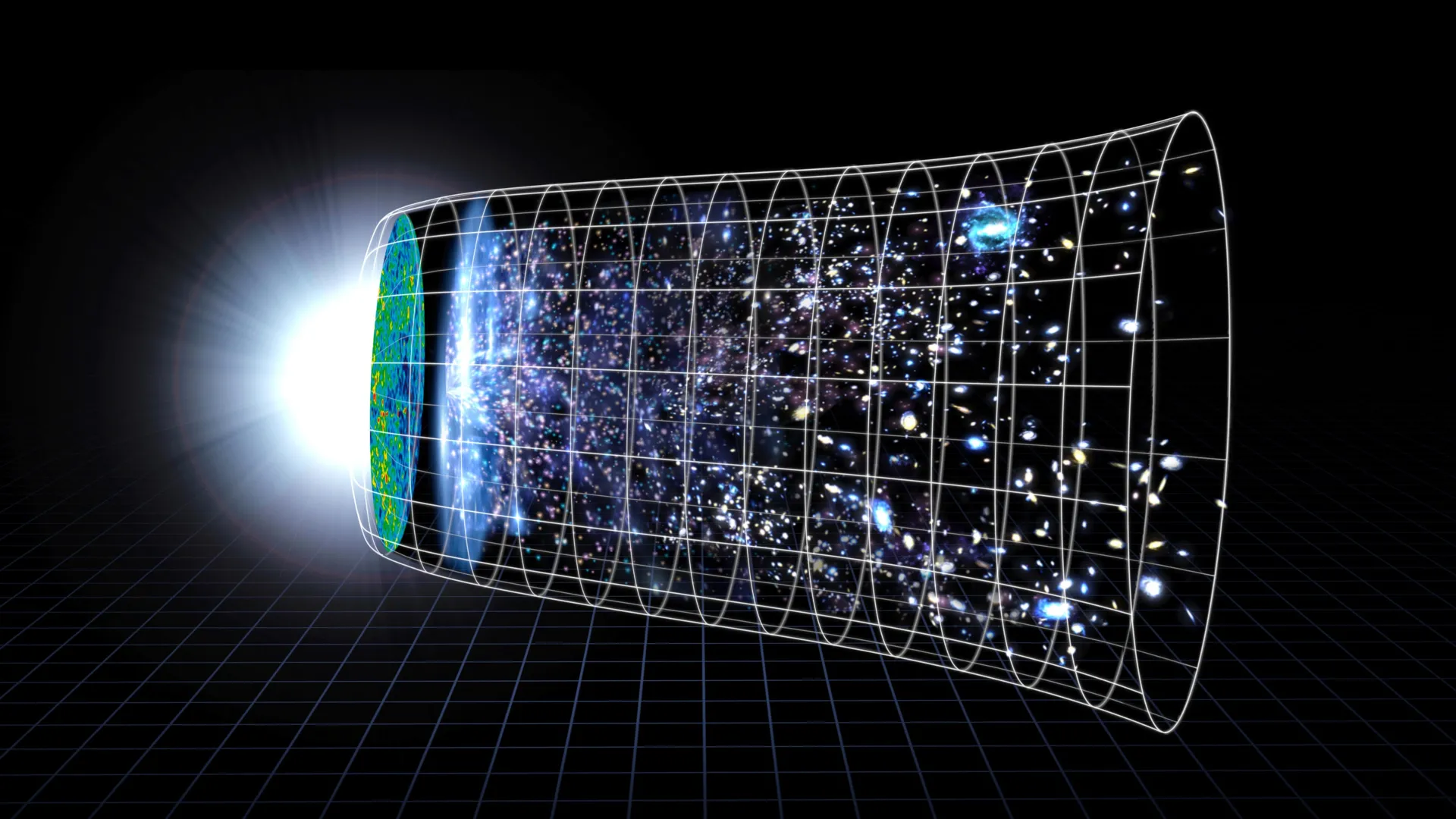
In an expanding universe, measuring cosmic distances requires accounting for how space itself continues to grow over time. When light from distant galaxies reaches Earth after billions of years of travel, that light represents the galaxies as they appeared in the distant past, not their current positions. Astronomers use cosmological models such as LCDM to estimate where those galaxies exist today based on the expansion history of the universe.
The observable universe extends to what scientists call the particle horizon, currently located approximately 45 billion light-years away. This boundary defines the farthest regions humans can detect, despite the universe being only 13.77 billion years old. This apparent contradiction is resolved by understanding that the universe can expand faster than light without violating Einstein’s laws of physics. The speed-of-light limit applies to objects moving through space in localized regions, not to the expansion of space itself across cosmic scales. Astronomers measure how quickly galaxies recede by observing redshift, the stretching of light toward longer wavelengths as objects move away.
Galaxies beyond the Hubble distance, located roughly 13.77 billion light-years away, are receding faster than light. However, we can still observe these distant galaxies because their light was emitted when they were much closer to us in the past. A more fundamental boundary exists at the cosmological event horizon, currently about 17 billion light-years away. Light emitted from beyond this point today will never reach Earth, as cosmic expansion will prevent it from crossing the ever-widening gap.
Dark energy, which drives accelerating cosmic expansion, intensifies this effect. The cosmological event horizon may eventually approach a maximum distance of approximately 60 billion light-years, but light from the most distant galaxies will become stretched to such long wavelengths that it effectively becomes invisible. Scientists predict that in roughly 100 billion years, all galaxies beyond the Local Group will disappear from view, leaving future observers in a seemingly smaller and emptier cosmos.
Article Attribution | Read More at Article Source
Article summary produced by Claude AI