

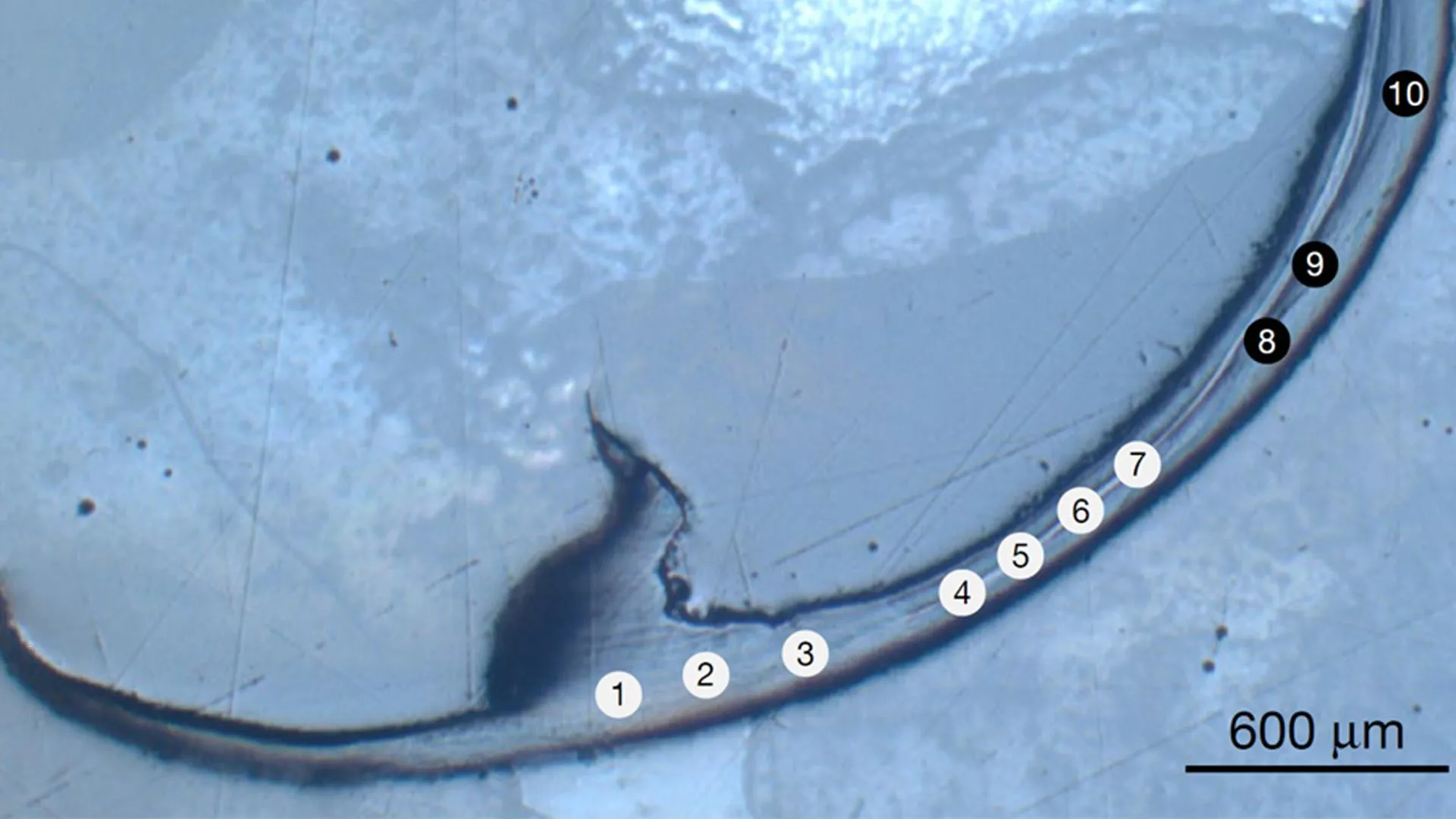
Researchers from TU Wien and the University of Vienna have conducted a detailed investigation into the jaw structure of Perinereis cultrifera, a predatory bristle worm species that remains extant today. The worm’s jaws are composed of structural proteins and ions arranged in a manner that produces material properties resembling those of metals. This discovery has led scientists to introduce the term “bio-metals” to describe biological substances that exhibit specific combinations of hardness, strain response characteristics, and ion-protein structural organization.
The research team employed nanoindentation testing, a technique involving microscopic-scale material penetration, alongside chemical analysis and advanced imaging to evaluate the worm’s jaw properties. Their measurements confirmed that metal ions concentrate more densely at the jaw tips compared to central regions, a distinction that likely contributes to enhanced hardness and effectiveness in biting and crushing food. When subjected to various indentation depths, the jaws exhibited the Nix-Gao nanoindentation size effect, a phenomenon also observed in metals like copper and silver, where smaller material areas demonstrate greater resistance to deformation.
Despite sharing certain characteristics with conventional metals, the sea worm jaws display mechanical properties that differentiate them significantly. Notably, the jaws demonstrate size-dependent elasticity, a quality that distinguishes bio-metals from standard crystalline metals. Researchers developed mathematical models to explain how these elastic effects may function at the atomic level, though they acknowledge that understanding these natural materials remains in its early stages.
The team indicated plans to expand their research by examining additional species and refining the theoretical framework underlying bio-metal classification. Researchers also expressed interest in exploring connections between genetic factors and material composition. The investigation highlights potential applications where natural biological designs might inform the development of new synthetic materials.