

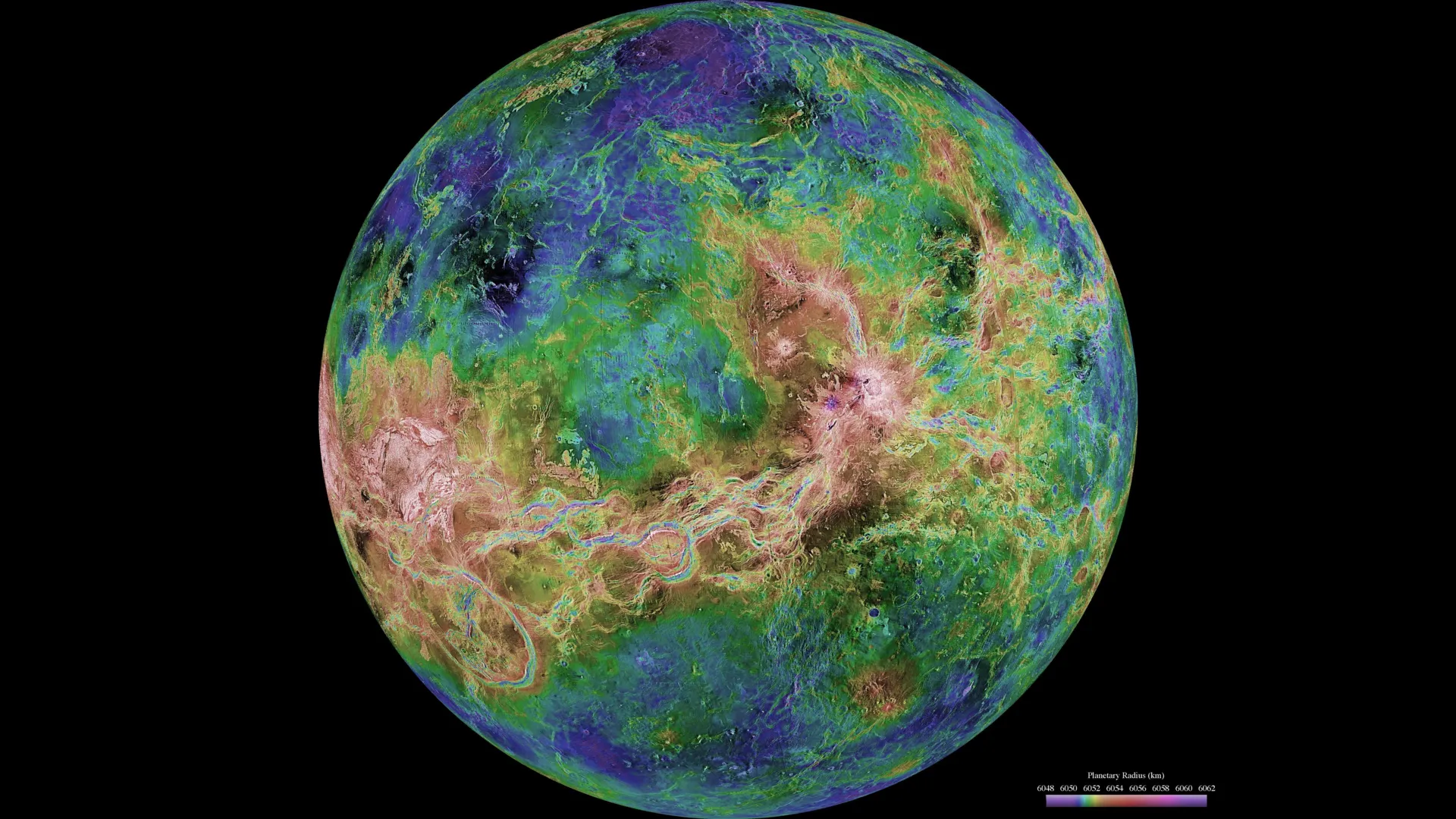
Researchers at ETH Zurich have developed advanced three-dimensional computer models indicating that some of Venus’s enormous rift valleys may have formed more recently than the scientific consensus previously held. The study, published in Nature Geoscience and led by Professor Taras Gerya, challenges long-standing assumptions that these vast rifts—some extending 10,000 kilometers—originated more than 100 million years ago.
The research team created the first high-resolution 3D simulations of Venusian rifts, a significant advancement from earlier two-dimensional models. These new simulations allowed scientists to reproduce rift structures with greater accuracy and develop more realistic explanations for their formation. The findings suggest that Venus’s crust stretches, shifts, and relaxes in ways that differ from previous theoretical models. According to the simulations, elevated ridges called rift flanks form along rift valleys during periods of geological youth, appearing while movement is still occurring or shortly after it ceases. The models also indicate that these rifts may spread at rates of 3 to 10 centimeters annually, faster than earlier estimates suggested.
A key discovery involves how rift flanks change over time. When tectonic movement ends, these raised features gradually flatten as the crust relaxes—a process distinct from erosion on Earth. The modeling results align with images obtained by NASA’s Magellan probe during its mission in the 1990s, with the similarities between predicted and observed structures suggesting recent rift formation. This alignment strengthens arguments for ongoing tectonic activity on Venus, contradicting the long-held view of the planet as geologically inactive.
The research may have practical implications for future exploration efforts. By identifying regions where geological activity may currently occur, scientists can prioritize targets for upcoming missions seeking evidence of active tectonics or volcanism. The work also holds broader significance for planetary science, potentially improving understanding of how rocky planets develop and evolve. These insights may eventually aid in detecting and studying rocky exoplanets beyond the solar system. Multiple space agencies are advancing Venus exploration, with ESA’s EnVision mission scheduled for launch in the early 2030s, which will investigate the planet’s surface, core, and atmosphere in unprecedented detail.
Article Attribution | Read More at Article Source
Article summary produced by Claude AI