

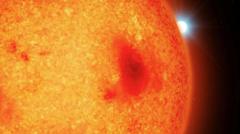
A research team from the University of Warwick has announced the discovery of four white dwarf stars that were previously undetected in a region of space relatively close to Earth. These stellar objects, located within 65 light years of our solar system, were identified using observations from the Hubble Space Telescope. Each of the four white dwarfs exists within a binary star system alongside a larger, brighter red dwarf companion, which had effectively obscured the white dwarfs from direct observation in visible light wavelengths.
Dr Mairi O’Brien, a research fellow at the University of Warwick, explained that while isolated white dwarfs in nearby space are generally straightforward to locate, the brightness of the red dwarf companions in these systems prevented their detection through conventional visible light observations. The research team, which collaborated with astronomers from the University of Colorado Boulder, identified these systems by analyzing radial wobble, a phenomenon indicating that a massive companion object is orbiting a star. One of the four binaries, designated G203-47, has now been officially classified as the ninth closest white dwarf system to the Sun.
Analysis of the binary systems revealed unexpected characteristics in their orbital dynamics. The red dwarf in G203-47, for instance, completes one rotation approximately every 100 days but orbits its white dwarf companion every 14.9 days, meaning the two objects are not tidally synchronized. Co-author Dr David Wilson noted that this rotational behavior appears inconsistent with conventional formation models for such systems, suggesting instead that these binaries experienced distinct evolutionary pathways. Some underwent intense gravitational interactions early in their development, while others like G203-47 experienced milder encounters that produced their current unusual orbital configuration.
Professor Pier-Emmanuel Tremblay of the University of Warwick indicated that the discovery may represent only a portion of similar undiscovered systems in the local cosmic neighborhood. The research team estimates that between nine and ten additional binary systems containing hidden white dwarfs potentially remain unidentified. The findings have been published through the Royal Astronomical Society.
Originally reported by BBC News. Read the full story →